Internal Linking Strategy: How to Build Links That Boost Rankings
Published: April 26, 2026 | Last updated: April 26, 2026 | 12 min read
Most sites have more untapped ranking potential sitting inside their own domain than they will ever extract from a backlink campaign. Internal links are fully within your control, they cost nothing to build, and a well-structured internal linking strategy consistently produces faster ranking improvements than any comparable investment in external link acquisition.
I build an internal linking structure as one of the first deliverables in every new content strategy engagement. Not because it is the most glamorous piece of SEO work, but because the compounding return on a well-structured internal link architecture is consistently underestimated and consistently underdelivered.
Here, I'll talk about why a solid internal linking strategy is often the difference between a site that compounds its organic visibility over time and one that plateaus regardless of how much new content it produces.
Author Bio
Graeme Whiles is an independent SEO and AEO consultant at GWContent. He has worked with ecommerce and SaaS brands, including Originality.ai, Connecteam, 6sense, and Practice Better, growing organic traffic and AI search visibility across some of the most competitive categories in B2B. He holds content bylines with Foundr Magazine and Originality.ai, and built Three Putt Golf Clothing from a blank domain as a live proof of concept for his methodology.
Short on time? Here are the key takeaways
- Internal links distribute link equity from high-authority pages to pages that need ranking support. They are the most underused ranking lever on most sites.
- A strong internal linking structure signals topical authority to search engines by showing which pages belong to a cluster and which page is the authoritative hub.
- Every important page should be reachable within three clicks from the homepage. Pages buried deeper receive less crawl budget and less link equity.
- Descriptive anchor text is essential. Generic anchors like "click here" provide no context to search engines about the linked page.
- In 2026, internal link structure also determines AI search citability. Sites with hub-and-spoke topic clusters see significantly higher citation rates in ChatGPT and Google AI Overviews.
- According to Ahrefs' 2025 crawl data analysis, pages with more internal links pointing to them consistently rank higher than comparable pages with fewer, confirming that internal links remain a direct ranking signal.
What Is an Internal Linking Strategy?
An internal linking strategy is a documented, intentional approach to connecting pages on the same website. Internal links serve multiple purposes simultaneously: they help search engine crawlers discover and navigate the site, they distribute link equity from pages that have accumulated authority to pages that need it, and they guide users to related content at the point where that content is most relevant to them.
The distinction from a random approach matters. Most sites have internal links. They exist in navigation menus, in footer sections, and in body copy added by writers who linked to something that seemed relevant. A strategy is different. It specifies which pages link to which other pages, what anchor text is used, and how link equity is deliberately directed toward the pages most important to the site's commercial goals.
A well-structured internal linking strategy and a strong content cluster strategy are not separable. The cluster architecture determines the logical linking relationships. The internal linking strategy makes those relationships structurally explicit to search engines and users alike. Internal links connect pages within a topic cluster in a way that is legible to both search engines and the humans navigating the site.
Why Internal Links Matter for SEO
Link equity distribution
Every page on a website holds some amount of authority based on its external backlinks, content quality, and engagement signals. Internal links pass a portion of that authority from one page to another within the same domain. This is link equity, and it is how the ranking strength of your best-performing pages can be directed to pass link equity to the pages that most need it.
The practical implication: your homepage typically holds the highest authority on the site. Your high-traffic blog posts accumulate authority from external backlinks. Deliberately linking from these high-authority pages to your service pages, product pages, or conversion-oriented content passes link equity to the pages where it generates commercial return. Without that deliberate direction, link equity pools on pages that do not need it and never reach the high-value pages that do.
When a high-authority page links to a lower-authority page on the same website, it helps elevate the linked page's visibility in search results by passing some of that authority. A strong internal linking strategy ensures that every important page receives its share of authority, making the entire site stronger in search results rather than concentrating link value on a handful of pages.
Crawlability and indexation
Search engine crawlers discover pages by following links. A page with no internal links pointing to it is an orphan page. It may never be found by crawlers, regardless of how good the content is. A page buried five clicks deep from the homepage is crawled less frequently and receives less link equity than a page two clicks away. According to Google's crawling and indexing documentation, maintaining a crawlable link structure is fundamental to ensuring all important pages are indexed and ranked appropriately.
Internal links help search engines discover new pages by following links from known pages to new ones, making it essential to link to all important content from the moment it is published. A page published without any incoming internal links from existing content starts with no link equity and may take weeks or months longer to rank than a page that is linked to from relevant, established pages on day one.
On every technical SEO audit I run, orphan pages are among the most consistent findings. Sites with a hundred pages often have thirty or forty that receive zero internal links from the rest of the site. That content is invisible to search engines regardless of its quality.
Topical authority signals
Internal links do not just pass authority between individual pages. They signal to search engines the thematic relationships between pages. When a pillar page links to multiple cluster pages covering related subtopics, and those cluster pages link back to the pillar, search engines interpret that interconnected structure as evidence of genuine topical depth. The site is not just claiming expertise; it is demonstrating it through structured, comprehensive coverage that links coherently.
Internal linking plays a central role in establishing topical authority. The cluster architecture creates the topical signal. The internal linking structure makes it legible to search engines and, increasingly, to AI tools.
The Types of Internal Links

Not all internal links carry the same weight, and I see this misunderstood on almost every site I audit. Most teams treat internal links as a single category (they either add them or they don't) without distinguishing between the types that carry significant SEO value and those that are primarily navigational. Understanding the difference changes how you prioritise your internal linking efforts.
Contextual links
Appear naturally within the body copy of content pages, linking to related topics or supporting pages at the point where that connection is most relevant to the reader. These carry the strongest SEO value of any link type because they appear in context, with anchor text that reflects the destination page's content.
Contextual links are the primary mechanism for building cluster architecture, and they are the type I focus on first in every internal linking audit. A contextual link from a ranking pillar page to a cluster page that has few internal links pointing to it is often the single fastest-ranking improvement available on a site.
Navigational links
Appear in the main menu and site header. These are technically the highest-authority links on most sites because they appear on every page. Navigation links signal to search engines which pages are most important and should be reserved for the highest-priority commercial and pillar pages, not every page on the site. I consistently find navigation menus populated with low-priority pages while key service pages receive no navigational link at all.
Breadcrumb links
Show users their location within the site hierarchy and allow easy navigation back to higher-level pages. They reinforce site structure signals for search engines and are particularly valuable on large sites with deep content hierarchies.
Footer links
Appear at the bottom of pages and contribute to overall crawlability and accessibility. They carry diluted equity compared to contextual links because the same link appears across the entire site, but they are useful for ensuring important service and legal pages are consistently accessible.
Related content links
Often appear at the bottom of a blog post or in a sidebar, suggesting other pages on similar topics to increase user engagement. These increase session duration and reduce bounce rates, which are behavioural signals that indirectly support rankings.
A Real Example: What Poor Internal Linking Looks Like
This is a pattern I encounter in almost every content audit I run on a SaaS site. The company has been publishing blog content consistently for two years. They have thirty to forty articles covering their core topic area. The pillar page (the one targeting the highest-value keyword) sits at position eleven. It has strong content. It has some external backlinks. But it is not moving.
When I audit the internal link structure, the picture is clear. The pillar page receives six internal links from the rest of the site. Three are from the footer. One is from a related article published eighteen months ago. Two are from a recent piece that went live the same month. Meanwhile, a blog post published in year one (ranking position three for a long-tail informational term) has never been updated to link to the pillar page it is supposed to be supporting.
The fix takes a morning. Identify the ten most relevant, highest-traffic pages on the site. Add a contextual internal link from each one to the pillar page, using descriptive anchor text that reflects the pillar's target keyword. In the engagements where I have run this process, the pillar page almost always moves to page one within four to six weeks without any other change. The content was already good enough to rank. The internal link structure was not directing enough authority to the page for search engines to treat it as the primary resource.
That is the link value sitting inside most sites right now. It is not a backlink campaign or a content refresh. It is a morning's work of redirecting existing authority toward the pages that most need it.
How to Build an Internal Linking Structure That Works
Step 1: Map your content architecture first
Before adding a single internal link, document the hierarchy. Which pages are pillars? Which are cluster pages supporting those pillars? Which are conversion pages (service pages, product pages, or landing pages) that should receive link equity from high-authority content?
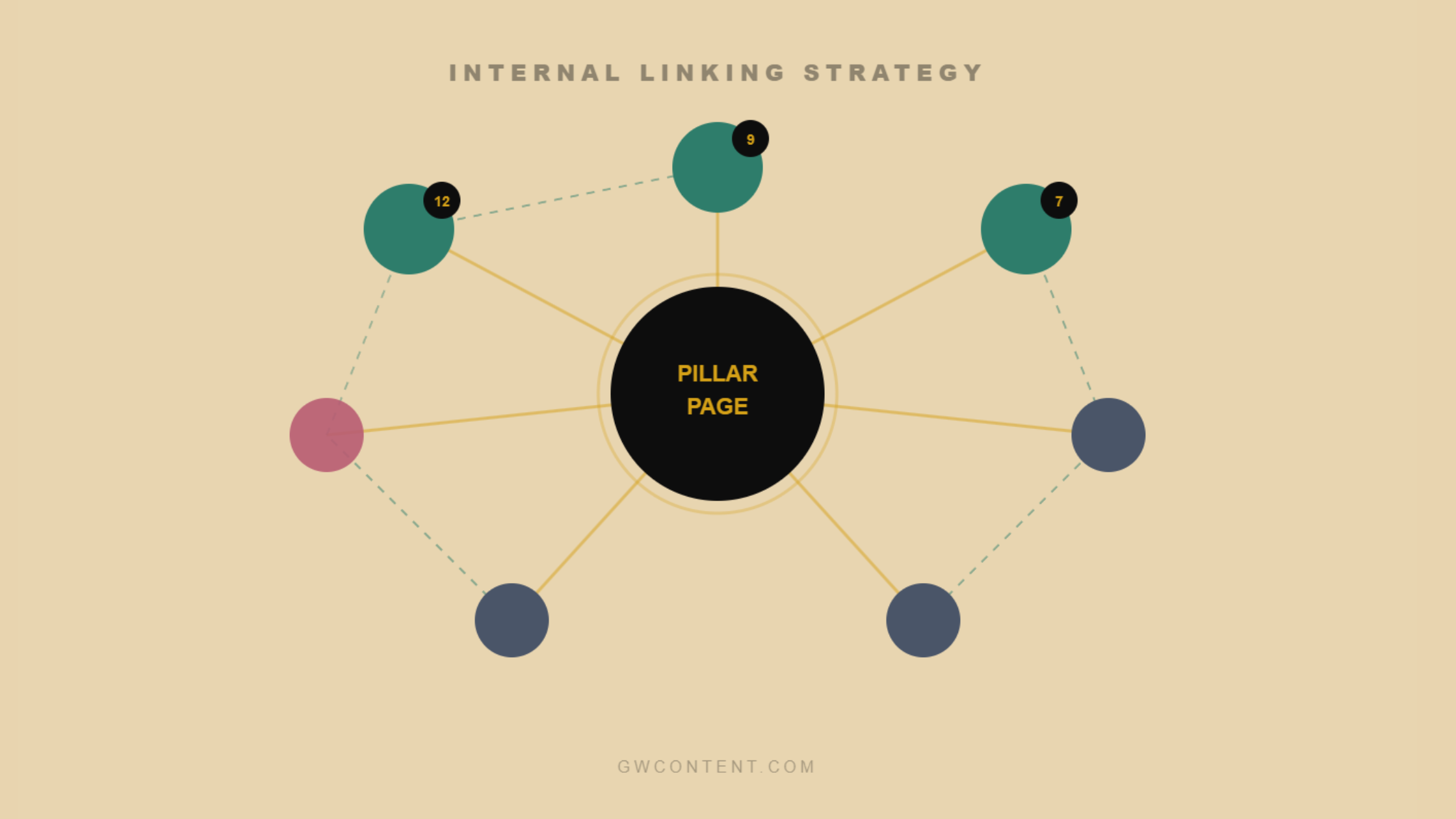
A clear site architecture map makes every subsequent linking decision straightforward. Each cluster page links back to its pillar. The pillar links out to all cluster pages. Related cluster pages link to each other where the connection is genuine. Conversion pages receive links from the most commercially relevant content in the cluster. This is the link structure that compounds. Each new piece of content added to the cluster makes every existing page stronger.
The interactive map below shows how a real ecommerce cluster is structured across four levels. Click any pink node to drill into its sub-cluster. Click the centre node to navigate back up.
Interactive Example
Ecommerce Internal Linking Architecture
Click any node to explore the cluster. Pink nodes drill deeper. Gold number badges show incoming internal link count. Click the centre node to go back up.
Step 2: Identify and fix orphan pages
Run a Screaming Frog crawl of the entire site and compare the output against the XML sitemap. Any page in the sitemap that receives zero incoming internal links from the rest of the site is an orphan page. Add at least two contextual internal links to each orphan from closely related content.
This is consistently one of the fastest ranking improvements available. Orphan pages that have been indexed but receive no internal link equity often rank at position 15 to 30 for their target keywords, with very little else holding them back. Adding relevant internal links from high-authority pages frequently moves these pages onto the first page of search results within four to six weeks.
According to research published by Upward Engine in 2026, approximately 40% of internal link value is wasted on poorly structured sites with orphaned pages, which is a figure that aligns closely with what I find in practice.
Step 3: Audit existing internal links
Before the next piece of content is published, audit what already exists. A SEO content audit surfaces the current internal linking structure across the site: which pages receive the most internal links, which receive the fewest, and where the linking pattern fails to reflect the intended content hierarchy.
The internal linking process on most sites is reactive rather than strategic. Links are added when a writer notices a relevant connection, not according to a documented plan. The audit makes the gap between the current internal linking structure and the intended architecture visible, so it can be systematically fixed.
Step 4: Use descriptive anchor text throughout
Anchor text is the clickable text of an internal link. It tells search engines what the destination page is about and reinforces the topical signal of the cluster architecture. Generic anchor text ("click here", "read more", "this article") provides no topical information whatsoever and represents a missed opportunity on every internal link that uses it.
Descriptive anchor text does not mean keyword-stuffed anchor text. It means the anchor accurately reflects the content of the destination page in language that reads naturally. "Content cluster strategy" is a good anchor for a link to the content cluster guide. "This post" is not. Vary anchor text across multiple links to the same page using the primary keyword, close variants, and natural descriptive phrases. Too many internal links using identical exact-match anchor text look unnatural and can trigger over-optimisation signals.
Step 5: Direct link equity toward high-value pages
The highest-authority pages on the site should actively distribute their link equity to the pages that most need it. Identify which pages have accumulated the most authority through a combination of external backlinks, organic traffic, and engagement signals. Then ensure those pages link to conversion-oriented pages, recently published content that has not yet accumulated authority, and any pages ranking just outside page one for their target keywords.
This is the most commercially impactful part of the entire internal linking process. A contextual link from a page ranking position one for a competitive keyword, pointing to a related service page, is worth far more than a dozen links from low-traffic pages. Audit which of your highest-authority pages do not currently link to your most commercially important pages and fix that gap first.
Step 6: Maintain the structure over time
Internal linking is not a one-time project. Every new piece of content published creates new opportunities to link to existing pages and creates a new page that the existing cluster should link to. Establish a process where every content brief specifies the internal links the piece should include before writing begins, and where a regular audit reviews the overall link structure for orphan pages, redirect chains, and broken internal links.
The SEO content strategy guide covers how this architecture connects to commercial outcomes across the full funnel, and the how to write a content brief guide covers how to specify internal links at the planning stage rather than leaving them to the writer's discretion.
Internal Linking and AI Search Visibility

The same link architecture that builds topical authority for Google increasingly determines AI search citability. When ChatGPT, Perplexity, or Google AI Overviews assess which source to cite for a topic, they interpret the internal link structure as a signal of which page is the authoritative hub.
Sites with hub-and-spoke topic cluster linking, where the pillar page receives internal links from multiple cluster pages all using semantically consistent descriptive anchor text, are classified by AI tools as having a clear, authoritative source for that topic. The link structure is the machine-readable evidence that tells AI tools which page belongs at the top of the citation hierarchy. Sites with fragmented or inconsistent internal linking send the opposite signal, with several pages covering the same topic without a clear primary source, which AI tools interpret as shallow coverage rather than genuine expertise.
The practical fix is identical to the fix that improves Google rankings: build the cluster architecture, link cluster pages to the pillar consistently, use descriptive anchor text, and ensure the pillar page links out to all cluster content. Internal linking plays a direct role in AI search visibility in a way that most site owners have not yet factored into their internal linking efforts.
Internal Linking in Practice
For Connecteam, reviewing and restructuring the internal linking between the blog cluster and key service and conversion pages was part of the engagement that contributed to a 62.6% increase in organic traffic and 79.4% growth in AI Overview visibility.
The content existed and was strong. The internal link structure was not directing authority to the pages where it would produce commercial return. Fixing the architecture before scaling content production meant every new piece was added to a foundation that was already working. Read the Connecteam case study.
For Originality.ai, building the internal linking architecture correctly from the outset was what made the content programme's growth sustainable. Organic traffic grew from 278,000 to 1.18 million sessions, a 324.7% increase, with referral domains growing from 1,098 to 9,942.
A content programme that doubles in size each year only compounds cleanly when the internal linking structure connects every new piece to the cluster correctly from day one. Read the Originality.ai case study.
The pattern is consistent: every site I audit has link value sitting unused. The content is there. The authority is there. The internal links connecting them are not.
Common Internal Linking Mistakes to Avoid

Too many internal links on a single page
Excessive internal links dilute link equity and make the page feel spammy to users. I see this most often on older sites that have been adding contextual links reactively for years without any plan.
These are pages that have accumulated forty or fifty body links that diffuse rather than concentrate authority. Aim for two to five contextual links per 1,000 words in body copy. Every link should serve a clear purpose: passing equity to a page that needs it, or helping the reader navigate to genuinely relevant content.
Linking to the wrong page
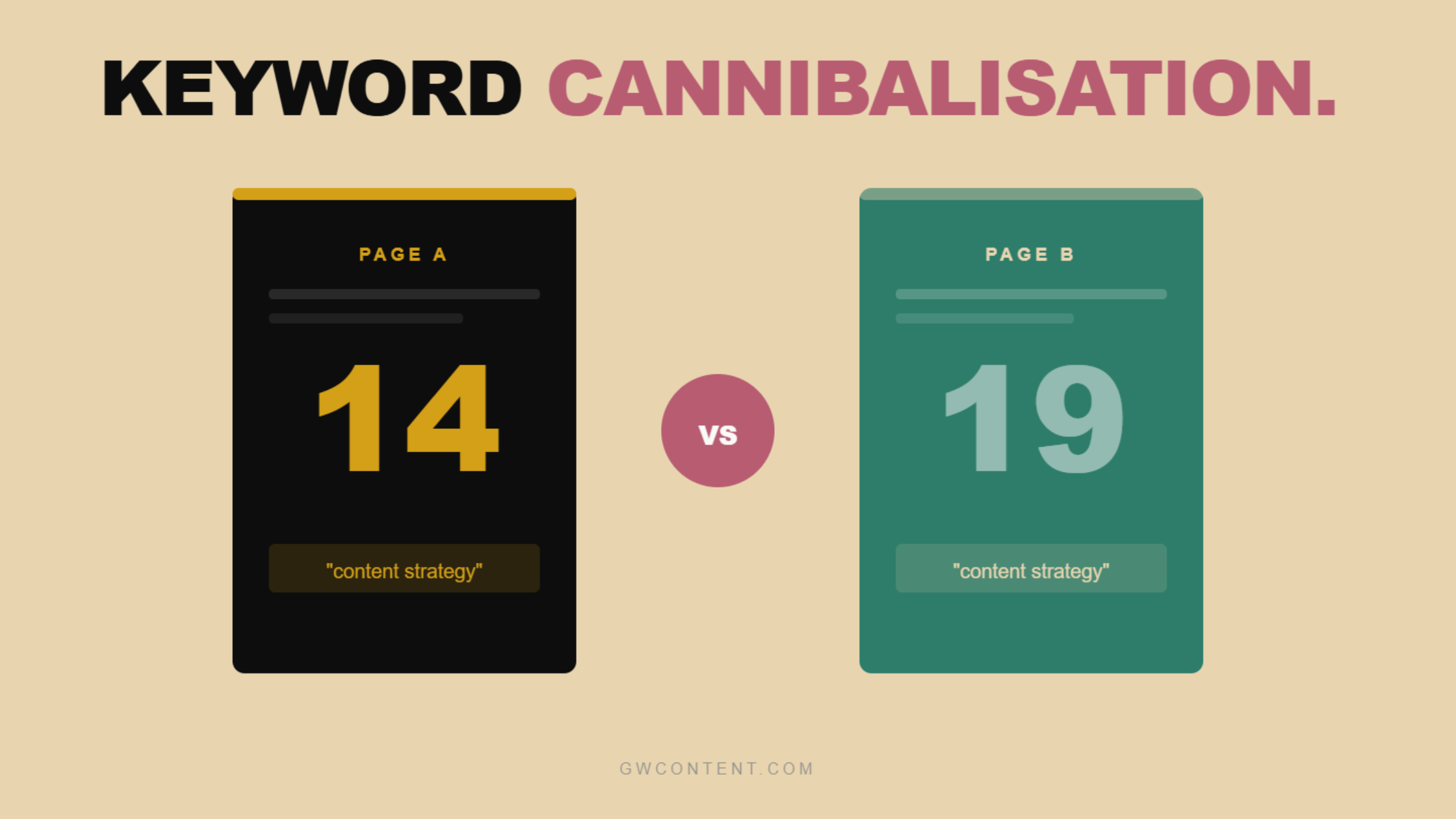
When multiple pages exist on similar topics, internal links should consistently point to the designated primary page for each keyword. Inconsistent linking (where different pages link to different versions of related content) contributes to keyword cannibalisation and confuses the topical hierarchy.
I find this in almost every content audit I run: three or four articles all linking to different versions of the same resource, with no consistent signal to search engines about which page is primary.
Redirect chains in internal links
After site migrations or URL changes, internal links often point to pages that redirect to other pages. Every redirect hop in a link chain loses a fraction of the link equity being passed and adds latency for users. After any migration, update all internal links to point directly to the final destination URL rather than through redirected pages. This is a quick fix that consistently produces measurable crawl efficiency improvements.
Ignoring crawl depth
Every important page should be reachable within three clicks from the homepage. Pages buried deeper than that receive less crawl budget and accumulate less link equity over time. If an important page requires four or five clicks to reach, it often has few internal links pointing to it from the broader site. Adding links from higher-level pages reduces crawl depth and immediately improves how frequently the page is crawled and how much link equity it receives.
The Bottom Line
Internal linking is the most controllable ranking lever available on any site, and it is consistently the most underused. The link equity to improve rankings for every important page on the site is almost certainly already there, sitting on high-authority pages that are not passing it to the pages that need it.
Build the cluster architecture. Fix the orphan pages. Direct link equity toward high-value pages. Use descriptive anchor text. Maintain the structure as the site grows. The internal links serve both users and search engines simultaneously, and doing that well is what separates sites that compound their organic visibility from sites that plateau regardless of how much content they produce.
If you want the internal linking structure built as part of a documented content strategy rather than retrofitted after the fact, the Content Strategy service covers the full process: cluster architecture, internal linking map, brief template, and ongoing maintenance.
Get a free SEO audit, and I will tell you exactly where your internal linking structure is leaving ranking potential on the table.
Frequently Asked Questions About Internal Linking Strategy
What is an internal linking strategy?
An internal linking strategy is a deliberate system for connecting pages within the same website to distribute link equity, signal topical authority to search engines, and guide users and crawlers through the content architecture.
A strategy specifies which pages link to which other pages, what anchor text is used, and how link equity is directed toward the site's most commercially important pages. Internal links connect pages on the same domain in a way that makes the site's content hierarchy legible to both users and search engines.
How many internal links should a page have?
Two to five contextual internal links per 1,000 words of body copy is a reasonable benchmark for most content pages. Total page links, including navigation and footer, should generally stay below 150 to maintain link value per link.
Too many internal links on a single page dilute the equity passed to each destination. The more important consideration is that every link serves a genuine purpose, like either passing equity to a page that needs it, or helping the reader navigate to genuinely relevant content.
What is the best anchor text for internal links?
Descriptive anchor text that accurately reflects the content of the destination page and reads naturally in context. Vary the phrasing across multiple links to the same destination page using the primary keyword, close variants, and natural descriptive phrases.
Avoid generic anchors like "click here" or "read more" which provide no topical signal, and avoid over-optimised exact-match keyword anchors used identically across all links to the same page.
How do internal links affect AI search visibility?
AI tools like ChatGPT, Perplexity, and Google AI Overviews use internal link structure to identify which pages belong to a topic cluster and which page is the authoritative hub.
Sites with hub-and-spoke cluster linking, where the pillar page receives incoming internal links from multiple cluster pages using semantically consistent anchor text, are classified as having a clear authoritative source for their topic, which significantly increases the likelihood of being cited in AI-generated responses.
What is link equity, and how do internal links distribute it?
Link equity is the ranking authority passed from one page to another through hyperlinks. Every page holds some authority based on its external backlinks and engagement signals. Internal links direct a portion of that authority to linked pages within the same domain.
Linking from high-authority pages to pages that need ranking support is the primary mechanism for distributing link equity strategically across the site.
How do I find orphan pages on my site?
Run a Screaming Frog crawl of the entire site and compare the output against the XML sitemap. Any page in the sitemap that receives zero incoming internal links from other pages on the site is an orphan page. Google Search Console's Links report can also surface pages with very low internal link counts. Add at least two contextual links to each orphan from closely related, high-traffic content.
How often should I audit my internal linking structure?
A full internal link audit should be run at least annually, and immediately after any site migration or significant structural change. A lighter monthly review through Google Search Console, checking for broken internal links, new orphan pages, and redirect chains, keeps the structure clean between full audits.
The internal linking process should be built into the content production workflow so that every new piece is briefed with its required internal links before writing begins.