Keyword Cannibalisation: How to Find It, Fix It, and Prevent It
Published: April 25, 2026 | Last updated: April 25, 2026 | 11 min read
Your site has been producing content consistently. Rankings are not where they should be. You run a site search and find three articles that are all essentially about the same thing, all targeting the same keyword, all competing against each other instead of reinforcing each other. None of them rank particularly well. One strong, well-structured page would outrank all three.
I find this in almost every content audit I run. It is consistently one of the most commercially damaging and most easily preventable SEO problems on sites with a reasonable volume of content. The fix is systematic. The prevention is a content brief and a keyword map.
Author bio
Graeme Whiles is an independent SEO and AEO consultant at GWContent. He has worked with enterprise and SaaS brands, including Originality.ai, Connecteam, 6sense, and Practice Better, growing organic traffic and AI search visibility across some of the most competitive categories in B2B. He holds content bylines with Foundr Magazine and Originality.ai, and built Three Putt Golf Clothing from a blank domain as a live proof of concept for his methodology.
Short on time? Here are the key takeaways
-
Keyword cannibalisation happens when multiple pages target the same keyword and search intent, splitting authority and confusing search engines about which page to rank.
-
The most common causes: publishing without a keyword map, refreshing old content that overlaps with newer pieces, and poor internal linking that fails to signal which page is primary.
-
Find it using a site search operator, Google Search Console's Performance report filtered by page, or a dedicated SEO tool.
-
Fix it by picking a preferred page per keyword, then merging weaker pages into it, setting up 301 redirects, or applying canonical tags.
-
According to Yoast's 2025 analysis of their own content cluster, consolidating competing pages consistently produced better rankings than maintaining separate weaker articles, even when those pages had been live for years.
-
Prevent it from recurring with a keyword map and a content brief that specifies the target keyword and search intent before writing begins.
What Is Keyword Cannibalisation?
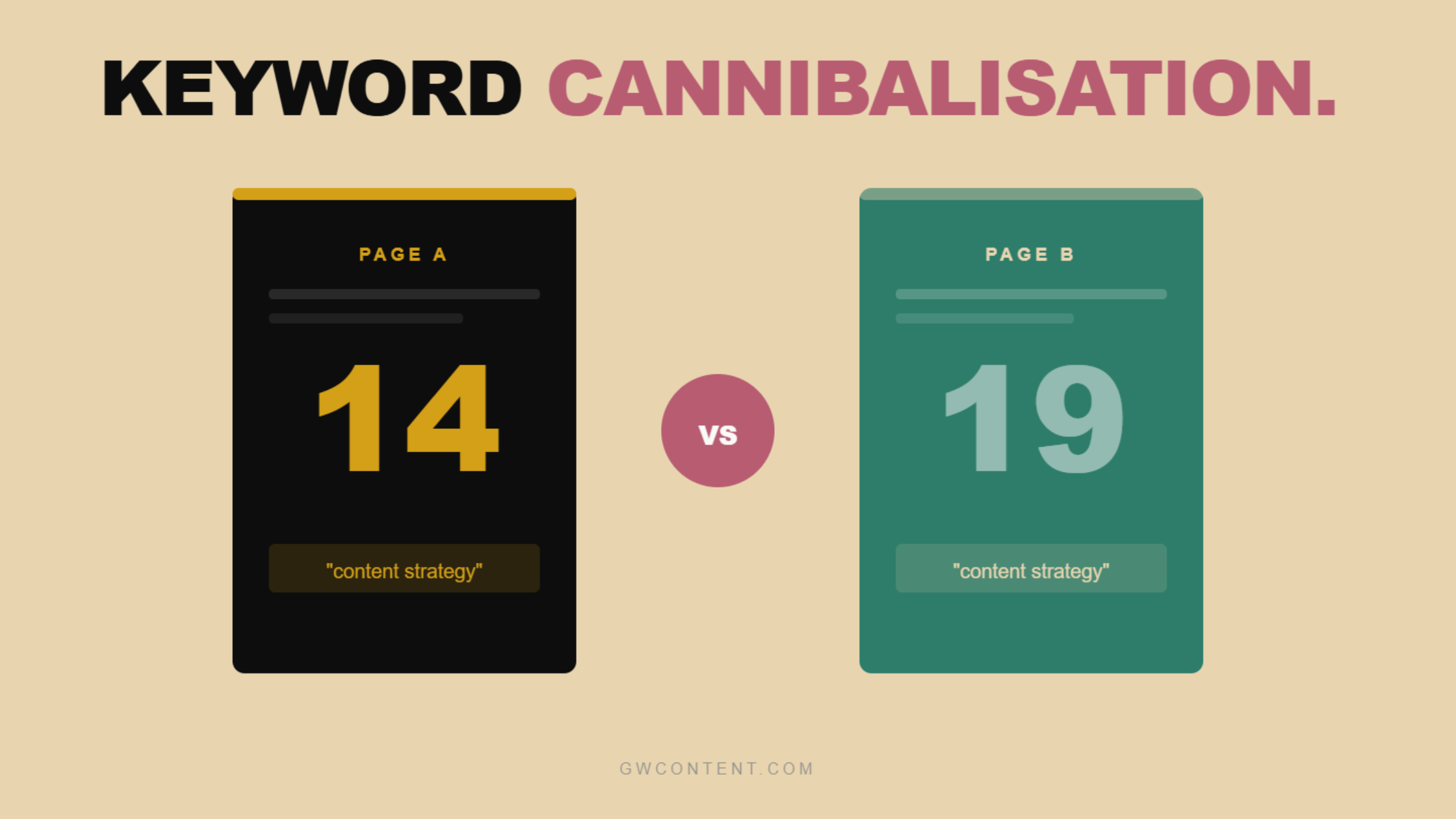
Keyword cannibalisation occurs when two or more pages on the same site target the same keyword and the same user's search intent, forcing them to compete against each other in Google search results. Instead of one authoritative page earning a strong ranking, search engines have to choose between several overlapping URLs, and the result is usually that all of them rank lower than a single consolidated page would.
The word "cannibalisation" is accurate. The pages are consuming each other's ranking potential rather than building on it. Backlinks point to multiple URLs instead of one. Page authority is diluted. Click-through rates drop as Google fluctuates between which URL to display for the same query. Organic traffic that should be concentrated on one high-performing page is spread thin across several weaker ones.
The important distinction is between cannibalisation and healthy topical coverage. Two pages ranking for related terms is not automatically a problem. A transactional product page and an informational guide can both rank for related terms without competing, because they address different stages of the buyer journey. Cannibalisation happens when multiple pages cover the same topic with the same intent, not when pages serve different user needs within the same broad subject.
Why Keyword Cannibalisation Harms Rankings
The damage is structural. When search engines face competing pages on the same site for the same query, several things happen simultaneously, all of them negative.
Authority is diluted
Backlinks and internal link equity that should concentrate on one strong page are spread across multiple URLs. According to Semrush's 2025 cannibalisation analysis, this fragmentation prevents any single page from fully consolidating the authority needed to rank competitively, with ranking power distributed across several pages rather than concentrated on one. Instead of one page accumulating what it needs to dominate a keyword, several pages accumulate less than they need individually.
Search engines get confused, and rankings become unstable.
When Google cannot determine which of your competing pages is the most relevant for a given search query, rankings fluctuate. The affected keyword bounces between two or more of your URLs, sometimes from one reporting period to the next. Neil Patel's March 2026 keyword cannibalisation guide identifies rank swapping, where the same keyword alternates between two URLs, as one of the clearest early indicators that cannibalisation is actively suppressing organic performance.
The wrong page often wins
Google may decide that an older, less optimised page is the primary version, ranking it ahead of the page designed to convert traffic. A blog post ranking for a commercial keyword instead of the product or category page designed to convert that visit is one of the most commercially costly versions of this problem. The traffic lands on the wrong page, and the conversion does not happen.
Crawl budget is wasted
Search engine crawlers have a finite budget per site. Multiple near-duplicate pages covering the same topic consume crawl budget that would be better spent on high-value pages. On larger sites, this measurably delays how quickly Google discovers and evaluates new content.
A Real Example of Cannibalisation in Action
This is the pattern I see most frequently in content audits. A SaaS company publishes an article called "What Is Content Marketing?" in year one. In year two, a different writer produces "Content Marketing Explained: A Complete Guide." In year three, the team refreshes the strategy and publishes "The Ultimate Guide to Content Marketing." All three target the same keyword with the same informational intent.
In Google Search Console, none of them rank consistently on page one. Instead, they alternate between positions 12 and 30 depending on the week, and the total combined traffic is a fraction of what one strong, well-maintained page would achieve. The backlinks earned over three years are split across three URLs rather than building one authoritative page.
The fix in this case is a merge and redirect: take the strongest content from all three, build one comprehensive pillar page, and 301 redirect the two weaker URLs. In almost every instance I have run this process, the consolidated page outperforms the three separate pages within six to eight weeks.
How to Identify Keyword Cannibalisation

There are three reliable methods. I typically use all three in combination during a SEO content audit to get a complete picture of where a site is competing against itself.
Method 1: Site search operator
The fastest way to start is a Google search using the site operator. Type site:yourdomain.com "keyword" into Google search and review which pages appear. If two or more pages appear for the same keyword, you have a potential cannibalisation issue worth investigating further.
This method is quick and free but limited. It only surfaces pages Google has indexed for that specific term and misses intent-level cannibalisation where different keyword variations are pointing to the same underlying user need.
Method 2: Google Search Console Performance report
This is the most reliable free tool for identifying keyword cannibalisation at scale. In Google Search Console, open the Performance report, click on a target keyword, and then filter by page to see which URLs are receiving clicks and impressions for that query. If multiple pages are appearing for the same keyword, they will all show in this view.
The key signal: if two or more pages have meaningful impressions for the same query, they are competing. If clicks are split between them, that is direct evidence cannibalisation is reducing the performance of what should be your primary page.
Method 3: SEO tools
Tools like Ahrefs and Semrush have dedicated cannibalisation reports that surface all instances of multiple URLs ranking for the same or similar keywords across the site. These are particularly useful on larger sites where manual review would be impractical. The free SEO tools at GWContent include a content decay detector that surfaces pages with overlapping content signals alongside performance data, helping prioritise which cannibalisation issues need addressing first.
How Do I Fix Keyword Cannibalisation?

Not every cannibalisation problem has the same solution. The right fix depends on the nature of the overlap, the authority the competing pages have accumulated, and whether the pages can genuinely be differentiated. Work through the four questions below to identify the correct approach for your specific situation.
Which fix applies to your situation?
How to Fix Keyword Cannibalisation
Option 1: Merge and redirect
This is the most effective fix for genuine cannibalisation where multiple pages cover the same topic with the same search intent. Consolidate the best content from all overlapping pages into one comprehensive primary page, then set up 301 redirects from the weaker pages to the merged primary page.
The 301 redirect passes link equity from the redirected pages to the primary page. Instead of backlinks and internal links pointing to several weak URLs, all of that equity now flows to one strong page. This produces the fastest and most durable ranking improvement of any of the four options because it addresses the root cause directly.
After merging, update all internal links across the site to point directly to the new primary page rather than through the redirect. Redirect chains waste link equity and add latency. Clean links to the final URL are better in every measurable way.
Option 2: Reoptimise for distinct keywords
If two existing pages cover the same broad topic but can genuinely serve different search intent with restructuring, the solution is to differentiate them rather than merge them. Assign each page a genuinely distinct target keyword, restructure the content to match the specific search intent of that keyword, and update internal linking to reflect the distinction clearly.
This only works when the pages serve different user needs. If the distinction is forced, two weakly differentiated pages will continue to compete. A content gap analysis can identify whether two competing pages are genuinely distinct enough to survive as separate assets or whether consolidation is the correct call.
Option 3: Apply canonical tags
Where pages must remain accessible but are near-duplicates for technical reasons (product variants in multiple categories, URL parameters, paginated content), canonical tags signal to search engines which URL is the preferred version. Place a canonical tag on secondary pages pointing to the primary URL, instructing Google to consolidate ranking signals there.
Canonical tags are a signal, not a directive. Google generally respects them but is not required to. For genuine content cannibalisation, merging and redirecting is more reliable. Canonical tags are better suited to technical duplication than to content that was published twice with different wording.
Option 4: Delete and redirect
For pages with no organic traffic, no meaningful backlinks, and no commercial purpose, deletion followed by a 301 redirect to the most relevant alternative page is often the cleanest solution. Low-quality pages competing for the same search queries dilute overall site authority and waste crawl budget. Removing them concentrates on the pages that matter.
Use Google Analytics and Google Search Console data to confirm a page genuinely has no traffic value before removing it. Pruning content should always be a considered decision.
The four fixes at a glance
| Fix | When to use it | Key action |
|---|---|---|
|
Best fix Merge and redirect |
Same intent, one page can cover both, meaningful authority exists | Combine content into primary page, 301 redirect weaker URLs |
|
Low authority Delete and redirect |
Same intent, competing pages have no traffic or backlinks worth preserving | Remove weaker page, 301 redirect to the primary page |
|
Keep both Reoptimise |
Same broad topic, but genuinely distinct subtopics can be assigned to each | Assign a distinct keyword and intent to each page, rewrite accordingly |
|
Technical only Canonical tags |
Technical duplication — URL parameters, product variants, paginated content | Set canonical tag on secondary pages pointing to the preferred URL |
Fixing Keyword Cannibalisation in Practice

For Connecteam, a SEO content audit at the start of the engagement identified specific cannibalisation between review and comparison content that was suppressing rankings on high-commercial-intent queries. Multiple articles were targeting overlapping search terms with the same commercial intent, splitting authority rather than building it. Addressing those structural issues before scaling the content programme contributed to a 62.6% increase in organic traffic and 79.4% growth in AI Overview visibility. Read the Connecteam case study.
For Originality.ai, understanding exactly which pages were competing against each other before scaling the content programme made the subsequent growth sustainable. Organic traffic grew from 278,000 to 1.18 million sessions, a 324.7% increase, with referral domains growing from 1,098 to 9,942. Building on a foundation where each page had a distinct keyword target and distinct search intent was what made that compounding possible. Read the Originality.ai case study.
The pattern is consistent: fixing keyword cannibalisation before scaling content production produces significantly faster results than scaling on top of an existing cannibalisation problem.
How to Prevent Keyword Cannibalisation
Build a keyword map
A keyword map is a document that assigns one primary keyword and one clear search intent to each URL on the site. Before any new content is commissioned or published, the keyword map is checked to confirm that no existing page already targets that keyword or serves the same user need.
According to Ahrefs' keyword research methodology, assigning a unique target keyword to each page before creating new content is one of the most reliable ways to prevent internal competition before it starts. Without a keyword map, cannibalisation is almost inevitable on any site producing content at scale. With one in place, every new piece has a defined, non-overlapping position in the content architecture before a word is written.
A keyword map also makes the content cluster strategy structurally visible. It shows which topics have pillar coverage, which subtopics have cluster pages, and where the genuine gaps are. Running a content gap analysis periodically updates the map and surfaces new opportunities before they become new cannibalisation problems.
Use a content brief with a defined target keyword
The content brief is the operational document that prevents cannibalisation at the point of content creation. Every piece commissioned should include a defined primary keyword and a defined search intent that has been checked against the keyword map. This is the step most content teams skip, and it is why cannibalisation is so common on sites producing content at volume. The how to write a content brief guide covers the full brief template, including how to specify target keywords and search intent in a way that prevents overlap.
Maintain internal linking with descriptive anchor text
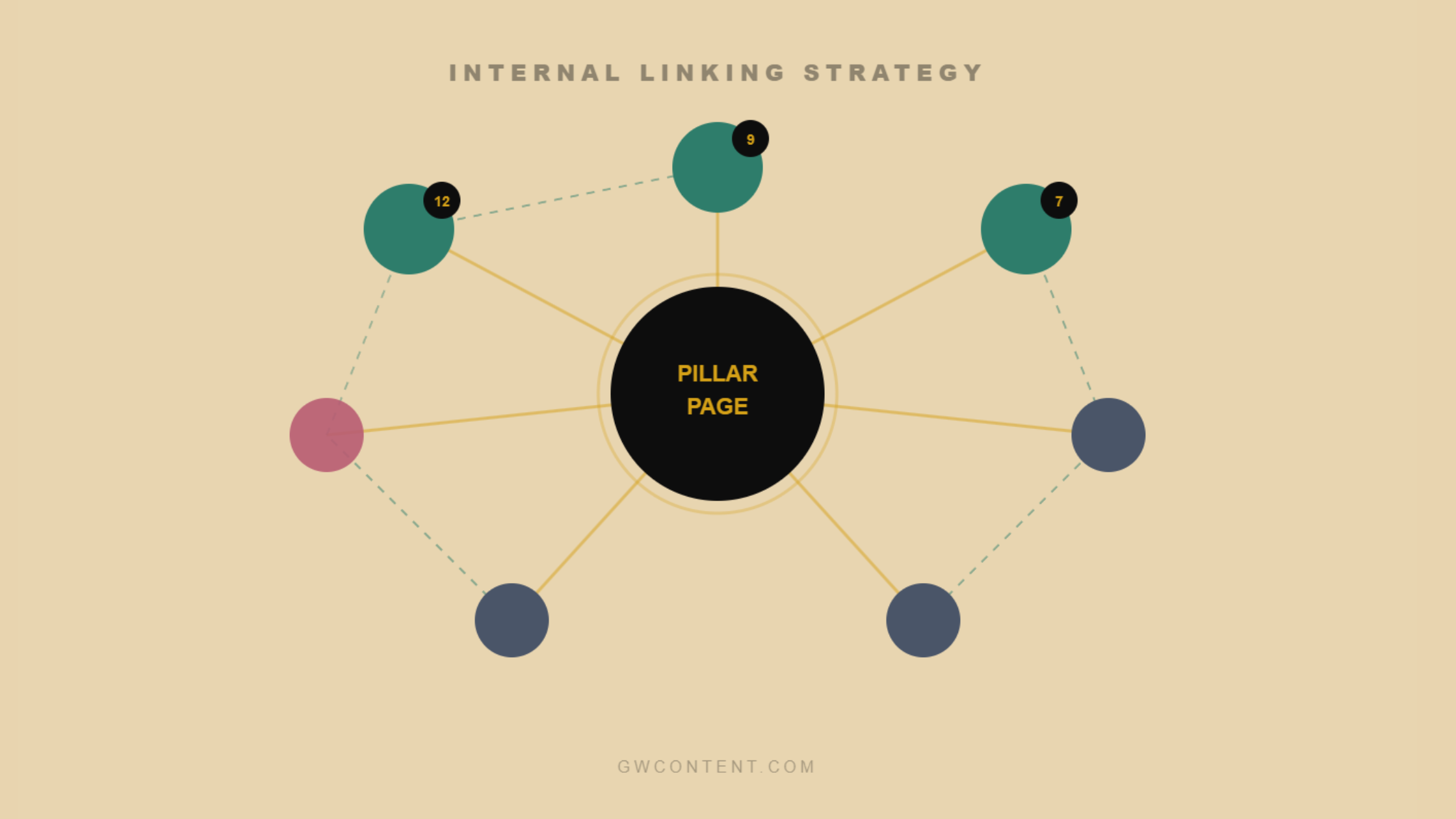
Internal links that consistently point to the primary page for each target keyword, using descriptive anchor text that reflects that page's content, reinforce to search engines which page is authoritative for each query. Poor internal linking (generic anchor text, inconsistent targets) leaves search engines to infer which page matters most, and they often infer incorrectly.
After any merge or redirect as part of a cannibalisation fix, audit internal links across the entire site to ensure they point directly to the new primary page rather than through a redirect chain.
Cannibalisation and AI Search
The same problem that harms traditional search rankings also affects AI search visibility. When ChatGPT, Perplexity, or Google AI Overviews (other search engines are available), evaluate a site's authority on a topic, they assess whether the site has clear, authoritative coverage. Multiple competing pages covering the same topic with the same intent signal redundancy rather than expertise, which reduces the likelihood of being cited in AI-generated responses.
Fixing cannibalisation and consolidating overlapping content into well-structured primary pages improves both traditional search rankings and AI citability simultaneously. The SEO content strategy that builds topical authority, with each page serving a distinct, clearly defined purpose, is the same strategy that earns AI citations. The topical authority guide covers how to build that architecture in full.
The Bottom Line
Keyword cannibalisation is one of the most common and most commercially damaging SEO problems on content-heavy sites, and it is almost always the result of publishing without a keyword map rather than a deliberate strategic failure.
The fix is systematic: audit the site to identify all overlapping pages, pick a preferred page for each affected keyword, merge and redirect weaker pages to the primary page, update internal linking, and use descriptive anchor text throughout. The prevention is simpler: a keyword map and a content brief that specifies the target keyword and search intent before writing begins.
If you want a structured content strategy that prevents keyword cannibalisation from the outset, with a keyword map, content cluster architecture, and briefing process built in from the start, the Content Strategy service covers the full process.
Get a free SEO audit, and I will tell you exactly where your site is competing against itself and what to prioritise first.
Frequently Asked Questions About Keyword Cannibalisation
What is keyword cannibalisation?
Keyword cannibalisation occurs when multiple pages on a website target the same keyword and serve the same search intent, causing them to compete against each other in search results. Instead of one authoritative page ranking strongly, search engines must choose between several weaker pages, resulting in lower rankings, split traffic, and diluted link equity across all competing pages.
How do I find keyword cannibalisation on my site?
Start with a Google site search using the operator site:yourdomain.com "keyword" to surface pages relevant to a specific term. Then check the Google Search Console Performance report filtered by page to see which URLs receive clicks and impressions for the same queries. For large sites, Ahrefs and Semrush have dedicated cannibalisation reports that surface all overlapping keyword targeting across the full site in one pass.
What is the best way to fix keyword cannibalisation?
The most effective fix is to merge the content from overlapping pages into one comprehensive primary page and set up 301 redirects from the weaker pages to that primary page. This consolidates authority, link equity, and internal link signals onto a single URL. Use the decision tree above to confirm which fix applies to your specific situation before acting.
How do canonical tags help with keyword cannibalisation?
A canonical tag tells search engines which URL is the preferred version when similar content exists across multiple URLs. Canonical tags are a signal rather than a directive, so merging and redirecting is more reliable for genuine content cannibalisation. Canonical tags are better suited to technical duplication (product page variants, URL parameters, pagination) than to content that was simply published twice.
Does keyword cannibalisation affect AI search visibility?
Yes. AI tools assess whether a site has clear, authoritative coverage of a topic. Multiple competing pages covering the same topic with the same intent signal redundancy rather than expertise, reducing the likelihood of being cited in AI-generated responses. Fixing cannibalisation improves both traditional search rankings and AI citability simultaneously.
How do I prevent keyword cannibalisation?
Build a keyword map that assigns one primary keyword and one search intent to each URL, and check it before commissioning any new content. Use a content brief that specifies the target keyword and search intent at the planning stage. Maintain internal linking with descriptive anchor text that consistently points to the primary page for each keyword. Run a content audit every six to twelve months to identify any new cannibalisation issues before they materially affect rankings.
Can having multiple pages rank for the same keyword ever be good?
Sometimes, but it depends entirely on search intent. Branded keywords often produce multiple results from the same domain legitimately, because users searching a brand name may be looking for different things. The problem arises when multiple pages target the same intent, which is when internal competition reduces the performance of all competing pages. The goal is one authoritative page per intent, not one page per topic.