How to Run an SEO Content Audit (Get a Free One for Your Site)
Published: April 10, 2026 | 11 min read
By Graeme Whiles
Most sites do not have a content creation problem.
They have a content structure problem.
Years of blog posts and website pages accumulating with no coherent relationship to each other. Site content competing against itself for the same keywords. Thin content diluting search engine rankings. Outdated content that once ranked and has been quietly declining ever since. And somewhere underneath all of it, genuinely good relevant content that is underperforming because the surrounding architecture is a mess.
An SEO content audit is how you find all of it. I run one at the start of every new client engagement, and what it reveals consistently shifts the entire strategy away from producing more content toward fixing what already exists. That shift almost always produces faster results. For growth-stage B2B companies in particular, where content investment decisions carry real commercial consequences, the B2B content marketing guide covers the strategic context that makes the audit decision-making easier.
If you want an expert eye on your site's content health before working through this yourself, get a free SEO audit, and I will tell you exactly what your site needs.
Author bio
Graeme Whiles is an independent SEO and AEO consultant at GWContent. He has worked with enterprise and SaaS brands, including Originality.ai, Connecteam, 6sense, and Practice Better, growing organic traffic and AI search visibility across some of the most competitive categories in B2B. He also built Three Putt Golf Clothing from a blank domain as a live proof of concept for his methodology.
Short on time? Here are the key takeaways
- An SEO content audit is a structured review of every page on your site to assess performance, quality, and alignment with search intent.
- Every page gets one of four decisions: keep and optimise, improve and update, consolidate, or remove.
- Updating underperforming content is almost always more effective than creating new content on the same topic.
- Content audits reveal index bloat, keyword cannibalisation, orphaned pages, and broken links that collectively suppress everything else on the site.
- In 2026, a complete audit should also assess AI search visibility, not just traditional search performance.
What Is an SEO Content Audit?

A website content audit, or SEO content audit, is a structured review of all the website content on a site to assess its SEO performance, quality, and alignment with current search intent, with the goal of identifying underperforming pages, technical issues, and content that is actively harming overall site authority. A successful content audit does not just catalogue what exists. It produces a clear action plan for every URL.
The primary goal is to shift content decision-making from reactive to proactive and data-driven. Instead of producing new blog posts on top of a site full of structural problems, you fix the foundation first. A site with three hundred pages of mixed quality covering a topic is less likely to rank well or be cited by AI tools than a site with fifty tightly structured, expert pages covering the same territory. Authority concentrates. It does not spread.
For startups and early-stage companies building content from scratch, the content marketing for startups guide covers how to avoid the structural problems that make audits necessary in the first place. For everyone else, the audit is the starting point.
A comprehensive SEO content audit should be performed at least annually. High-growth sites, recently migrated sites, or any site that has experienced an unexplained drop in organic search traffic should be audited every six months.
What a Content Audit Reveals
Before the process, it is worth understanding what you are looking for. In my experience, every site audit reveals some combination of the following.
- Index bloat occurs when a site has too many URLs indexed that add no SEO value, often through duplicate content, parameter pages, or multiple pages targeting the same keyword. Search engine crawlers have a finite crawl budget per site. Index bloat wastes that budget on low-value pages at the expense of high-value ones.
- Search trends shift over time, which means content that matched search intent two years ago may no longer match what users are actually searching for today. Keeping site content up to date is not just about accuracy. It is about ensuring that visible content on every page aligns with the queries driving traffic now, not the queries that drove traffic when the content was first published.
- Keyword cannibalisation happens when multiple pages target the same search intent and compete against each other rather than reinforcing each other. Neither page ranks as well as a single consolidated page would.
- Orphaned pages have no internal links pointing to them. They are invisible to search engine crawlers following the site's link structure, which means they often do not get indexed or ranked regardless of their content quality.
- Content decay describes pages that previously drove organic search traffic but have declined due to outdated information, shifting search intent, or increased competition. Identifying decay early allows for a refresh before the rankings loss becomes commercially significant.
- Redundant, outdated, and trivial content dilutes overall site authority. Thin pages and low-quality content drag down the E-E-A-T signals that both search engines and AI tools use to assess site credibility.
A well-executed audit addresses all of these. For Connecteam, resolving exactly these structural issues before scaling the content programme contributed to a 62.6% increase in organic traffic and a 79.4% growth in AI Overview visibility. The content already on the site performed significantly better once the structural problems were removed. That is the compounding return on audit investment. Read the Connecteam case study.
How to Run an SEO Content Audit: Step by Step

Step 1: Crawl the site and build your content inventory
Before assessing any page, you need a complete inventory of everything on the site. Use a crawl tool to extract every URL: landing pages, blog posts, product pages, and any other web pages currently accessible.
Tools to use: Screaming Frog for a full site crawl that surfaces JavaScript rendering issues, broken links, duplicate content, and URL accessibility problems; Google Search Console for organic search performance data; and your Google Analytics account for user behaviour and analytics data. The free SEO tools complement these analytics tools with additional content health and decay signals. Together, these allow you to pull data across every dimension of content performance before a single decision is made.
Pull the following data into a content audit spreadsheet for every URL: URL, page title, meta description, word count, internal links pointing to the page, organic traffic, impressions and clicks from Search Console, average keyword ranking position, and last modified date. This free content audit template approach, pulling all SEO metrics into a single spreadsheet, is what makes the content audit process manageable at scale, regardless of how many website pages the site contains. Every decision that follows is made against this inventory.
Step 2: Assess each page against consistent criteria
With the inventory built, assess each page against four questions:
- Is this page generating meaningful organic search traffic or assisting conversions?
- Does this page match the current search intent for its target keyword?
- Is this page contributing to or diluting overall site authority?
- Does this page serve a clear purpose for the target audience?
Use your Google Analytics account data to identify pages with high exit rates. These indicate where users are leaving without converting or navigating further, which signals a content quality or intent mismatch. Flag high-impression, low-click pages in Google Search Console: these are appearing in search results but not earning clicks, which usually means a title tag or meta description problem rather than a content quality issue.
Identify orphaned pages by filtering for URLs with zero internal links pointing to them. These are invisible to site navigation and frequently invisible to search engine crawlers as a result.
Also flag pages where multiple pages are covering the same topic or targeting the same relevant keyword. When the same page intent appears across related pages, none of them perform as well as a single authoritative page would. Gathering data on keyword overlap at this stage makes the consolidation decisions in Step 3 significantly faster.
Step 3: Apply the four-decision framework
Every page in the content audit receives one of four decisions. This is where most content audit templates fall short: they catalogue the analytics data but provide no framework for action.
Keep and optimise. The page is performing well or has strong potential. Optimise the title tag, meta description, and internal linking. Check Core Web Vitals using Google PageSpeed Insights and fix user experience issues. These pages are the authority foundation of the site and should be protected and strengthened.
Improve and update. The page has good keyword alignment or existing organic search traffic, but the content is outdated, thin, or no longer aligned with current search intent. Updating and expanding underperforming content is consistently more effective than creating new content on the same topic. Refresh with current information, add depth, improve internal links to and from the page, and ensure the content fully resolves user intent. Top-ranking pages in your category are useful benchmarks here: assess content quality against what is currently ranking and identify the specific depth or detail gaps that are preventing your page from competing for the same search engine results.
Consolidate. The page overlaps significantly with another page, targeting the same keyword or covering the same subject. Merge the content from the weaker page into the stronger page and redirect the weaker URL. This concentrates authority on a single URL and eliminates cannibalisation. Pruning content should be a mindful process: assess the SEO value of any URL before consolidating rather than simply removing it.
Remove. The page has no organic search traffic, no backlinks, no internal link value, and serves no purpose for the target audience. Low-quality pages, duplicate content, and outdated articles that cannot be refreshed should be removed from search results to prevent wasted crawl budget and index bloat. Always redirect removed pages to the most relevant alternative URL to preserve any residual link equity. Assess content on each candidate for removal against its business value before acting: a page with minimal organic traffic but a specific role in the content marketing strategy, as a support page or a conversion asset for a particular audience, may have more business priorities attached to it than the analytics data alone suggests.
Step 4: Fix technical issues surfaced by the audit
Content quality improvements on pages with technical problems will underperform until the technical issues are resolved. The audit will surface several categories worth fixing immediately.
Fixing internal and external links is one of the fastest wins in the content audit process because it improves both how search engine crawlers navigate the site and how visitors interact with it. Fix internal broken links by updating the link destination. For external links pointing to removed pages, update or remove the reference entirely.
Duplicate content issues arise from URL parameters, pages without canonical tags, and near-duplicate pages. Implement canonical tags correctly across the site and consolidate where necessary.
Core Web Vitals, specifically Largest Contentful Paint, Interaction to Next Paint, and Cumulative Layout Shift, affect both user experience and SEO performance. Assess these across key pages and address any significant failures before investing in content improvements that will be undermined by poor page performance. Ahrefs covers the full technical audit methodology if you want to go deeper on this layer.
Step 5: Rebuild the internal linking structure
A content audit almost always reveals internal linking problems. Pages that should be interconnected are not. Topical clusters that exist implicitly are not reflected in the link structure. Authority is not flowing to the pages that need it.
After implementing the four-decision framework, rebuild the internal linking structure deliberately. Hub pages link to all cluster pages. Cluster pages link back to the hub. Related cluster pages link to each other where the connection is genuinely useful to the reader. The content cluster strategy guide covers the full architecture in detail, including how to structure hub and spoke content so that every internal link is doing meaningful work.
Internal links should use descriptive anchor text that reflects the destination page's content. Generic anchors provide no topical signal to search engines and are a missed optimisation opportunity on every page. A content manager working through this step should also assess how well the internal linking structure reflects the broader content marketing strategy. If the cluster architecture is not visible in the link structure, it is not functioning as a cluster regardless of how well the individual pages are written.
Step 6: Assess AI search visibility
A modern SEO content audit must assess how AI systems interpret and prioritise the site's content, not just how it performs in traditional search results.
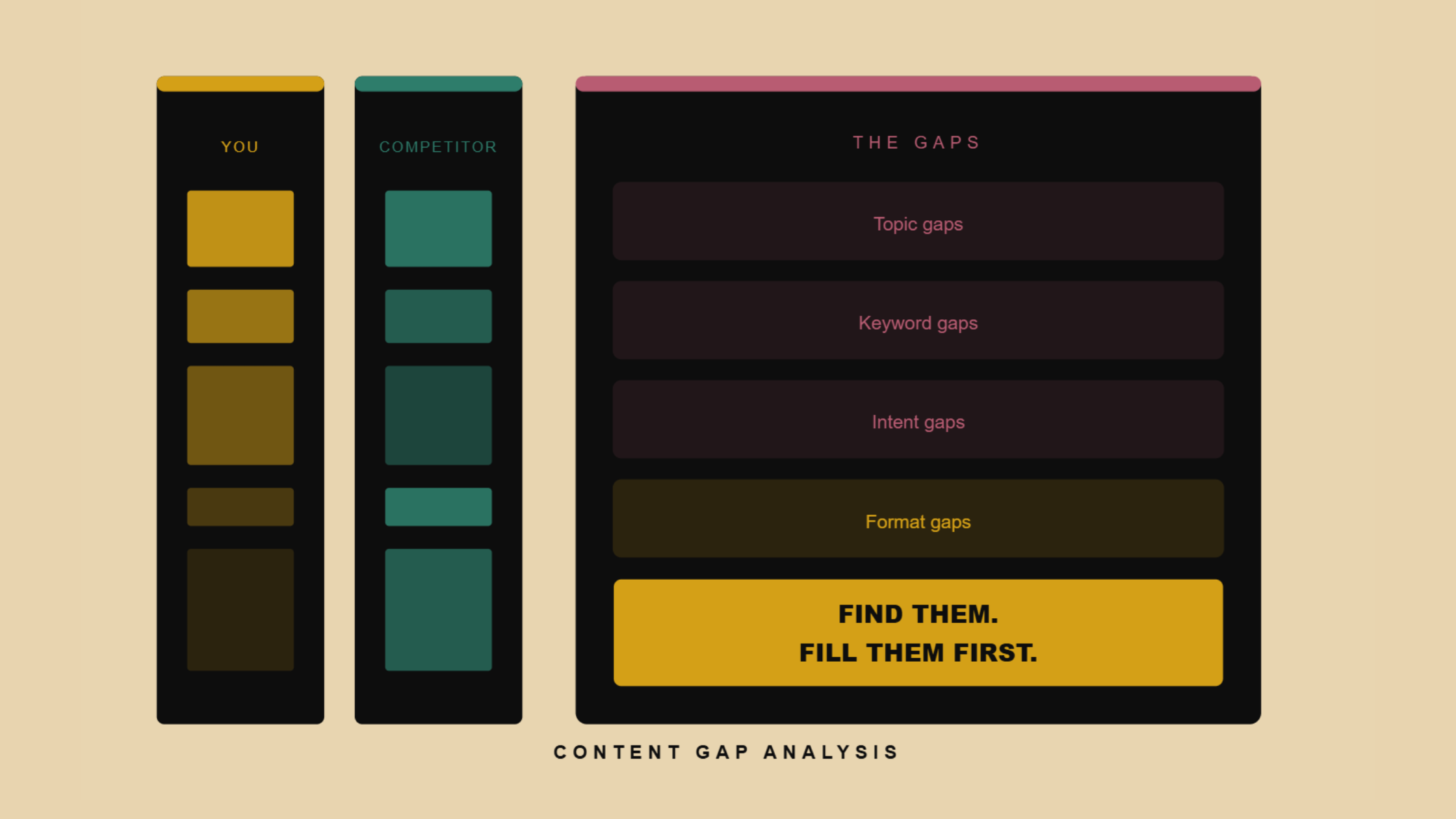
After completing the standard audit, run the site through the AEO Readiness Score to assess how the content, schema markup, and E-E-A-T signals are performing for AI search visibility. This identifies whether the structural improvements made through the traditional audit are also improving AI citation potential in ChatGPT, Perplexity, and Google AI Overviews. The content gap analysis guide covers identifying AI visibility gaps alongside traditional content gaps, which makes it a useful companion to the audit process.
Content fresh enough to reflect current search trends and recently updated information consistently outperforms stale pages in both traditional search engine results and AI-generated responses. Assess content freshness as a standing SEO metric in every audit cycle, not just when traffic drops.
Step 7: Implement in order of commercial impact
The audit produces a prioritised action list. Implement in this sequence: fix technical issues first, consolidate cannibalised content second, refresh high-potential underperforming pages third, and remove genuinely low-value pages last.
Track the impact of changes using Google Search Console for organic search traffic and keyword rankings, and Google Analytics for user behaviour. SEO performance should be assessed against the business value each piece of content produces, not just against raw traffic numbers. Pages perform differently at different stages of the funnel: a low-traffic decision-stage page that consistently generates high-quality leads has more business value than a high-traffic awareness page with zero conversion. Analytics data should reflect both dimensions.
The content marketing metrics guide covers the full framework for connecting content performance to commercial outcomes. Use the SEO ROI Calculator to model the expected return from the audit improvements, which makes the commercial case for the investment internally. The content marketing ROI guide covers how to present those numbers in a way that survives a budget conversation.
What the Results Look Like

For Originality.ai, understanding the existing content baseline before expanding the content programme made the growth trajectory sustainable rather than fragile. The audit identified which existing pages had the strongest authority signals and should anchor the cluster architecture, and which needed consolidation before new content was built on top of them.
Building on a properly audited foundation rather than producing content on top of structural problems: organic traffic grew from 278,000 to 1.18 million sessions, a 324.7% increase, while referral domains grew from 1,098 to 9,942. Compounding content returns requires a solid foundation. The audit is how you establish it. Read the Originality.ai case study.
The pattern is consistent across every engagement I run. The brands that audit first and build second consistently outperform the brands that produce more content on top of unresolved structural problems.
Common Content Audit Mistakes
- Auditing but not acting. A content audit that produces a spreadsheet and no implementation plan is wasted effort. The value is in the decisions and the execution.
- Deleting content without redirects. Removing low-value pages without redirects loses accumulated link equity and creates 404 errors that waste crawl budget.
- Treating all low-traffic pages the same. A recently published page with low traffic is a different situation from a three-year-old page that has never ranked. Age and trajectory both matter in the assessment.
- Ignoring search intent. A page may have decent organic traffic but still needs improvement if that traffic is misaligned with the target audience or fails to convert. Assess intent alignment alongside performance metrics.
- Skipping technical issues. Content improvements on pages with Core Web Vitals failures or broken internal links will underperform. Fix the technical layer first.
- Not assessing AI visibility. A content audit that only evaluates traditional search performance misses the growing dimension of AI citation visibility.
- No structured template to work from. Running a content audit without a free content audit template produces inconsistent assessments and makes it almost impossible to prioritise the action list. Build the template before you start gathering data, not after.
The Bottom Line
A content audit is not a housekeeping exercise. It is the strategic health check that should precede every content investment decision.
Most sites are not producing too little content. They are producing new content on top of a foundation full of structural problems that are suppressing everything else. Fix the foundation first. The content already on the site will perform significantly better for it, and every new piece built on top will compound faster.
Get a free SEO audit, and I will give you a structured assessment of your site's content health and tell you exactly what to prioritise first.
Frequently Asked Questions About SEO Content Audits
What is an SEO content audit?
A website content audit, or SEO content audit, is a structured review of all the website content on a site to assess its SEO performance, quality, and alignment with current search intent. The goal is to identify underperforming pages, technical issues, keyword cannibalisation, and content that is actively harming site authority, then implement a data-driven plan to address each finding.
How often should I run a content audit?
At least annually. High-growth sites and sites that have experienced significant changes in organic search traffic should audit every six months. Run an immediate audit after a major site migration, a significant rankings drop, or at the start of a new content marketing strategy.
What data do I need for a content audit?
Organic traffic from your Google Analytics account, impressions and click-through rate from Google Search Console, keyword rankings, page-level engagement metrics including exit rate and time on page, internal link count per page, and last modified date. Pull this into a content audit spreadsheet to create your full content inventory.
What is the four-decision framework?
Every page in the audit receives one decision: keep and optimise for strong or high-potential pages; improve and update for pages with good intent alignment but outdated or thin content; consolidate for pages that cannibalise each other; remove for pages with no traffic, no backlinks, no internal link value, and no audience purpose.
What is index bloat?
Index bloat occurs when a site has too many low-value URLs indexed, often through duplicate content or multiple pages targeting the same keyword. It wastes the crawl budget that search engine crawlers would otherwise spend on high-value pages, suppressing the performance of content that should be ranking.
Should I delete low-performing content?
Not automatically. Assess content quality and business value before deciding. Pages with some impressions, existing internal link value, or a relevant topic should be improved or consolidated rather than deleted. Always redirect removed pages to the most relevant alternative URL to preserve any residual link equity.
How does a content audit improve AI search visibility?
Removing thin content, consolidating duplicate pages, and strengthening E-E-A-T signals all improve the topical authority signals that AI tools use when deciding whether to cite a site. Running the AEO Readiness Score after the standard audit identifies the specific AI visibility improvements produced by the structural changes.