Semantic SEO: How to Write for Entities, Topics, and Meaning
Published: April 27, 2026 | Last updated: April 27, 2026 | 12 min read
Most content teams are still optimising for keywords. The sites outranking them are optimising for meaning.
The shift from lexical search (matching the exact words in a query to pages containing those words) to semantic search is not a future trend.
It is the current reality. Google's Knowledge Graph has grown to over 800 billion facts and 8 billion entities. BERT, RankBrain, and MUM have transformed how search engines interpret user queries. And AI Overviews require content that demonstrates genuine topical understanding, not keyword density.
A web page stuffed with exact keywords no longer competes with a page that demonstrates comprehensive semantic understanding of a subject.
I build semantic architecture into every content strategy engagement I run. This is how it works in practice.
Author bio
Graeme Whiles is an independent SEO and AEO consultant at GWContent. He has worked with enterprise and SaaS brands including Originality.ai, Connecteam, 6sense, and Practice Better, growing organic traffic and AI search visibility across some of the most competitive categories in B2B. He holds content bylines with Foundr Magazine and Originality.ai, and built Three Putt Golf Clothing from a blank domain as a live proof of concept for his methodology.
Short on time? Here are the key takeaways
- Semantic SEO optimises for meaning, context, and entity relationships rather than keyword frequency. Search engines now interpret user intent rather than just match strings of text.
- Traditional keyword research finds terms to target. Semantic keyword research maps the full topic neighbourhood: related entities, related questions, and related concepts that signal genuine expertise.
- Schema markup and structured data help search engines understand the relationships between entities on a page, improving eligibility for rich results, knowledge panels, and AI citations.
- Topic clusters and pillar pages are the content architecture that makes semantic relevance structurally visible to search engines.
- Pages with integrated FAQ blocks average 4.9 AI citations compared to 4.4 for pages without them, confirming that semantic structure directly impacts AI search visibility.
What Is Semantic SEO?
Semantic SEO is the process of optimising web content for meaning and context rather than for exact keyword matching. Where traditional SEO focused on how many times a keyword appeared on a page, semantic search engine optimisation focuses on whether a page demonstrates a genuine understanding of a topic: covering the entities involved, the questions users searching for that topic actually ask, the relationships between related concepts, and the intent behind the search query.
The practical difference: a page targeting "content marketing" that only uses the phrase "content marketing" is keyword-optimised. A page that covers the same topic and also naturally incorporates related entities like content strategy, editorial calendar, search results, buyer personas, content distribution, and conversion metrics demonstrates semantic understanding. The second page signals to search engines that the web content is written by someone who actually understands the subject, not someone who inserted just keywords into a generic article.
Semantic search engine optimisation has evolved directly from the failure of traditional keyword-focused approaches. When users searching for information were being served keyword-stuffed pages that matched queries but provided no relevant information, search engines responded by developing the ability to understand semantic meaning rather than relying on matching keywords alone.
Semantic SEO vs Traditional SEO

Traditional SEO focuses primarily on keyword matching. The question was: does this page contain the keyword the user searched for? Search engine results pages were heavily influenced by keyword frequency, keyword placement in headings, and the number of times exact keywords appeared in body copy. This approach led directly to keyword stuffing and thin web content that satisfied algorithms but delivered a poor experience to actual readers.
Traditional keyword research produces a list of terms to insert into content, often grouped by search volume. Semantic keyword research maps an entire topic neighbourhood: the primary entity, related entities, related questions from People Also Ask, the concepts that an expert in the field would naturally discuss, and the different ways a user might express the same underlying intent. Grouping keywords by semantic meaning rather than just search volume is one of the most significant shifts from traditional to semantic keyword research in practice.
Semantic SEO requires understanding user intent before a word is written. A user searching "content marketing" might be informational (what is it), commercial (what services exist), or transactional (hire a consultant). The user's search intent determines the content structure, the entities covered, and the conversion pathway, not just which keyword to target. Traditional SEO focuses on the keyword. Semantic SEO focuses on the question the keyword represents and all of the relevant information users searching for that topic actually need.
Pages ranked number one average a semantic similarity score of 0.68 compared to 0.52 for pages ranked two through five, confirming that semantic relevance is now the primary on-page ranking signal, ahead of domain authority, backlinks, and page speed.
How Semantic Search Works
Understanding how semantic search engines process web content explains why semantic SEO produces better results than keyword optimisation alone. I find it useful to explain each layer separately because most teams conflate them, which leads to implementing the tactics without understanding why they work.
Natural language processing (NLP)
NLP enables search engines to interpret content the way a human reader would. Google's BERT and MUM models use natural language processing to understand the relationships between words in a sentence, not just the individual words. This means search engines can now distinguish between "how to fix a broken leg" (medical) and "how to fix a broken table leg" (DIY) based on context.
Content written in natural, conversational language that demonstrates genuine expertise performs better under NLP evaluation than content engineered around keyword placement. Writing naturally for human readers and writing for semantic search are now the same thing.
The Google Knowledge Graph
This is a database of facts and relationships between entities that Google uses to interpret search queries and evaluate content. When Google's Knowledge Graph encounters a page about content marketing, it cross-references the entities on that page against its knowledge of related concepts. A page that covers the entities the Knowledge Graph associates with content marketing signals genuine topical coverage.
A page that repeats the phrase "content marketing" without addressing the semantic neighbourhood signals shallow coverage regardless of keyword density. In June 2025, Google's Knowledge Graph underwent a significant clarity cleanup, removing over 3 billion ambiguous entities to prioritise unambiguous, high-confidence data. Entity clarity is becoming more important, not less.
Entity recognition
Entity recognition is the mechanism by which search engines identify specific objects, concepts, people, brands, and places in web content and map them to their records in the Knowledge Graph. Relevant entities in content are not just related keywords: they are distinct concepts that form a knowledge network.
Writing about "content marketing" without mentioning buyer personas, conversion funnels, editorial calendars, or content distribution channels produces a page that, from the search engine's perspective, discusses the topic superficially.
Latent semantic indexing (LSI)
LSI was an earlier method for understanding semantic relationships between terms, now largely superseded by modern neural approaches. I mention it because it still appears in semantic SEO guides written by people who have not updated their understanding.
Current semantic search engine optimisation focuses on entity relationships and intent, not LSI keyword lists. LSI was a useful approximation at the time, but does not reflect how modern search engines evaluate semantic meaning.
A Real Entity Map Example
The fastest way to understand entity mapping in practice is to see it applied to a specific topic. Here is the entity map I would build before writing a content brief on "content marketing strategy."
Primary entity: Content marketing strategy
Related entities (concepts a genuine expert would cover naturally):
- Editorial calendar
- Buyer persona
- Content audit
- Content distribution
- Conversion funnel
- Organic traffic
- Content ROI
- Topic cluster
- Content brief
- Search intent
Related questions (from People Also Ask and semantic gap analysis):
- What is a content marketing strategy?
- How do you measure content marketing success?
- What is the difference between content strategy and content marketing?
- How do you build a content calendar?
- What types of content perform best for B2B?
Semantic keywords (different ways the same intent is expressed):
- Content strategy framework
- B2B content planning
- Content marketing plan
- Content programme
- Inbound content strategy
A content brief built from this entity map produces a page that covers the full semantic field of the topic. A content brief that just says "target keyword: content marketing strategy" produces a page that may rank for one query but signals no topical depth to search engines or AI tools.
This is the map I run before every piece of content in a client engagement. The entities in the map become the brief. The brief becomes the article. The article demonstrates to search engines that the site understands the topic completely, not just that it contains the target keyword.
Use the explorer below to see how this works across four different topic areas. Click any card to understand its specific SEO role.
Interactive tool
Semantic Entity Builder
Pick a topic to see its full semantic neighbourhood. Click any card to see how it contributes to semantic authority. Watch the depth score fill as you explore.
How to Build a Semantic SEO Strategy

Step 1: Map the entity landscape before writing
Before planning any content, I map the full semantic neighbourhood of the topic. Start with the primary entity. Then identify the related entities that belong to the same topic cluster, the questions users searching this topic ask from People Also Ask, the related concepts that an expert in the field would naturally cover, and the semantic keywords representing different ways the same intent is expressed.
This entity map becomes the foundation of the content brief. Every piece of content commissioned from it should cover the entities and related concepts that signal genuine expertise. A brief that specifies "target keyword: content marketing" is a keyword brief. A brief that specifies the primary entity, related entities, semantic questions to address, and entity relationships to establish is a semantic brief. The how to write a content brief guide covers how to structure briefs for semantic depth rather than keyword density.
Use Google's People Also Ask results, Search Console query data, and NLP tools to find relevant keywords and related entities in your topic neighbourhood. Search volume matters, but semantic relevance matters more. A related entity with low search volume that genuinely belongs to your topic cluster strengthens your semantic signal more than a high-volume keyword that only shares surface-level relevance.
Step 2: Build content that covers the full semantic field
I see the same mistake in almost every content audit I run: teams writing longer content in the belief that length signals expertise. Semantic SEO does not mean writing more words. It means covering the full semantic field of a topic, including the related entities, related questions, and related concepts that signal genuine understanding. A 1,000-word page that covers the complete semantic neighbourhood will outperform a 5,000-word page that repeats the primary keyword without demonstrating semantic depth.
Write with natural, conversational language that reflects how an expert actually discusses the subject. Natural language processing models evaluate content the way a human reader does. Content that reads naturally for users is the same content that performs best under semantic search evaluation. The two goals have converged completely in 2026.
Directly answering the primary question in the first paragraph in 40 to 60 words improves the chance of appearing in featured snippets and knowledge panels. Structure subsequent sections to cover semantic depth: related questions, related entities, and the conceptual context surrounding the primary topic. The content marketing for startups guide demonstrates how this semantic structure works in practice for early-stage content programmes.
Step 3: Implement structured data for every content type
I find schema markup is the single most underimplemented element in semantic SEO across every site I audit. Schema markup makes entity relationships explicit to search engines. Every blog post should have Article schema with the author entity linked to the Organisation entity. Every FAQ section needs FAQPage schema. Every service page needs service schema. Every author bio should link the Person entity to the Organisation entity.
Structured data is how you tell search engines what your content means, not just what it says. Other structured data types beyond the obvious Article and FAQ schema, including BreadcrumbList, HowTo, Review, and Organisation schema, all contribute to how clearly your site's entity structure is communicated to search engines and AI tools. Implementing structured data helps search engines and AI tools map your content to the Knowledge Graph directly rather than inferring entity relationships from text alone.
The Free Schema Markup Generator covers the core schema types for most content pages. The AEO Readiness Score assesses how well a site's structured data and semantic signals align with what AI tools require to cite it as an authoritative source.
Step 4: Build internal links that reinforce semantic relationships
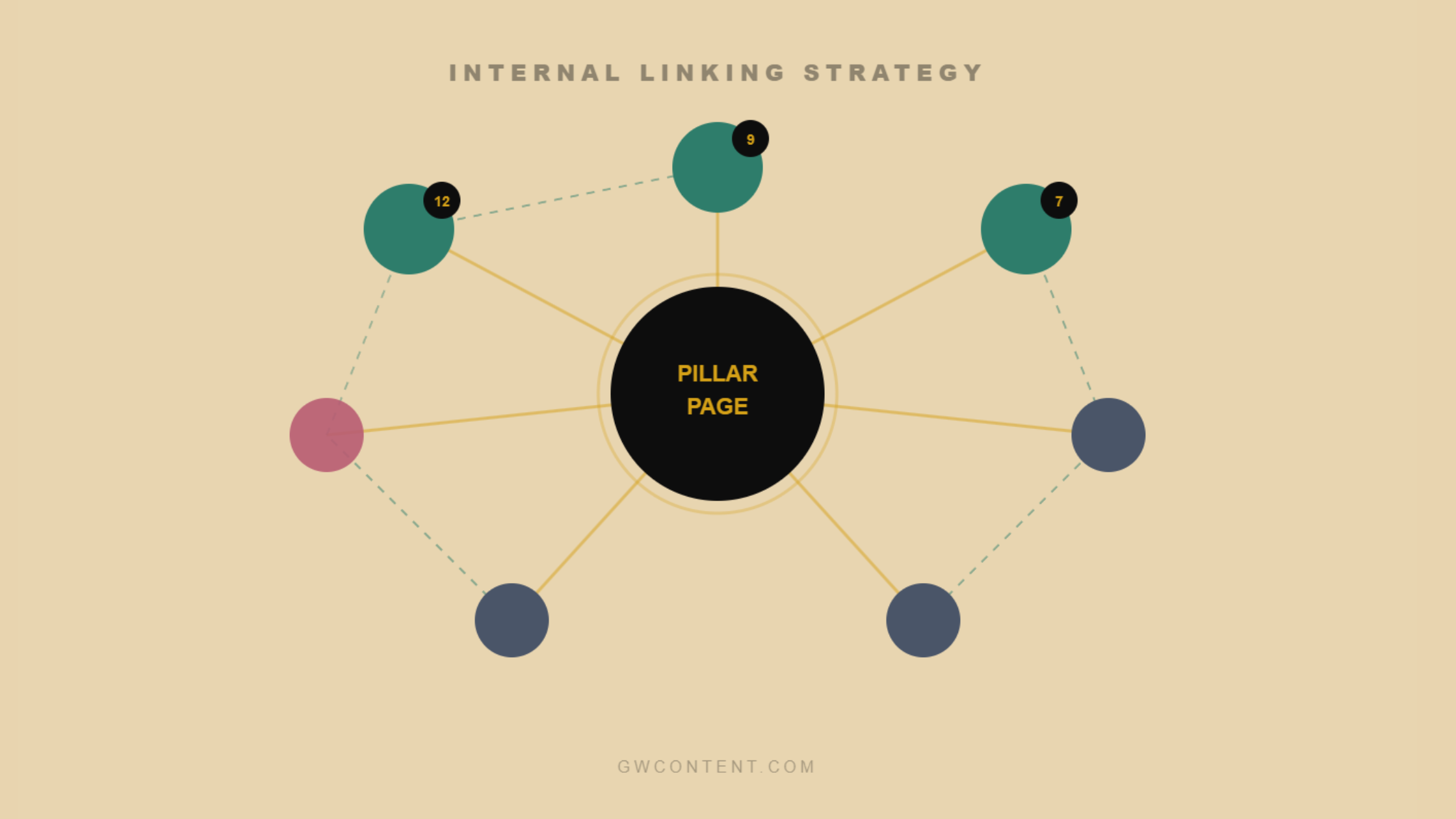
Every internal link with descriptive anchor text is a semantic signal. I treat internal linking as an explicit part of the entity architecture, not an afterthought. Descriptive, topic-focused anchor text in internal links helps search engines understand the entity relationship between the linking page and the linked page, improving semantic visibility for related queries across the entire cluster.
This is why a cluster page about "content marketing metrics" should link to the pillar page about "content marketing strategy" using anchor text like "content marketing strategy" rather than "this article." The anchor text is the machine-readable semantic signal connecting two related entities. A site where all internal link anchor text is generic ("click here", "read more", "this post") is a site where entity relationships are structurally invisible to search engines, regardless of how good the content is. The content cluster strategy guide covers this architecture in full.
Step 5: Use semantic gap analysis to identify missing entities
A semantic gap analysis compares entity coverage in existing content against entity coverage in top-ranking competitor content for the same query. Where competitors cover entities that your content omits, there is a semantic gap that is likely suppressing rankings. I run this analysis as standard during any SEO content strategy engagement before a single new piece of content is planned.
NLP tools can identify content gaps by analysing which entities and related concepts appear in top-ranking content but are absent from yours. This is more precise than asking "what keywords am I missing?" It finds the semantic meaning gaps that keyword research alone does not surface.
Semantic SEO and AI Search Visibility

In 2026, semantic SEO and answer engine optimisation are effectively the same discipline. The content structure that performs best in Google semantic search is the same structure that gets cited in ChatGPT, Perplexity, and Google AI Overviews.
AI models utilise semantic understanding to interpret entity relationships when evaluating which sources to cite. A page with comprehensive entity coverage, strong semantic structure, FAQPage schema, and clear topical authority signals is significantly more likely to be cited than a page that ranks for the same keyword through backlinks alone. AI Overviews now trigger for 18.76% of keywords in US SERPs, which means semantic structure is increasingly the determining factor in whether content appears in AI-generated answers or not.
Generative AI systems like Google's AI Overviews rely on semantic SEO principles to provide accurate, contextually relevant answers. The semantic architecture that signals topical authority to Google produces the same entity clarity that AI tools use to identify authoritative sources. There is no separate AI visibility strategy. There is semantic SEO done properly, and it works for both.
The AEO Readiness Score benchmarks a site's current AI search visibility across content, schema, and E-E-A-T signals. The E-E-A-T Score checker assesses how well a site's content demonstrates the expertise and authority that semantic SEO requires. The practical check: run target queries in ChatGPT and Perplexity. If you are not cited, the gap is almost always semantic: missing entities, thin topic coverage, or absent schema markup.
Semantic SEO in Practice
For Originality.ai, building semantic architecture into the content programme from the outset was what enabled the scale of growth. The content was not just keyword-optimised. It was structured around entity clusters, with schema markup on every page, FAQ sections designed for AI citation, and internal linking that made topical authority visible structurally to search engines. Organic traffic grew from 278,000 to 1.18 million sessions, a 324.7% increase, while referral domains grew from 1,098 to 9,942. Read the Originality.ai case study.
For Connecteam, the semantic SEO work focused on entity mapping before scaling content production, ensuring every new piece covered the full semantic field for its target topic rather than targeting isolated keywords. This contributed to 62.6% organic traffic growth and 79.4% growth in AI Overview visibility. The AI visibility growth in particular was a direct result of the semantic structure, schema implementation, and FAQ blocks built into every content piece. Read the Connecteam case study.
The pattern across every engagement: sites that treat semantic SEO as a content strategy discipline, with entity mapping before writing, structured data implemented consistently, and topic clusters built deliberately, produce compounding organic growth. Sites that treat it as "add some schema and use related keywords" see marginal improvements and plateau. The difference is semantic SEO principles applied to the full content architecture before publishing, not retrofitted afterwards.
The Bottom Line
Most sites are still optimising for keywords. The sites outranking them are optimising for meaning. That gap is where semantic SEO creates its competitive advantage, and it compounds. A site with comprehensive entity coverage, structured topic clusters, consistent schema implementation, and internal linking that reinforces semantic relationships becomes progressively harder for keyword-only competitors to displace.
The practical steps are not complicated: map entities before writing, cover the full semantic field of every topic, implement structured data across all content types, build topic clusters deliberately, use descriptive anchor text in every internal link. What requires discipline is doing all of this consistently at scale rather than adding it reactively as a technical fix after content is already published.
If you want semantic SEO built into a content strategy from the ground up rather than retrofitted, the Content Strategy service covers the full process: entity mapping, cluster architecture, schema implementation, and AI visibility measurement.
Get a free SEO audit and I will assess where your current content architecture sits on the semantic SEO spectrum and what needs to change first.
Frequently Asked Questions About Semantic SEO
What is semantic SEO?
Semantic SEO is the practice of optimising content for meaning, context, and the relationships between entities rather than for exact keyword matching. It involves covering the full semantic field of a topic: the related entities, related questions, and related concepts that signal genuine expertise, rather than repeating a target keyword throughout a web page. Search engines now use natural language processing to interpret user intent and evaluate semantic meaning, making keyword frequency a weak signal compared to semantic relevance.
What is the difference between semantic SEO and traditional SEO?
Traditional SEO focuses on keyword frequency and exact keyword matching. Semantic SEO focuses on user intent, entity relationships, and comprehensive topic coverage. Traditional keyword research finds terms to target and groups them by search volume. Semantic keyword research maps the full topic neighbourhood, including related entities, related questions, and the conceptual vocabulary that belongs to genuine expertise. In 2026, semantic SEO is not an alternative to traditional SEO. It is what effective SEO looks like.
What is semantic keyword research?
Semantic keyword research maps the full topic neighbourhood of a primary keyword: the related entities, semantic keywords, related questions, and different ways a user might express the same underlying intent.
It identifies the vocabulary that belongs to genuine expertise on a subject, which informs what web content needs to cover to signal topical authority. Finding relevant keywords for semantic SEO means identifying semantic meaning and entity relationships, not just matching keywords by search volume.
How does schema markup relate to semantic SEO?
Schema markup makes entity relationships machine-readable, telling search engines explicitly which entities a page covers and how they relate to each other. It connects content to the Google Knowledge Graph directly rather than requiring search engines to infer entity relationships from text alone. Implementing structured data and other structured data types improves eligibility for rich results, knowledge panels, and AI Overview citations, making it one of the highest-return technical implementations in a semantic SEO strategy.
How does semantic SEO affect AI search visibility?
AI tools like ChatGPT, Perplexity, and Google AI Overviews use semantic understanding to evaluate which sources to cite. Pages with comprehensive entity coverage, clear topical authority signals, FAQPage schema, and natural language structure that addresses the full semantic field of a topic are significantly more likely to be cited in AI-generated responses.
The same semantic architecture that ranks in Google increasingly determines AI search citability. In 2026, implementing semantic SEO principles is the primary mechanism for improving AI search visibility.
What are topic clusters and why do they matter for semantic SEO?
Topic clusters are a content architecture in which a pillar page covers a broad topic comprehensively and acts as the semantic hub for a set of cluster pages, each covering a related subtopic in depth. Internal links between pillar and cluster pages reinforce entity relationships structurally. Topic clusters signal semantic breadth at the pillar level and semantic depth at the cluster level, which together demonstrate the topical authority that semantic search engines reward with higher rankings and more AI citations.
How do I start implementing semantic SEO?
Start with entity mapping: identify the primary entity your content covers and map the related entities, related questions, and semantic keywords that belong to the same topic neighbourhood.
Then, audit existing content against this map to find relevant keywords and entities that are missing. Implement schema markup on all content pages. Build topic clusters around core subject areas. Use descriptive anchor text in internal links. Measure AI search visibility alongside traditional rankings to assess whether the semantic architecture is working. My SEO content strategy guide covers how to connect this semantic architecture to commercial outcomes.