SEO Content Strategy: A Framework That Drives Traffic and Revenue
Published: April 15, 2026 | Last updated: April 15, 2026 | 12 min read
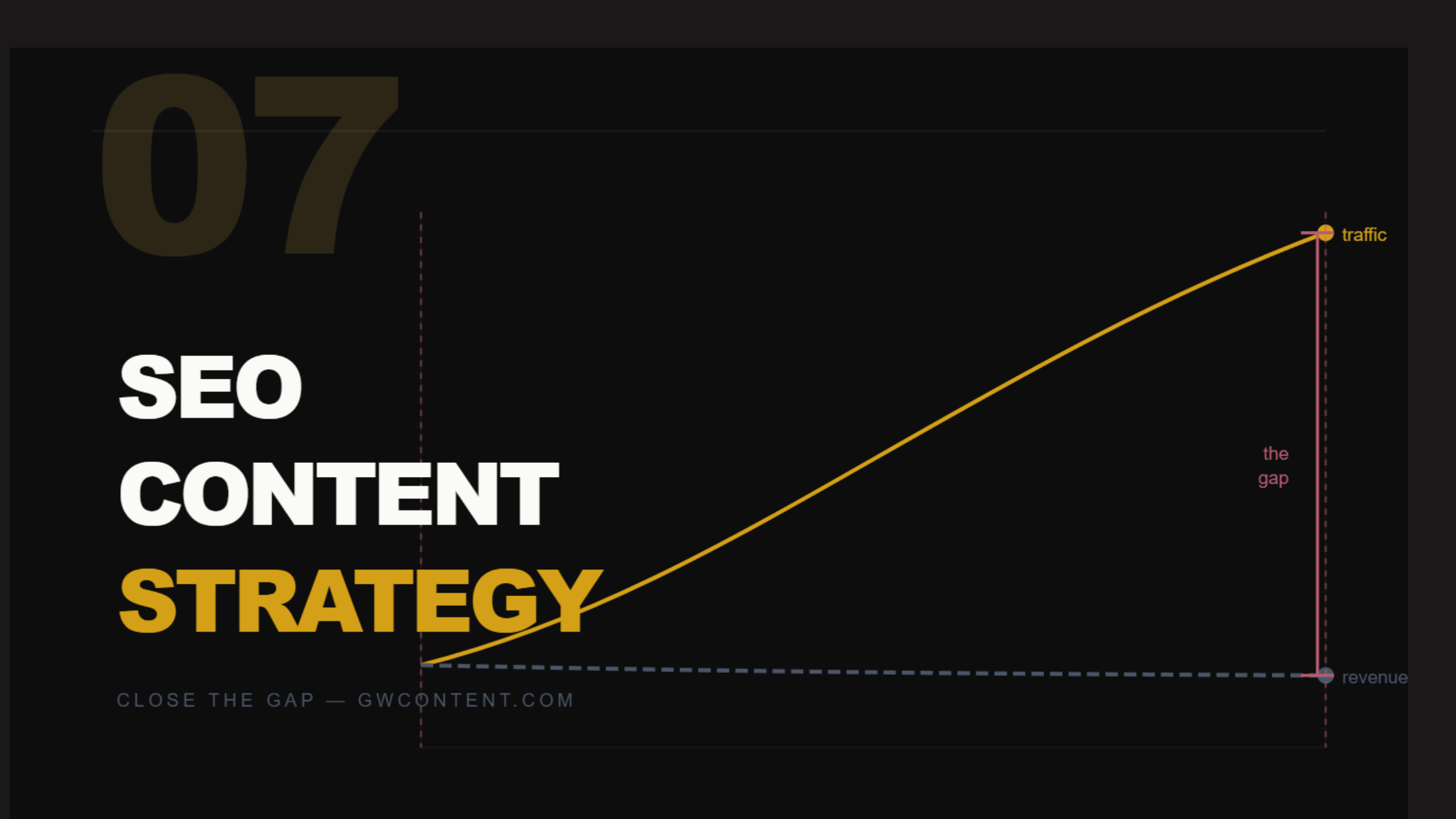
Most SEO content strategies have the same problem. The site gains organic traffic. Rankings improve. The monthly report looks good. Then someone asks what it generated for the business. The revenue number has not moved.
Traffic without commercial intent is not an SEO success. It is a visibility exercise with no return. A clear SEO content strategy is not a content calendar with keyword targets attached. It is a documented framework that connects every piece of content to a specific search intent, a specific stage of the customer journey, and a specific commercial outcome.
I have audited enough content strategies to know the two failure modes that repeat. The first is publishing without a framework and hoping something ranks. The second is building a technically correct strategy that generates traffic from the entirely wrong audience. Both look fine in a rankings report. Neither produces revenue.
This is the framework I use. Seven steps, each building on the last, none of them optional.
Author bio
Graeme Whiles is an independent SEO and AEO consultant at GWContent. He has worked with enterprise and SaaS brands, including Originality.ai, Connecteam, 6sense, and Practice Better, growing organic traffic and AI search visibility across some of the most competitive categories in B2B. He holds content bylines with Foundr Magazine and Originality.ai, and built Three Putt Golf Clothing from a blank domain as a live proof of concept for his methodology.
Short on time? Here are the key takeaways
-
An SEO content strategy connects content creation to search intent, topical authority, and commercial outcomes. Traffic that does not convert is not a success metric.
-
Start with an audit of what you already have before producing anything new. Most sites are sitting on fixable problems suppressing existing performance.
-
Keyword research is about search intent and commercial relevance first, volume second.
-
Content cluster architecture is what tells search engines a site has genuine topical authority. Individual well-written pages do not.
-
Technical SEO and content quality are not separate disciplines. Excellent content will not rank if the technical foundations prevent search engines from crawling and evaluating it.
-
In 2026, a complete SEO content strategy also accounts for AI search visibility. The same architecture that ranks in Google increasingly determines what gets cited in ChatGPT and Google AI Overviews.
What Is an SEO Content Strategy?

An SEO content strategy is a plan that guides how to create, structure, and optimise content to support search engine rankings and business outcomes simultaneously. A successful SEO content strategy aligns website content with user intent and relevant keywords to achieve visibility in organic search results and convert that visibility into commercial return.
The distinction from a general content strategy matters. An SEO content strategy is built around search demand. Every content decision is informed by keyword research, search intent analysis, and an understanding of how search engines evaluate and rank content. It is not enough to produce high quality content. That content needs to be structured, optimised, and connected in a way that search engines can interpret and reward.
The revenue connection is where most strategies fail. The most common reason an SEO content strategy does not produce commercial outcomes is that it optimises for visibility rather than for the right visibility. Ranking for terms that attract no commercial intent, or attracting organic traffic from audiences who will never buy, is a technical success with no business value. The framework below builds the commercial filter in from step one.
7 Steps to a Successful Content Strategy

Step One: Audit Before You Build
Every SEO content strategy I build starts here, not with a content calendar.
Most sites begin their SEO content strategy by producing new content and hoping something ranks. The correct sequence is to run a SEO content audit before producing anything new. What the audit consistently reveals: index bloat from low-value pages wasting crawl budget, keyword cannibalisation where multiple pages compete for the same search terms, orphaned pages invisible to search engine crawlers, and content decay on pages that once ranked and have been quietly declining.
The audit output is a prioritised action list: keep and optimise strong pages, refresh pages with good intent alignment but outdated content, consolidate cannibalised pages, remove low-value content suppressing crawl budget. This is the foundation the content strategy is built on, and almost none of the strategies I see have it.
For Connecteam, addressing these structural issues before scaling the content programme contributed to a 62.6% increase in organic traffic and 79.4% growth in AI Overview visibility. The content already on the site performed significantly better once the structural problems were removed. That is the return on audit investment: faster results from work that has already been done. Read the Connecteam case study.
Use Google Search Console to identify existing performance gaps, pages with high impressions and low click-through rates, and content decay signals before any new content is planned. The free SEO tools complement this with content health signals, including meta description performance and decay detection.
Step Two: Keyword Research and Search Intent
Keyword research for an SEO content strategy is not a list of high-volume terms to target. It is a structured understanding of what the target audience searches for, why they search for it, and where that search sits in their decision-making process.
Search intent is the critical filter. Informational intent is where the user is researching a topic. Commercial intent is where they are evaluating options. Transactional intent is where they are ready to act. An SEO content strategy needs content mapped to all of these stages, with particular emphasis on commercial and transactional intent for pages designed to drive revenue. This is the step where most strategies go wrong: they generate high rankings for informational queries and then wonder why the traffic does not convert.
The practical approach: use Ahrefs' keyword research methodology alongside Google Search Console data to identify the search terms the target audience uses at each stage. Long tail keywords typically have lower search volume but higher commercial specificity. A long tail keyword that matches the exact problem a product solves is more commercially valuable than a high search volume generic term attracting the wrong audience. I have seen brands triple their conversion rate from organic traffic simply by shifting keyword priorities from volume to intent without changing a word of their content.
Beyond keywords, a modern SEO content strategy maps the entities, named concepts, brands, tools, and people that establish topical authority. Search engines no longer rely on keyword density. They assess whether content demonstrates genuine expertise across the entire semantic field of a topic. Entity mapping at this stage makes the content architecture decisions in step three significantly more effective.
For brands with a geographic dimension, local SEO keyword research is a distinct layer. Location-qualified keywords, service area terms, and Google Business Profile signals all feed into the local dimension of the SEO content strategy and should be mapped separately from the core cluster architecture.
Step Three: Content Architecture and Topical Authority
Once the keyword research is done, the content architecture determines whether individual pieces accumulate authority or sit in isolation. A content cluster strategy is the architecture that works: a central pillar page covering the core topic comprehensively, linked to cluster pages addressing specific subtopics in depth, all connected through deliberate internal links.
Why this matters: a site with one well-optimised page on a topic demonstrates it has something to say. A site with a structured cluster covering the topic from every relevant angle demonstrates genuine expertise. Search engine algorithms reward topical authority, and topical authority is built through cluster architecture, not through individual pages competing in isolation.
The internal linking structure is what creates the cluster. Every cluster page links back to the pillar. The pillar links out to every cluster page. Related cluster pages link to each other where the connection is natural. This distributes authority across the entire cluster and makes every page stronger than it would be alone.
The content calendar for an SEO content strategy should be built around this cluster architecture, not a list of individual topics. Every piece planned needs an assigned cluster, a target keyword, a search intent stage, and a clear relationship to its pillar page before writing begins. Content produced without this structure fills the calendar without building the compounding authority the strategy needs.
Three Putt Golf Clothing reached 668,000 impressions and average position 4.5 across its content cluster in six months from a blank domain using this architecture. The cluster structure was the entire SEO strategy from day one.
Step Four: Technical SEO Foundations
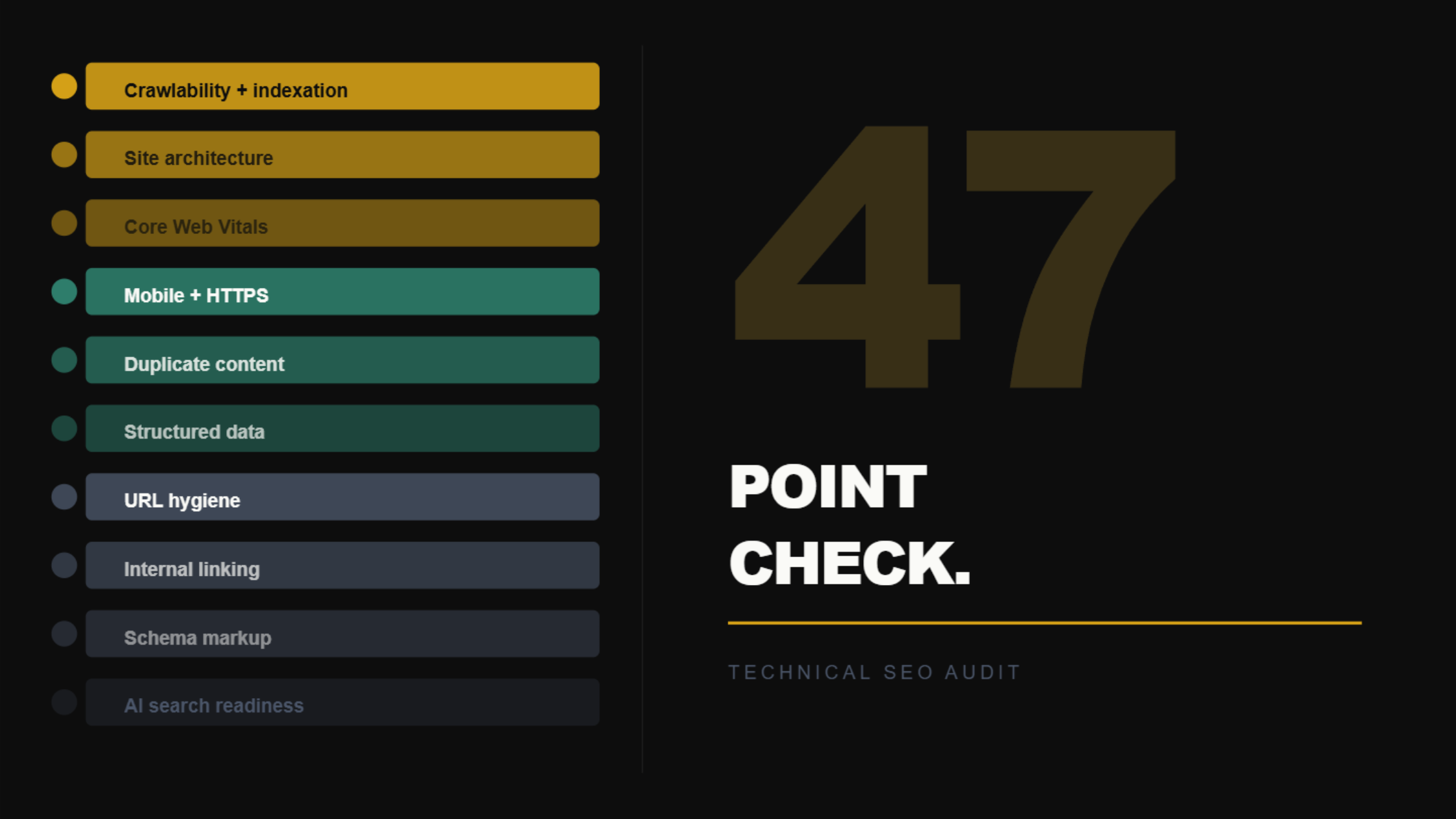
Even well-structured content with strong E-E-A-T signals will not rank if technical SEO issues prevent search engines from crawling, indexing, and evaluating it. Technical SEO is not a separate discipline from the content strategy. It is the foundation the strategy is built on.
The non-negotiables: a clean site structure that search engine crawlers can navigate efficiently, correctly implemented canonical tags preventing duplicate content issues, fast page loading times meeting Core Web Vitals standards, and mobile-first indexing readiness. Google primarily uses mobile versions of sites for indexing, which means a poor mobile experience is a rankings problem regardless of content quality.
Meta descriptions and meta titles do not directly affect search engine rankings but they directly affect click-through rate from search results. A meta description that accurately matches the search intent of the query earns clicks that a generic one does not. Every page in the SEO content strategy needs a unique, optimised meta description and meta title. The Meta Description Checker flags length, duplication, and intent-mismatch issues across the site.
Schema markup is increasingly important for both traditional search engine results and AI search visibility. Article schema, FAQPage schema, BreadcrumbList schema, and author schema all contribute to how search engines and AI tools interpret and cite content. The Free Schema Markup Generator covers the core schema types for content pages. Pages with FAQ schema are significantly more likely to appear in AI Overviews, which makes schema implementation a content strategy decision, not just a technical one.
Step Five: Creating Content That Ranks and Converts
Content creation is where most SEO guides begin. It is step five in this framework because producing content without the preceding steps is how brands end up with large blog archives and flat revenue lines.
Search intent alignment is the most important content decision on any page. The content structure and format must match what the user expects to find based on their search query. A page targeting an informational keyword that leads with a hard product pitch will bounce. A page targeting a transactional keyword that buries the conversion path behind two thousand words of context will lose the buyer. I see both patterns in almost every content audit I run.
E-E-A-T signals, Experience, Expertise, Authoritativeness, and Trustworthiness, are what separate content that ranks from content that sits. Named author credentials, first-hand experience language, real client results with specific numbers, and cited sources all contribute. In a search landscape flooded with AI-generated generic content, the content that demonstrates genuine first-hand expertise is what earns rankings and AI citations. The E-E-A-T Score Checker assesses how well a page's signals measure up against these criteria.
Blog posts remain the cornerstone of SEO content for most B2B categories. Long-form pillar pages establish topical authority. FAQ sections structured for direct answers increase the chance of appearing in AI Overviews and featured snippets. Video results are prominent in search results for how-to queries and increasingly cited in AI-generated responses alongside text content.
Every piece of content in the SEO strategy needs a clear conversion pathway. Not a generic CTA, but a specific, contextually relevant next step. A piece targeting an informational keyword should move the reader toward a consideration-stage piece or a lead magnet. A piece targeting a commercial keyword should move toward a demo, a free audit, or a direct conversion. The content creates the traffic. The pathway creates the revenue.
For Originality.ai, building content that matched search intent precisely at every stage of the customer journey drove organic traffic from 278,000 to 1.18 million sessions, a 324.7% increase, while referral domains grew from 1,098 to 9,942. Read the Originality.ai case study.
Step Six: Measuring What Actually Matters
Most SEO content strategies are measured on organic traffic and search rankings. Both are useful leading indicators. Neither is a business outcome.
The metrics that connect SEO content strategy to commercial performance: conversion rate from organic content pages to qualified leads, content-attributed pipeline in the CRM, and cost per lead from organic content versus paid channels. A page generating high organic traffic from informational queries with zero conversion events is not a commercial success regardless of where it ranks.
Google Search Console provides the search performance data. Google Analytics provides the traffic and engagement data. The CRM provides the commercial connection. Building the attribution chain from organic content touchpoint to closed deal is what makes the case for sustained SEO investment to leadership. Most SEO practitioners I speak with have the first two layers but not the third. That gap is where content programmes lose budget.
Track organic traffic by intent stage, not just as a total. Informational traffic and commercial traffic are different assets with different conversion expectations. Reporting them together obscures the performance of the pages that actually drive pipeline.
The content marketing ROI guide covers the measurement framework for connecting content performance to commercial outcomes in full. The SEO ROI Calculator is useful for modelling expected returns from an SEO content investment before making the case internally.
Step Seven: AI Search Visibility
A complete SEO content strategy in 2026 accounts for AI search visibility alongside traditional search engine rankings. This is not a separate workstream. It is an extension of the same framework.
The architecture that builds topical authority for Google increasingly determines what gets cited in ChatGPT, Perplexity, and Google AI Overviews. Comprehensive topic coverage, strong E-E-A-T signals, question-based headings, FAQ sections with direct answers, schema markup, and regularly refreshed content all improve performance in both traditional search results and AI-generated responses simultaneously.
The specific content structure that earns AI citations: lead with a direct answer to the primary question in the first paragraph rather than burying it after context. Structure each section so it can stand alone as a citable passage. Keep key answer paragraphs under sixty words. Attribute all statistics to named sources. These are not AI-specific optimisations. They are good content practice that AI tools have made newly visible as a ranking factor.
The answer engine optimisation guide covers the specific AEO framework for structuring content that gets cited by AI tools. The AEO Readiness Score benchmarks current AI search health across content, schema, and E-E-A-T signals in one assessment.
The practical check: manually test target keywords in ChatGPT and Perplexity. Are you cited? Are competitors being cited for topics your site covers? That gap is a content strategy problem. Fix the architecture, refresh the content, and add the schema. The AI visibility follows.
For brands in SaaS, the SaaS content strategy guide covers how AI visibility connects to the three-funnel commercial framework specifically.
The Framework at a Glance

The Bottom Line
The brands I see compounding their organic growth are not the ones that publish the most content. They are the ones with the clearest framework connecting every content decision to search demand, topical authority, and commercial outcomes.
Start with the audit. Build the cluster architecture. Get the technical foundations right. Produce content that matches intent and converts. Measure pipeline, not just traffic. The framework is not complicated. Executing it consistently and in the right sequence is where most SEO content strategies fall short.
Get a free SEO audit and I will tell you exactly where your SEO content strategy has gaps and what to prioritise first.
Frequently Asked Questions About SEO Content Strategy
What is an SEO content strategy?
An SEO content strategy is a plan that guides how to create, structure, and optimise content to achieve visibility in organic search results and convert that visibility into commercial outcomes. It connects keyword research, search intent analysis, content architecture, technical SEO, and performance measurement into a single coherent framework rather than treating each as a separate discipline.
How is an SEO content strategy different from a content marketing strategy?
A content marketing strategy focuses on creating valuable content for a defined audience. An SEO content strategy builds on that foundation with specific search demand: every content decision is informed by keyword research, search intent, and an understanding of how search engines evaluate and rank pages. The two should be integrated rather than run separately. The content marketing for startups guide covers how to build both from scratch simultaneously.
How do I start building an SEO content strategy?
Start with an audit of existing content before producing anything new. Most sites have fixable structural problems suppressing existing performance. Identify what you have, what is working, what is cannibalising, and what should be removed before planning a single new piece of content. Build the keyword and intent map second. Build the content calendar third.
How long does an SEO content strategy take to produce results?
For a new domain or a site with significant structural problems, three to six months of consistent execution before meaningful organic traffic growth. For a site with existing authority that has been audited and properly structured, improvements can be visible within weeks of fixing technical issues and consolidating cannibalised content. Content cluster authority compounds over six to twelve months of consistent publishing.
What is the role of technical SEO in a content strategy?
Technical SEO is the foundation. Even excellent content will not rank if search engine crawlers cannot find, access, and evaluate it properly. Site structure, canonical tags, Core Web Vitals, schema markup, and mobile-first indexing readiness all need to be in place before content creation scales. Technical issues identified in the SEO content audit should be fixed before the content calendar begins.
How does AI search affect an SEO content strategy?
The same architecture that builds topical authority for traditional search increasingly determines what gets cited in ChatGPT, Perplexity, and Google AI Overviews. Comprehensive topic coverage, strong E-E-A-T signals, direct-answer content structure, FAQ sections, and schema markup improve performance across both simultaneously. A complete search engine optimisation strategy in 2026 accounts for AI visibility as a built-in outcome rather than a separate workstream.
How do I measure the success of an SEO content strategy?
Track conversion rate from organic content to qualified leads, content-attributed pipeline in the CRM, and cost per lead from organic content versus paid channels. Organic traffic and keyword rankings are useful leading indicators, but not business outcomes. Connect the SEO data in Google Search Console and Google Analytics to your CRM to close the attribution gap between content touchpoints and commercial results throughout digital marketing efforts, including social media platforms.