Topical Authority: What It Is and How to Build It for SEO
Published: April 22, 2026 | Last updated: April 22, 2026 | 11 min read
Most sites trying to improve their search engine rankings are focused on the wrong thing.
They are chasing individual keywords, acquiring backlinks, and optimising individual pages, while competitors with lower domain authority are consistently outranking them. The difference is almost always topical authority.
Understanding topical authority means moving beyond the idea that SEO is about matching keywords. Google associates topical authority with a site's ability to answer the full range of search queries a user might have on a particular subject, not just the single keyword that brought them there.
I have been building topical authority for clients across B2B SaaS, professional services, e-commerce, and more for long enough to know the pattern. The sites that compound their organic visibility over time are not the ones with the most content or the highest domain authority. They are the ones that own a topic completely, in a way that is structurally visible to search engines and increasingly to AI tools.
This is how topical authority works, how Google measures it, and how to build it systematically.
Author bio
Graeme Whiles is an independent SEO and AEO consultant at GWContent. He has worked with enterprise and SaaS brands, including Originality.ai, Connecteam, 6sense, and Practice Better, growing organic traffic and AI search visibility across some of the most competitive categories in B2B. He holds content bylines with Foundr Magazine and Originality.ai, and built Three Putt Golf Clothing from a blank domain as a live proof of concept for his methodology.
Short on time? Here are the key takeaways
- Topical authority is how search engines assess whether a site genuinely owns a subject, not just whether individual pages match keywords.
- Sites with strong topical authority rank for more keywords, rank faster for new content, and hold rankings more defensibly than sites relying on backlinks alone.
- Building topical authority requires a content cluster architecture: a pillar page covering the core topic, supporting cluster pages addressing every related subtopic, and a deliberate internal linking structure connecting them.
- In 2026, topical authority is also the primary signal AI tools use when deciding which sources to cite. The same architecture that builds Google rankings increasingly determines AI search visibility.
- It takes time. Three to six months of consistent, structured content production before search engine rankings materially move. The moat it builds is worth it.
What Is Topical Authority?
Topical authority is a strategic SEO concept where a website is recognised by search engines as a trusted expert on a particular subject. Rather than evaluating whether a single page matches a search query, Google assesses whether the entire site demonstrates comprehensive, consistent expertise across that topic and its related subtopics.
The concept of topical authority matters because of how Google evaluates content. Google rewards sites that demonstrate genuine depth on a subject. Low-quality sites that publish thin, disconnected content on unrelated topics signal the opposite of topical expertise. Google associates comprehensive, well-structured coverage with trustworthiness in a way that just individual keywords and just links alone never could.
Topical authority is closely aligned with Google's E-E-A-T framework, Experience, Expertise, Authoritativeness, and Trustworthiness. Strong topical authority is one of the clearest ways a site signals E-E-A-T at a structural level, not just through individual content quality signals.
The practical consequence is significant: sites with high topical authority rank higher for target keywords, rank faster when they publish new content within their established topic area, and hold those rankings more defensibly than sites that have achieved rankings through backlinks alone. A well-established topic cluster is harder for competitors to displace than any individual keyword ranking.
Topical Authority vs Domain Authority

Domain authority measures the strength of a website's backlink profile. Topical authority measures the depth and comprehensiveness of a site's coverage on a specific subject. Both matter for SEO performance, but they are different signals that respond to different activities.
Website authority in the traditional sense, measured through domain authority scores and inbound links from other sites, remains a relevant signal. But high-quality links earned naturally through authoritative content produce better long-term results than links acquired in isolation. The distinction matters for SEO strategy: brand authority built through genuine topical depth earns the kind of relevant links that compound over time, rather than requiring ongoing acquisition effort.
The distinction matters most for sites that do not yet have high domain authority. Sites with strong topical coverage consistently outrank higher-authority competitors that lack topic depth. I have seen this across multiple client engagements: a site with a structured content cluster outranking competitors with significantly more backlinks, because the topical authority signal is stronger than the link authority signal for the specific queries in question.
This does not mean external links are irrelevant. High quality links from authoritative sources remain an important signal, and natural link building occurs when authoritative, comprehensive content earns links from other reputable sites. But in the current search landscape, topical authority built through content cluster strategy consistently produces ranking results that link acquisition alone cannot replicate.
The practical implication: building topical authority is largely within your control. It requires content strategy and consistent execution, not outreach campaigns or budget for paid link placement. That makes it the most accessible path to sustained organic visibility for most sites, and one I build into every content strategy engagement.
How Google Measures Topical Authority
Google does not publish a topical authority score. What it does is assess a site's content across several dimensions that, in combination, signal genuine expertise on a subject.
Content coverage depth
Does the site address the full range of topics and subtopics a user might search for within the subject area? A site covering a particular topic that also addresses related entities, semantic search patterns, and the search queries users actually run signals more comprehensive expertise than one targeting individual keywords in isolation. Semantic SEO, the practice of mapping content to the full semantic field of a subject rather than to single keywords, is what separates content that builds topical authority from content that merely ranks for matching keywords.
Semantic relationships between pages
Google's understanding of content has moved far beyond keyword density to entity and semantic analysis. Google search crawlers assess whether a site's content covers related entities, named concepts, and the seed keyword's full topic neighbourhood. Topic-based keyword research that maps these relationships before content is produced makes the architecture decisions in the build process significantly more targeted. The goal is to become the go-to resource for a particular subject area, not just to rank for individual search terms.
Internal linking structure
The internal linking between pages signals the relationships between topics and the relative importance of different pages. A deliberate internal linking strategy, including using descriptive anchor text and ensuring relevant links connect related cluster pages to each other, creates both the user navigation pathway and the authority distribution signal that makes topical authority visible in a site's architecture to both users and search engines.
Freshness and consistency
Search engines tend to crawl and index new pages more quickly for sites established as experts in a niche. Regularly refreshing existing content and consistently publishing within the established topic area both contribute to the topical authority signal over time.
E-E-A-T signals
Named authors with credentials, first-hand experience, language, cited sources, and real evidence of expertise all contribute to how Google assesses the trustworthiness of the content. A technical SEO audit checklist that demonstrates direct practitioner experience signals more genuine expertise than one assembled from secondary sources.
How to Build Topical Authority Systematically

Step 1: Choose a specific topic area and own it completely
The most common mistake in topical authority work is choosing a topic area that is too broad to own meaningfully. "Marketing" is not a topic area. "B2B content marketing strategy for growth-stage SaaS companies" is. The more specific the topic area, the faster the authority builds, and the more defensible the resulting cluster becomes.
Effective topical authority work starts with topic-based keyword research that goes beyond individual target keywords to map the full semantic field. What search queries does your target audience run within this subject area? What are the related entities and concept clusters a genuine expert would naturally address? What gaps exist in your existing content against that full map? This is the keyword strategy phase that drives everything that follows, and it is where most content strategies produce a list of individual keywords rather than a coherent topic architecture.
Use SEO tools such as Google Search Console, Ahrefs, or Semrush to pull SEO data on search volume and difficulty for the full topic cluster. Google Analytics provides the behavioural data on how existing website content is performing and which search queries are already driving organic search traffic to your own site. These two data sources together are the foundation for any serious topical authority work.
Step 2: Build the pillar page
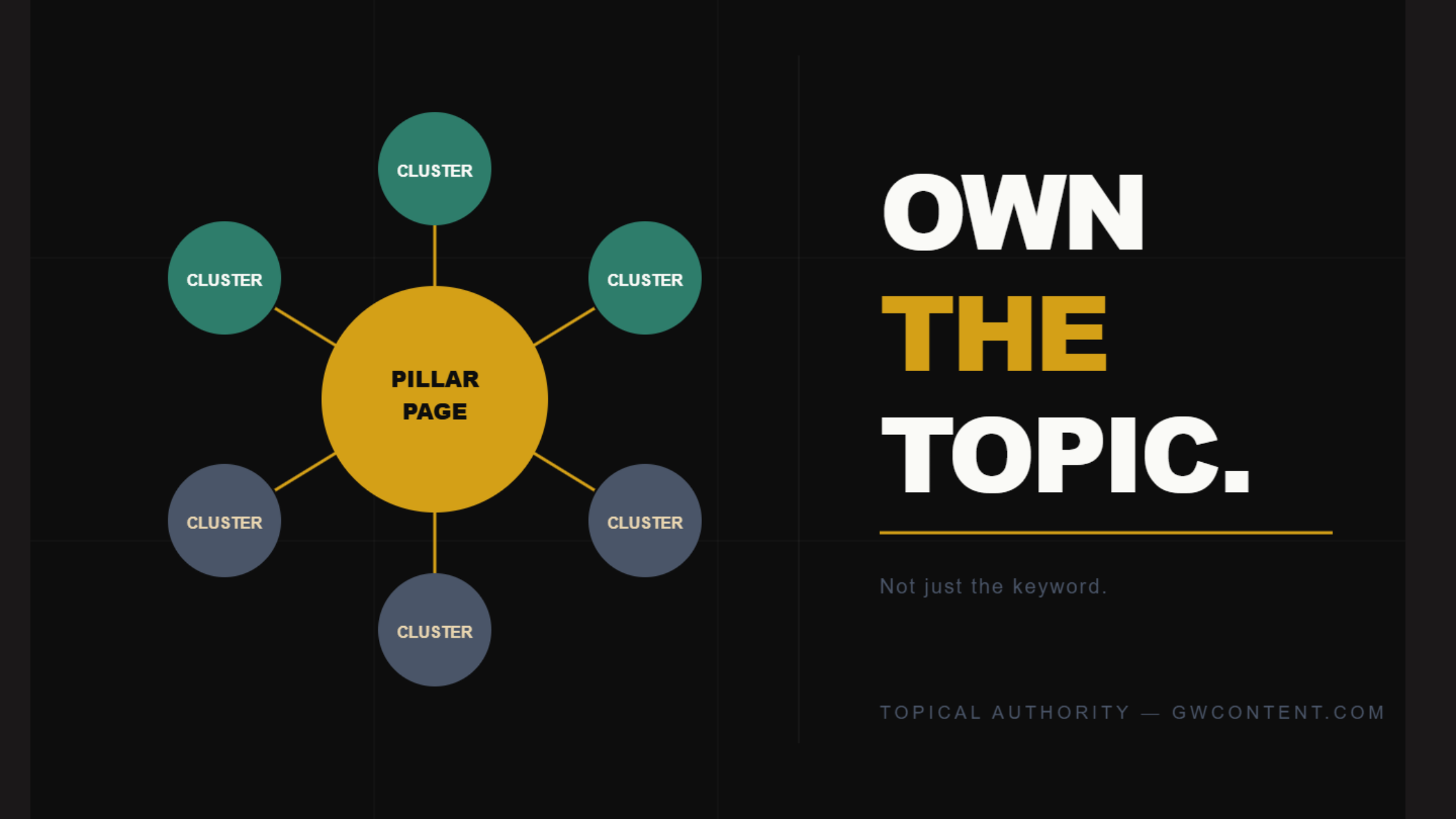
A pillar page is a comprehensive, standalone page covering the core topic in depth. It is the hub of the content cluster: the page that covers every major aspect of the subject, links out to all cluster pages, and earns the most internal links from the supporting pages.
Achieve topical authority on the core subject by treating the pillar page as the definitive resource: the page a user should not need to leave to understand the central topic. Every SEO effort on the pillar should serve that goal. Strong pillar pages consistently outperform individual keyword-optimised landing pages for broad, high-competition terms because they signal topical depth rather than single-page optimisation.
Effective pillar pages include a hyperlinked table of contents, clear heading hierarchy, FAQ schema, and strong E-E-A-T signals, including named author credentials. They should open with a direct, snippet-ready answer to the primary query, then expand into comprehensive coverage with internal links to every cluster page.
For Originality.ai, building a structured pillar and cluster architecture around the AI detection category was central to the content strategy that drove organic traffic from 278,000 to 1.18 million sessions, a 324.7% increase, while referral domains grew from 1,098 to 9,942. The pillar page anchored the cluster and accumulated authority that flowed to every supporting page through the internal linking structure. Read the Originality.ai case study.
Step 3: Build supporting cluster pages systematically
Cluster pages are focused articles addressing specific subtopics, related questions, and long-tail keyword opportunities within the core topic area. Supporting pages in a well-structured cluster serve two jobs: they address specific search intent for subtopic queries, and they transfer authority back to the pillar through internal links. Every supporting page is a separate entry point to the cluster from Google search, which means each one extends the site's organic visibility across a wider range of relevant keywords while simultaneously reinforcing the pillar's authority.
The systematic approach matters here. Building a small number of high-quality cluster pages produces more topical authority signal than producing a large volume of thin pages. Google rewards sites that show depth on a subject. Five excellent, thoroughly researched cluster pages on related subtopics signal more expertise than twenty shallow articles covering the same territory.
Every piece of website content produced for the cluster should target a specific subtopic and be clearly distinguished from every other cluster page. Avoid creating multiple pages that address the same search intent from different angles: this produces keyword cannibalisation rather than topical depth, and it directly undermines the authority signal the cluster is designed to produce.
Three Putt Golf Clothing reached 668,000 impressions and an average position of 4.5 across its entire content cluster in six months from a blank domain. That performance came from a focused cluster architecture built around golf clothing and golf fashion content, where every page reinforced the topical signals of every other page.
Step 4: Build the internal linking structure deliberately
Internal linking strategies are the mechanism that creates the cluster in a form that search engines can interpret. Without deliberate, consistent internal links connecting cluster pages to the pillar and back, the topical authority architecture exists conceptually but not structurally. Relevant links between related pages, using descriptive anchor text that reflects the destination page's topic, create both the user navigation pathway and the authority distribution signal.
Every cluster page must link back to the pillar page. The pillar must link out to every cluster page. Related cluster pages should link to each other where the connection is genuinely useful to the reader. The content cluster strategy guide covers this architecture in detail.
The internal linking structure is also what allows topical authority to compound: when a cluster page earns an external backlink, some of that authority distributes across the cluster through internal links. Each new cluster page strengthens the pillar. Each improvement to the pillar strengthens every cluster page.
Step 5: Audit before building new content
Before scaling new cluster content, audit what already exists. Most sites have content that could form the basis of a cluster, but lack the internal linking structure and pillar architecture that would make it work. A SEO content audit identifies pages that can be retrofitted into the cluster architecture, pages that are cannibalising each other for the same keywords, and genuine content gaps where important subtopics are not yet covered.
Building cluster architecture on top of a site with existing structural problems produces worse results than fixing the foundation first. Keyword cannibalisation, duplicate content, and broken internal links all undermine the topical authority signal that the cluster is designed to create.
Step 6: Maintain and expand over time
A content cluster is not a one-time build. Search trends shift, new subtopics emerge, and existing content decays as information becomes outdated. Regularly refreshing existing cluster content, adding new cluster pages to address emerging subtopics, and monitoring performance through Google Search Console and Google Analytics are what keep the topical authority signal strong over time.
Brand authority in a desired niche compounds over time with consistent maintenance. A site that publishes in a focused topic area regularly, refreshes existing content, and fills content gaps as new subtopics emerge creates an increasingly defensible SEO position that competitors must invest significantly to challenge.
The competitive advantage of strong topical authority is exactly this: a well-established topic cluster is harder for competitors to displace than any individual keyword ranking. That defensibility is what makes the investment worthwhile.
Topical Authority and AI Search Visibility
In 2026, topical authority is not just a Google ranking signal. It is the primary signal AI tools use when deciding which sources to cite in response to user queries.
When ChatGPT, Perplexity, or Google AI Overviews generate a response, they are not matching keywords. They are assessing whether a source has proven, consistent, comprehensive coverage of the subject they are being asked about. Google's AI Overviews, ChatGPT, and Perplexity all assess authoritative sources using signals that map closely to topical authority. Sites that create content demonstrating consistent expertise across an entire subject area are significantly more likely to be cited as trusted sources in AI-generated responses than sites relying on individual keyword rankings and just links alone. This is why topical authority work is increasingly the same activity as AI visibility work.
The same content architecture that signals topical authority to Google signals credibility to AI tools. A structured content cluster with comprehensive topic coverage, strong E-E-A-T signals, regular freshness updates, and schema markup performs significantly better in AI-generated responses than isolated, unconnected pages.
The practical check: run target queries in ChatGPT and Perplexity. Are you being cited for the topics you should own? Are competitors being cited instead? That gap is a topical authority problem, and it responds to the same fix. Build the cluster architecture, deepen the content, and add the schema. The AI visibility follows.
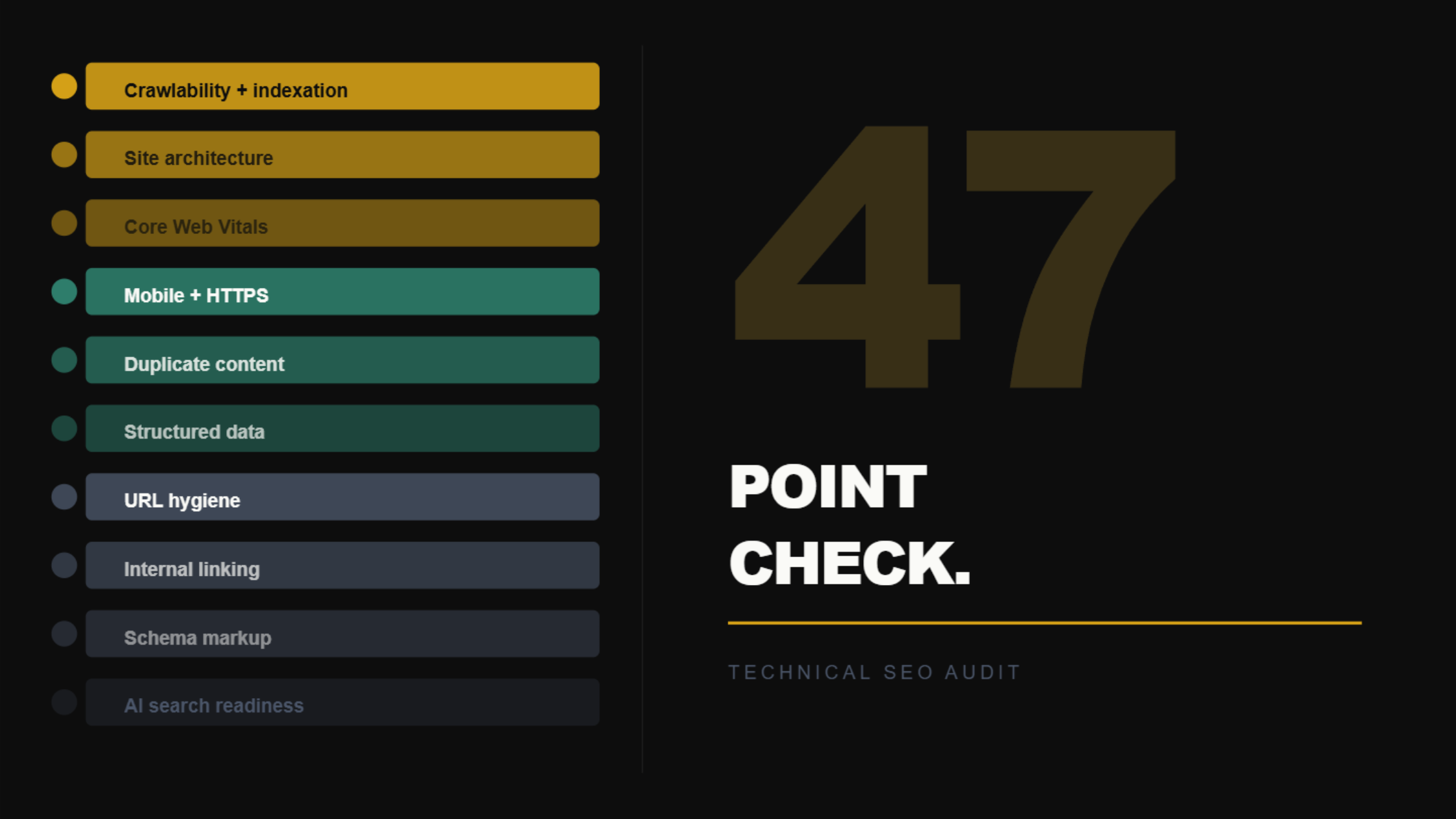
The answer engine optimisation guide covers the specific structural optimisations that improve AI citation rates alongside the cluster architecture. For the technical layer specifically, the technical SEO audit includes AI crawler accessibility as part of the full audit process.
How Long Does Building Topical Authority Take?

This is the question most guides avoid answering directly. The honest answer: three to six months of consistent, structured content production before search engine rankings materially move. Faster on new topics with lower competition. Slower on established, competitive topics where authority has already accumulated on competitor sites.
Gain topical authority faster on focused, specific topic areas with lower competition. Understand topical authority in your category by auditing what competitors are already covering: the gaps in their topic architecture are often the fastest path to establishing your own cluster with less direct competition. SEO projects that start with this competitive gap analysis before producing content consistently outperform those that begin with a keyword list and a content calendar.
The more specific the topic area, the faster the authority builds. Owning a specific niche completely produces ranking results faster than spreading thin across a broad category. The quality of the cluster architecture matters more than the volume of content produced. Five excellent, interconnected cluster pages on a focused topic produce faster results than twenty shallow articles.
According to research from the Content Marketing Institute, high-performing B2B content teams are significantly more likely to document their content strategy and align it directly to business goals. That documented strategy is what ensures every cluster page is built with a clear commercial purpose rather than simply filling an editorial calendar.
The reason the investment is worth it: the resulting topical authority is significantly more defensible than individual keyword rankings achieved through link acquisition. A competitor can match a single optimised page. They cannot quickly replicate a deep, well-structured, consistently maintained content cluster.
The Bottom Line
Topical authority is the most defensible competitive advantage available in organic search. Individual keyword rankings can be matched by a competitor with a better-optimised page. A deep, well-structured, consistently maintained content cluster built around genuine expertise is significantly harder to displace.
The architecture is not complicated: choose a specific topic area, build the pillar page, produce supporting cluster pages systematically, link everything deliberately, and maintain it over time. The results compound in exactly the way the architecture is designed to produce.
If you want to build topical authority as a structured content strategy engagement rather than working through it alone, the Content Strategy service covers the full process: topic selection, cluster mapping, content production, and ongoing maintenance.
Get a free SEO audit, and I will tell you exactly where your topical authority gaps are and what to build first.
Frequently Asked Questions About Topical Authority
What is topical authority in SEO?
Topical authority is the degree to which search engines recognise a website as a trusted, comprehensive expert on a specific subject. It is built through a structured network of interconnected content that demonstrates genuine depth across an entire topic area, rather than through individual keyword-optimised pages. Google rewards sites with strong topical authority with higher rankings, faster indexation of new content, and more stable long-term search visibility.
How is topical authority different from domain authority?
Domain authority measures the strength of a website's backlink profile. Topical authority measures the depth and comprehensiveness of a site's coverage on a specific subject. Both contribute to search engine rankings, but they respond to different activities. Topical authority is built through content strategy and cluster architecture. Domain authority is built through link acquisition. Sites with strong topical coverage consistently outrank higher-authority competitors that lack topic depth.
How do you build topical authority?
Build a content cluster: a central pillar page covering the core topic comprehensively, linked to cluster pages addressing every related subtopic, all connected through deliberate internal links. Run a content audit before building anything new to identify structural issues. Choose a specific topic area and own it completely rather than spreading thin across a broad category. Maintain the cluster with regular content refreshes and new cluster pages as new subtopics emerge.
How long does it take to build topical authority?
Three to six months of consistent, structured content production before rankings materially move, as a general benchmark. The timeline varies with topic competitiveness and existing domain authority. Specific, focused topic areas with lower competition respond faster. The topical authority that results is more defensible than individual keyword rankings and compounds over time with continued investment.
Does topical authority affect AI search visibility?
Yes, significantly. AI tools like ChatGPT, Perplexity, and Google AI Overviews assess comprehensive topic coverage when deciding which sources to cite. A site with a structured content cluster demonstrating consistent, deep expertise on a subject is significantly more likely to be cited in AI-generated responses than a site with isolated, unconnected pages. The same content architecture that builds Google topical authority builds AI search visibility simultaneously.
How do I measure topical authority?
Track keyword rankings across the full topic cluster, not just primary keywords. Organic visibility growth across related terms is the clearest signal that topical authority is building. Monitor Google Search Console for impressions and click growth across the topic area. Track referral domains to the cluster, as natural link building follows genuine topical authority. Monitor AI search visibility by manually testing target queries in ChatGPT and Perplexity and noting whether the site is cited.
Can a new site build topical authority?
Yes. Three Putt Golf Clothing reached 668,000 impressions and average position 4.5 in six months from a blank domain using a focused content cluster strategy. The cluster structure was the entire SEO strategy from day one. New sites cannot compete for broad, high-competition terms immediately, but they can own specific, focused topic areas faster than established sites expect, particularly when the cluster architecture is built correctly from the outset.