How to Write a Content Brief That Gets Results (Template Included)
Most content that underperforms was not let down by the writer. It was let down by the brief. Or more accurately, by the absence of one.
I produce content briefs for every piece of content I commission or write as part of a client engagement. Not because it is a process for its own sake, but because a well-crafted brief is the single most reliable way to reduce revisions, align the writer with the content strategy, and produce content that actually does what it is supposed to do.
The most common pattern I find when I start working with a new client: the team is producing content without briefs, attributing underperformance to writer quality, and missing the fact that the brief is the problem.
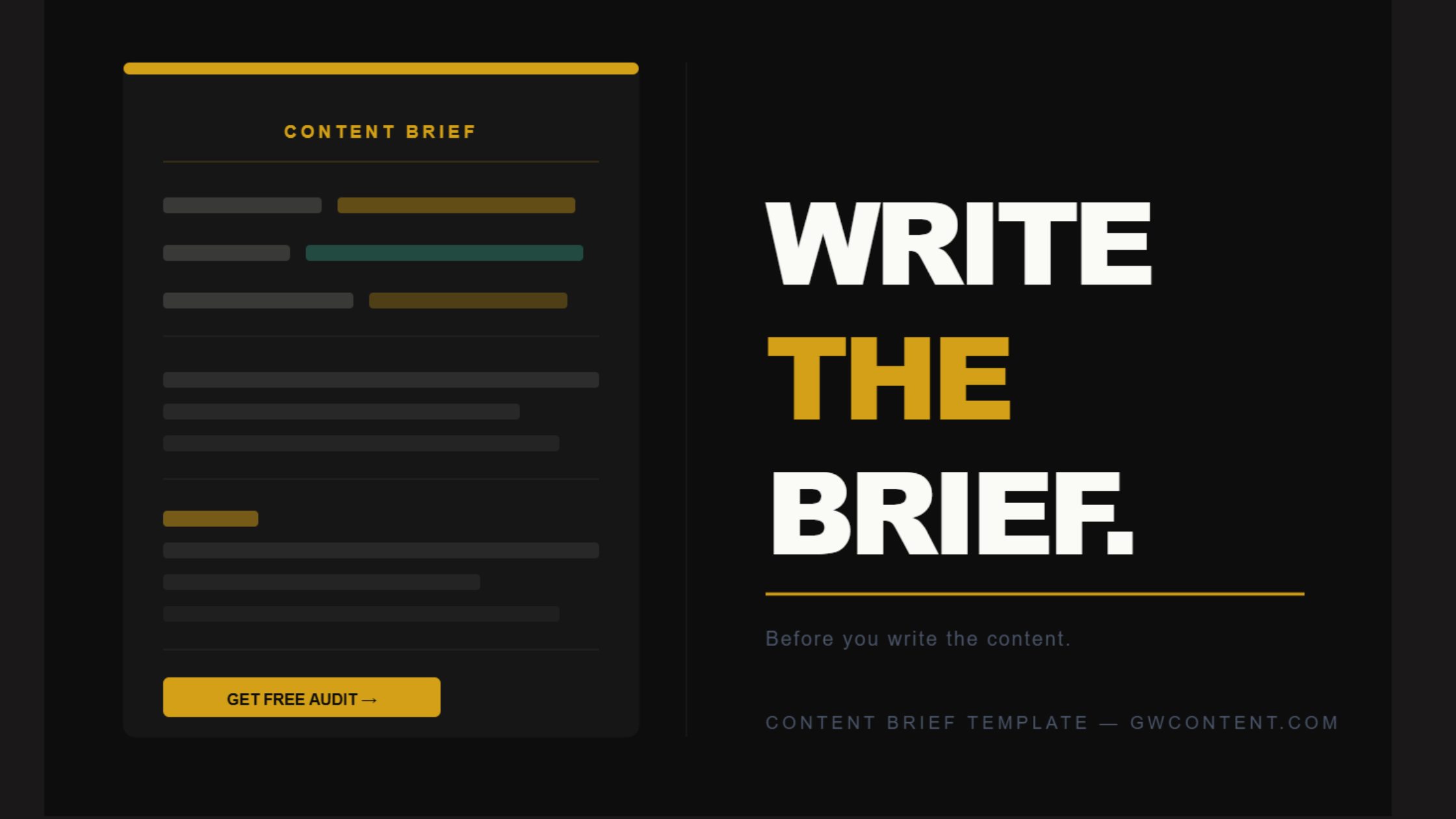
Below I cover what makes an effective content brief, and provide four ready-to-use templates you can copy directly into Word or Google Docs.
Author bio
Short on time? Here are the key takeaways
- A content brief is a short document that gives writers the strategic, SEO, and commercial context they need before writing begins. Without one, content is written blind.
- A good brief reduces revisions, aligns the writer with the content strategy, and ensures the finished piece serves its intended purpose.
- The essential elements: target audience, search intent, primary and secondary keywords, proposed structure, internal links, meta descriptions, target word count, tone, and the commercial CTA.
- A content brief is not a script. It provides context and goals, not prescriptive sentences. Trust the writer to fill the structure.
- According to Search Engine Land, the most important components of a content brief are SEO-related, specifically the primary keyword, related keywords, outline, and internal and external links. Everything else builds on that foundation.
What Is a Content Brief?
A content brief is a document that outlines the purpose, target audience, structure, SEO requirements, and commercial goals for a piece of content before the content creation process begins. It is a short document, typically one to two pages, that gives the writer, editor, and content manager a clear shared understanding of what the piece needs to achieve and how success will be measured.
A well-crafted content brief does three jobs simultaneously. It aligns the writer with the content strategy so the finished piece serves the intended commercial and SEO purpose. It reduces revision cycles by answering the questions a writer would otherwise ask mid-draft, which saves time for everyone involved in the content production process. And it creates a clear description of success criteria so the review process has an objective standard rather than a subjective one.
The most common failure mode I see in content production is content marketers and content managers treating briefs as optional overhead. The result is writers making their own assumptions about audience, angle, keyword usage, and tone. Some of those assumptions are right. Enough of them are wrong that the revision process becomes longer, more expensive, and more frustrating than the brief would have been. A Semrush study found that 77% of companies with a documented content strategy outperform those without one. The brief is where that documentation gets translated into individual content pieces.
Content Brief vs Creative Brief

These two terms are used interchangeably in many marketing teams, but they serve different purposes and should be treated as distinct tools.
A well-crafted creative brief is typically one or two pages long and serves as a roadmap for a creative project: an advertising campaign, a brand redesign, a video series. It covers the project's objectives and vision, the target audience, key messages, the creative team involved, creative assets required, and the deliverables expected from multiple contributors, including a creative director, designer, and copywriter.
A creative brief template is designed to get everyone working on a campaign onto the same page before a creative project begins.
A content brief is narrower. It covers a single piece of content: a blog post, guide, landing page, or case study. No project aims or outside noise. It is designed to give one writer everything they need to produce that specific piece.
Where a creative brief provides strategic direction for an advertising campaign or broader creative project, a content brief provides operational instructions for a single piece of content. Both matter. They are different tools for different jobs.
The distinction also matters for team member accountability. A creative brief involves multiple contributors and requires sign-off from multiple stakeholders. A content brief is typically created by the content manager or SEO strategist and handed directly to the writer. Conflating the two adds unnecessary complexity to both the content creation process and the creative project process.
Why Content Briefs Produce Better Results
A clear upfront direction from a content brief reduces the back-and-forth between content planners and freelance writers or in-house writers that silently inflates the cost of every piece of content a team produces. When a writer receives a brief with clear instructions and essential information, they spend their time writing. When they receive a vague project description and a due date, they spend time researching what the piece should do, making assumptions, and producing a draft that needs significant revision.
The commercial consequence is direct. Content produced without a brief is more likely to miss its keyword target, fail to match search intent, omit internal links, produce the wrong word count, and arrive without the structural elements that improve AI citability and featured snippet eligibility. A brief prevents all of these problems before they exist.
I see the same pattern repeatedly when onboarding new clients: brief-free content programmes produce inconsistent quality, high revision rates, and content that generates traffic without achieving business goals. Introducing a standardised brief template immediately reduces revision cycles, brings freelance writers and in-house team members into alignment, and makes the content creation process repeatable at scale.
For Connecteam, systematic content briefing was part of the programme that contributed to a 62.6% increase in organic traffic and 79.4% growth in AI Overview visibility. Every piece produced had a brief that specified the primary keyword, search intent, cluster architecture position, required internal links, and target word count. The brief made consistent quality possible at scale. Read the Connecteam case study.
The Key Elements of an Effective Content Brief

Not every brief needs to be the same length. A brief for a 500-word product page is different from a brief for a 3,000-word pillar guide. But certain key elements belong in every brief regardless of content type, because they are the information a writer always needs to do the job correctly. These are also the elements I find most consistently missing when I audit a team's existing briefs.
Target audience
Not a demographic profile assembled from secondary research. Specific enough to inform tone, vocabulary, and assumed knowledge. "Growth-stage SaaS marketing managers who understand SEO basics but have not yet built a systematic content programme" is a useful audience description. "Marketing professionals aged 25 to 45" is not. The more specific the audience definition, the more likely the writer is to produce content that resonates rather than content that could apply to anyone.
Search intent
What is the user expecting to find when they search the target keyword? Informational, commercial, transactional, or navigational? The content structure, opening paragraph, and primary CTA should all be determined by search intent. This is the most important element in the brief and the most commonly omitted. In my experience, intent mismatch is the primary reason technically competent content fails to rank.
Primary keyword and secondary keywords
The main target keyword the piece is optimised for, plus secondary keywords and related terms that should appear naturally throughout. Include guidance that keywords should be integrated naturally, not forced. The goal is semantic relevance, not keyword density. Include the primary keyword in the H1, the opening paragraph, at least one H2, and the meta description. Secondary keywords should appear where they fit naturally.
Proposed structure
The H1, proposed H2s, and where relevant H3s. This is the content outline: the framework the writer uses to ensure the piece covers the topic comprehensively and in the right order. A well-structured outline signals to search engines how the content is organised and makes it easier for both users and search engines to navigate the piece. This is not a script. It is a scaffold. The writer fills it. The most useful thing I can include in a brief structure is a one-sentence description of what each H2 section should achieve, not what it should say.
Internal links
Which pages on the site should the piece link to, and at which natural points? Internal linking is a core component of content cluster strategy and should be specified in the brief rather than left to the writer to decide. Specify the destination URL and the anchor text context. Internal links placed by a writer who does not know the full content architecture are often placed incorrectly or omitted entirely.
Meta descriptions
The meta description should reflect the search intent of the target keyword within 140 to 160 characters and include the primary keyword naturally. Whether the writer or content manager produces it, the brief should include the requirements and a suggested draft. Meta descriptions directly affect click-through rate from search results, which makes them too commercially important to leave as an afterthought.
Target word count
A range based on the word counts of top-ranking competitor content for the target keyword. Include a note that quality and search intent alignment matter more than hitting an exact number. The Content Marketing Institute's B2B research consistently shows that a documented content strategy produces better results than an undocumented one. Word count targets are part of that documentation.
Tone and brand guidelines
Especially important when briefing freelance writers or a new team member who has not yet internalised the brand voice. Include a one-paragraph description and one or two examples of published content that represent the target tone. For GWContent pieces: first person, UK English, no em dashes, direct and authoritative, concise paragraphs of two to three sentences, no corporate language.
Commercial CTA
What action should the reader take after reading the piece? Which page should the CTA link to? This aligns the writer with the commercial purpose of the content and ensures the closing section is not an afterthought. Content without a clear CTA is a visibility asset without a conversion mechanism.
Due date
Clear and specific. Include any interim milestones for longer pieces, such as outline approval before full draft production. A due date without interim milestones for complex content projects often produces a late, under-developed draft rather than a well-structured piece that has been refined.
What to Leave Out of a Content Brief
A brief that is too prescriptive is as damaging as one that is too vague. High-performing content briefs provide context and goals rather than prescriptive sentences. A brief that specifies every paragraph undermines the writer's ability to produce natural, engaging content and makes the brief itself longer and harder to use as a reference during editing content.
Leave out: specific sentences the writer must use verbatim, rigid requirements that ignore search intent in favour of internal preferences, keyword density targets rather than natural integration guidance, and anything that turns the brief into a script rather than a framework.
The brief should make the writer's job easier and their content ideas better informed. It should not replace their judgment or produce the same content that any AI assistant would generate from a basic prompt.
Free Content Brief Templates
Ready-to-use templates
Four templates covering the most common content types. Click any template to expand it, review the fields, then copy the content into Word or Google Docs.
How to Use a Brief in Practice

A brief is only useful if the writer reads it and uses it as an active reference throughout the writing and editing process. Share the brief before any research begins, not after an outline has already been drafted. Revisit it at the outline stage, the first draft stage, and during the review stage.
Using the brief as a checklist during the review process ensures that all key questions are answered, target keywords are included naturally, internal links are placed correctly, and the CTA is present and correctly linked. A piece that passes the brief checklist is ready to publish. A piece that does not has identifiable, actionable gaps.
The brief also makes Google Docs or Google Drive collaboration significantly more effective. When the brief is a shared document, the content manager can leave inline comments at specific sections, the writer can flag questions directly in the brief, and the editor can check the final piece against the brief requirements without a separate communication thread. This is how brief templates save time across the entire content production workflow.
For client content production specifically, the brief is the document that aligns the client, the content manager, and the writer on the scope of the piece before production begins. It prevents scope creep, reduces revision cycles, and creates a clear record of what was agreed. It also makes the content manager's job easier: a brief that has been approved by the client before writing begins eliminates the situation where a finished draft is rejected because the strategy changed between commission and delivery.
For Originality.ai, systematic briefing across the content programme was part of the infrastructure that made scaling to 1.18 million organic sessions sustainable rather than fragile. When every piece is produced from a documented brief, quality is repeatable regardless of who writes it. Read the Originality.ai case study.
Content Briefs Within a Broader Content Strategy
A content brief is an operational tool, not a strategic one. It tells a writer how to produce a specific piece. It does not decide which piece should be produced, where it fits in the cluster architecture, which keyword it should target, or how it connects to business goals and company objectives.
Those decisions belong to the SEO content strategy and content cluster strategy that sit above the brief. A brief produced without a clear content strategy to inform it is a brief for a piece of content that may or may not need to exist. A brief produced as part of a documented strategy is a precise instruction for a piece with a defined place in the architecture and a specific commercial purpose.
The SEO content audit identifies which pieces need to be created, refreshed, or consolidated before new briefs are written. The topical authority framework determines the cluster structure each brief should serve. For SaaS companies, the SaaS content strategy guide covers how briefs map to the acquisition, conversion, and expansion funnels.
The Bottom Line
Most content that underperforms was not let down by the writer. It was let down by the brief. A clear, well-structured brief is the lowest-cost investment available in any content programme, and it produces returns across every piece it informs: fewer revisions, better keyword alignment, stronger internal linking, and content that serves its commercial purpose from the first draft.
The best content brief templates share the same foundation: a clear project description, a specific target audience, documented search intent, a structured content outline, and a commercial CTA that connects the piece to the pipeline. Everything else builds on that foundation.
If you want the brief, the strategy, and the execution managed as a single content programme rather than assembling the pieces yourself, the Content Strategy service covers the full process.
Want to know where your current content production process has gaps?
Get a free SEO auditFrequently Asked Questions About Content Briefs
What is a content brief?
A content brief is a short document that gives a writer the strategic, SEO, and commercial context they need before the content creation process begins. It covers the target audience, search intent, primary and secondary keywords, content structure, internal links, meta descriptions, target word count, tone, and the commercial CTA. A well-crafted content brief reduces revisions, aligns the writer with the content strategy, and ensures the finished piece achieves its intended purpose.
What is the difference between a content brief and a creative brief?
A content brief focuses on a single piece of content and gives one writer the essential information they need to produce that specific piece. A creative brief outlines a broader creative project or advertising campaign and includes messaging and deliverables from multiple contributors, including a creative director and design team members. Both are useful tools. They serve different purposes and should not be treated as interchangeable.
How long should a content brief be?
One to two pages for most blog posts and guides. Long enough to transfer the full strategic context a writer needs, short enough that they will actually read it. A brief that runs to five pages becomes a document that writers skim rather than follow. The templates above cover all essential elements in a structured format that fits comfortably within two pages for a standard piece.
What should a content brief include?
Target audience description, search intent, primary keyword, secondary keywords, proposed content structure with H2s and H3s, internal links with destination URLs and anchor text context, meta description guidance, target word count range, tone and brand guidelines, commercial CTA, and any key messages or proof points the piece should include. These are the elements that most directly affect whether the content achieves its SEO and commercial objectives.
How do I brief a freelance writer?
Share the completed brief before any research or writing begins. Include examples of published content in the target tone alongside the brief. Set clear expectations for revision rounds in the brief itself. Use the brief as a checklist during the review process once the first draft is submitted. A freelance writer who receives a comprehensive brief with clear instructions produces better first drafts and requires fewer revision cycles than one given a vague topic and a deadline.
Should I use a content brief for AI-generated content?
Yes, and arguably more rigorously than for human writers. An AI assistant given a detailed brief, including target keyword, search intent, proposed structure, internal links, tone guidelines, and key messages, produces significantly better first drafts than one given a topic alone. The brief constrains the AI to the strategic requirements of the piece rather than allowing it to produce generic content that matches the topic but misses the commercial and SEO objectives.
How does a content brief connect to content strategy?
A content brief is the operational instruction for a single piece within a broader content strategy. The strategy determines which pieces should exist, what cluster they belong to, which keywords they target, and what business goals they serve. The brief translates those strategic decisions into clear instructions for the writer. A brief produced without a documented content strategy is a brief for a piece that may not need to exist.