Content Cluster Strategy: How to Build Topical Authority That Google Rewards
Published: April 9, 2026 | 11 min read
By Graeme Whiles
Most brands publish blog posts the same way they send press releases: one at a time, on loosely related topics, with no coherent relationship between them. Each post sits in isolation. Each one competes weakly for its own keyword. None of them signal anything meaningful to search engines about what the site actually knows.
The result is a blog archive that grows steadily and a rankings chart that stays flat.
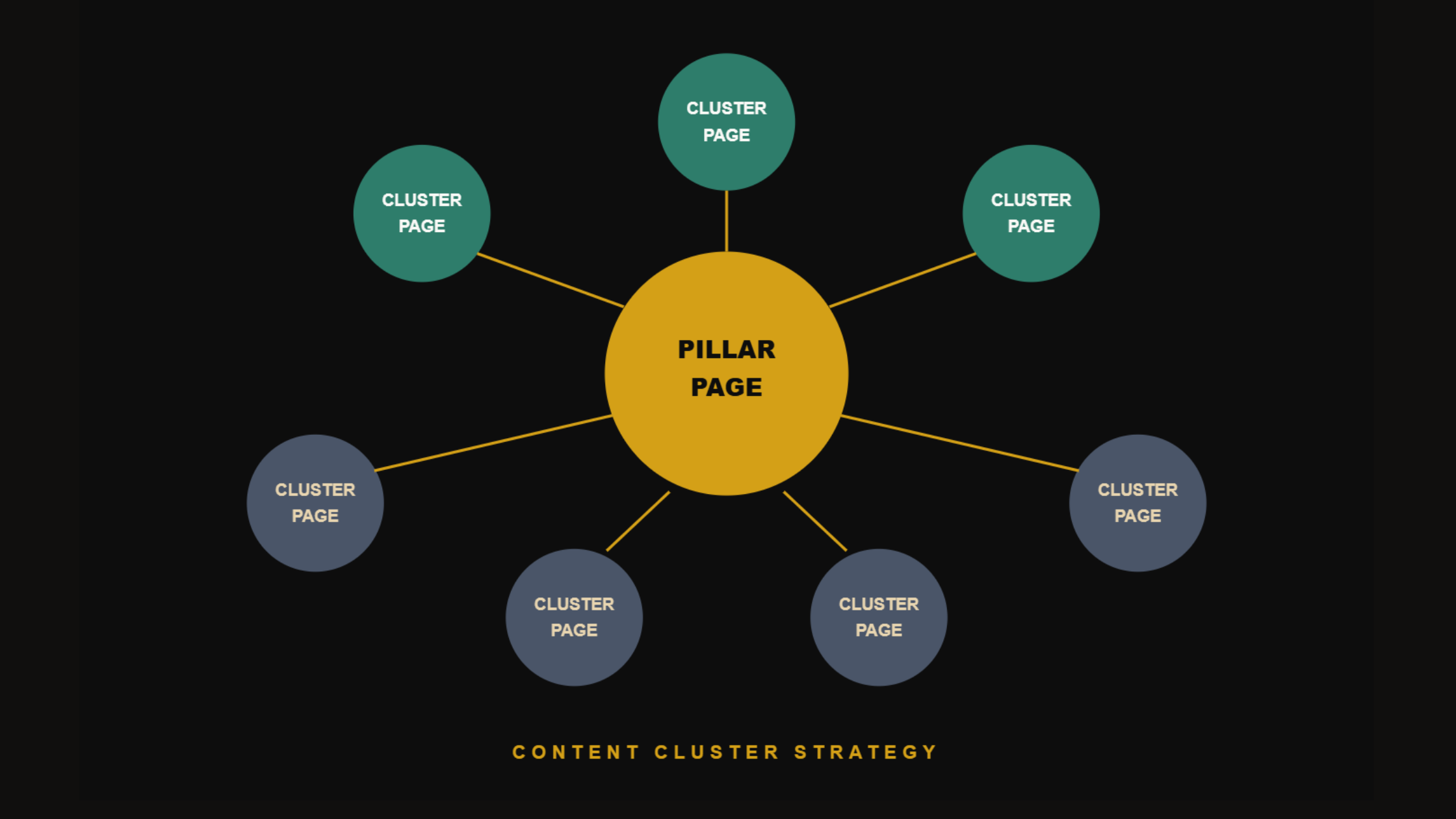
A content cluster strategy solves this. Instead of producing isolated posts, you build a structured content ecosystem: a central pillar page covering a core topic comprehensively, supported by cluster pages that address specific subtopics in depth, all connected through deliberate internal linking. Search engines reward this architecture because it demonstrates genuine topical authority rather than superficial coverage.
I use this approach across every client engagement and in every property I build. Three Putt Golf Clothing reached 668,000 impressions and an average position of 4.5 in six months from a blank domain using exactly this structure. The architecture is not complicated. Getting it right consistently is where most brands fall short.
Author bio
Graeme Whiles is an independent SEO and AEO consultant at GWContent. He has worked with enterprise and SaaS brands including Originality.ai, Connecteam, 6sense, and Practice Better, growing organic traffic and AI search visibility across some of the most competitive categories in B2B. He also built Three Putt Golf Clothing from a blank domain as a live proof of concept for his methodology.
Short on time? Here are the key takeaways
-
A content cluster strategy groups multiple pieces of content around a central topic, connected through internal linking to signal depth and expertise to search engines.
-
The structure: one pillar page covering the core topic, multiple cluster pages going deeper on specific subtopics, all linking back to the central pillar page.
-
Internal linking is the mechanism that makes content clusters work. Without it, you have related articles. With it, you have topical authority.
-
Audit existing content before creating anything new. Most brands already have the pieces. They just need structuring correctly.
-
The same architecture that builds authority for Google also signals credibility to AI tools like ChatGPT and Perplexity.
What Is a Content Cluster Strategy?
A content cluster strategy is a structured approach to content creation where multiple pieces of content are grouped around a central topic, connected through deliberate internal linking that signals depth and expertise to search engines and navigational clarity to users.
The architecture has three components. A pillar page covers the core topic comprehensively and links out to every cluster page. Cluster pages address specific subtopics in more depth and link back to the central pillar page. Internal links connect the entire structure, creating a coherent signal of topical authority that no single page can produce on its own.
This is a significant shift from traditional blog publishing. Instead of producing isolated posts, a content cluster strategy creates a content ecosystem where every piece reinforces the authority of every other piece. Search engines assess this comprehensiveness. A site with one well-written post on a topic looks thin. A site with a structured cluster covering the topic from every angle looks authoritative.
The same logic applies to AI search. Large language models evaluate whether a source covers a subject comprehensively before deciding whether to cite it. A well-structured content cluster is both an SEO strategy and an AEO strategy working simultaneously. The AEO Readiness Score measures how well your content architecture is performing across both.
Why search engines reward content clusters
Search engine algorithms are designed to surface the most authoritative, trustworthy source on any given query. Content clusters help search engines understand a site's expertise by covering a particular topic in depth across multiple interlinked pages. This increases the chances of ranking for the full range of related keywords rather than just the primary keyword on a single page.
Internal linking within a cluster distributes authority signals across every page in the structure. A cluster page that earns an external backlink transfers some of that authority to the pillar through internal links. The pillar distributes authority back to cluster pages. Content clusters also increase the time users spend on a site, which signals to search engines that the content is valuable and directly relevant to search intent. The whole is consistently more valuable than the sum of the parts.
The Architecture of a Content Cluster

The pillar page
A pillar page is a comprehensive, standalone page that covers the core topic in depth. It is not the most detailed treatment of every subtopic. It is the definitive overview of the entire subject area, with clear signposting to the cluster pages that go deeper on each specific aspect.
Include a hyperlinked table of contents at the top of every pillar page. This improves user experience by enabling readers to navigate directly to the section most relevant to their search journey, and it creates clear internal navigation signals for search engines. The length of pillar content matters less than comprehensiveness: cover the topic thoroughly and provide all the information users need. A pillar page can serve as a hybrid hub and pillar page, combining in-depth coverage with a directory-style approach to linking cluster pages.
Cluster pages
Cluster pages are focused articles addressing specific long-tail keywords or subtopics within the central topic. They are typically 1,200 to 1,800 words, targeting a specific aspect of the broader subject with more detail than the pillar page can provide.
Every cluster page links back to the pillar page. This is structural, not optional. The back-to-the-pillar link is what creates the cluster architecture and tells search engines that this page is part of a coherent content ecosystem rather than a standalone post. Cluster pages can also link to each other where the connection is genuinely useful to the reader, reinforcing topical signals across the whole structure.
Internal linking: the mechanism that makes it work
Internal linking is the critical technical element of a content cluster strategy. Without deliberate, consistent internal links connecting cluster pages to the pillar and back, the content architecture exists conceptually but not in a form search engines can interpret as a meaningful authority signal.
The internal linking structure should be logical and user-first: link when it genuinely helps the reader. But within a content cluster, the pillar-to-cluster and cluster-to-pillar links are structural requirements. Internal links can be woven naturally into body copy or placed at the start and end of content under headings like "related reading." Both work. The important thing is consistency.
Multiple pillar pages can coexist on the same site, targeting different core topics, each with its own cluster of supporting articles. This increases the internal linking architecture across the site and helps search engines map the full scope of the site's topic coverage.
How to Build a Content Cluster Strategy

Step 1: Choose your core topic
Start with keyword research to identify the central topic your content cluster will be built around. The core topic should have sufficient search demand, a clear relationship to your service offerings, and enough subtopics to support a full cluster. It should also be specific enough to be ownable.
"Marketing" is too broad. "B2B content marketing strategy" is a viable core topic for a growth-stage marketing consultancy. "Golf clothing" is viable for a golf streetwear brand. "AI detection" is viable for a brand operating in that category. Finding the specific angle that matches your expertise and has genuine search demand is the decision that shapes everything that follows.
Use the free SEO tools to assess search demand and keyword difficulty before committing to a cluster. Building a content cluster around a topic with insufficient search demand is wasted resource regardless of how well the content is written.
Step 2: Map your cluster pages
Once the core topic is defined, map every subtopic and related question beneath it. These become your cluster page targets. A well-mapped cluster typically contains between five and fifteen cluster pages, each targeting a specific long-tail keyword or subtopic with clear search intent.
Primary keywords belong on the pillar page. Secondary keywords and long-tail variants belong on cluster pages. This deliberate separation prevents keyword cannibalisation, where multiple pages compete against each other for the same search terms and dilute the authority of both. Map the keyword allocation clearly before writing a word.
Question-based keywords, comparison queries, and how-to searches are common cluster page targets because they reflect real user intent and are typically less competitive than primary keywords. Tools like Ahrefs are useful for identifying question-based keywords across a topic area at this stage.
Step 3: Audit existing content before creating anything new
Before producing a single new piece of content, audit what you already have. Many brands already have content that could form the basis of a cluster but lacks the internal linking structure that would make it work. Building more content before addressing the structural problem produces more of the same result.
A content audit against the cluster architecture typically reveals three things: pillar-level content that is not linked to its supporting articles, cluster-level content that is not linked back to any central page, and genuine content gaps where important subtopics are not yet covered. Map existing pages to the cluster architecture first. Retrofit the internal linking structure. Then identify gaps and prioritise new content creation to fill them.
The content marketing metrics guide covers how to identify which existing pages are performing and which need refreshing as part of this process.
Step 4: Build the pillar page
The pillar page carries the most topical authority in the cluster and should be treated accordingly. Write it to answer the core topic comprehensively: cover every major aspect, define key terms, address the most common questions, and link clearly to every cluster page with descriptive anchor text.
Technical SEO fundamentals apply: clear heading hierarchy, well-structured meta descriptions, schema markup, fast loading time. A pillar page with strong content and solid technical SEO foundations compounds its authority faster than one with content quality alone. Refer to the Google Search Central documentation for indexing and crawling best practice if you are setting up a new pillar page on a new domain.
Step 5: Produce and link cluster pages
Produce cluster pages in order of search demand and commercial relevance. Start with the subtopics most likely to attract qualified traffic and most directly related to your service offerings. Each cluster page should target one specific long-tail keyword, open with a direct answer to the question its title poses, link back to the pillar page early in the content and again at the end, and link to other relevant cluster pages where the connection is genuinely useful.
Cluster pages that are updated regularly and refreshed within the last thirty days are significantly more likely to be cited by AI search platforms alongside traditional search engines. Build content freshness into your maintenance workflow from the outset, not as an afterthought.
Step 6: Monitor, maintain, and expand
A content cluster strategy is not a one-time build. Search engine algorithms constantly evolve, user intent shifts, and new subtopics emerge within established topic areas. Regular maintenance keeps clusters competitive.
Use Google Search Console to monitor keyword rankings and organic traffic across the cluster. Track which pages are gaining impressions without converting to clicks, which are losing ground, and which are generating direct traffic and leads. The AEO Readiness Score identifies whether the cluster is also performing well in AI search. Expand the cluster as new subtopics emerge or as content gaps are identified through ongoing keyword research.
What the Results Look Like in Practice
Three Putt Golf Clothing was built on a blank domain with zero existing authority. The content cluster strategy was the entire SEO strategy from day one: identify the core topic, map the cluster, build the pillar, produce cluster pages in order of priority, link everything deliberately. 668,000 impressions, 6,795 organic clicks, and average position 4.5 in six months. That performance did not come from individual well-written posts. It came from the cumulative authority signal of a structured cluster where every page reinforced every other. Read the Three Putt Golf case study.
For Originality.ai, a structured content cluster approach applied to the AI detection category drove organic traffic from 278,000 to 1.18 million sessions, a 324.7% increase, while referral domains grew from 1,098 to 9,942. As individual cluster pages earned backlinks, that authority distributed across the entire cluster through internal linking rather than staying isolated on a single page. The architecture is specifically designed to produce that compounding effect. Read the Originality.ai case study.
For Connecteam, deliberate content cluster strategy targeting the deskless workforce management category contributed to a 62.6% increase in organic traffic and a 79.4% growth in AI Overview visibility. The internal linking structure that makes topic clusters effective for Google also signals topical depth to AI models evaluating content for citation. These two outcomes are not separate. They are the same architecture producing parallel results across traditional and AI search. Read the Connecteam case study.
The pattern is consistent: brands that build this architecture early accumulate a topical authority advantage that takes competitors a significant time to close.
Common Content Cluster Mistakes
-
Building without auditing first. Most brands have content they could cluster immediately. Producing more before mapping what exists creates more of the same structural problem.
-
No internal links back to the pillar. Cluster pages with no link back to the central pillar are standalone posts. The internal linking structure is what creates the cluster. Without it, the architecture does not exist.
-
Keyword cannibalisation. Multiple cluster pages targeting the same search intent compete against each other rather than reinforcing each other. Map primary and secondary keywords carefully before writing.
-
Pillar pages that are too narrow. A pillar page that covers only part of the core topic creates a fragmented cluster that confuses rather than clarifies. Build pillar pages that orient the reader across the entire topic area.
-
Building the cluster and leaving it. Content clusters require ongoing maintenance. Pages that fall out of date lose rankings. New subtopics that are not added create gaps competitors will fill.
The Bottom Line
Brands that produce quality content in isolation will always be outranked by brands with the same content quality and a coherent content architecture. The cluster strategy is that architecture.
The implementation sequence is straightforward: identify the core topic, audit what exists, build the pillar, produce cluster pages in priority order, link everything deliberately, and maintain the structure over time. Every client engagement I run uses this sequence. The results compound in exactly the way the architecture is designed to produce.
The SEO ROI Calculator can model the expected return from a content cluster investment before you build it. The content marketing ROI guide, B2B content marketing guide, and content marketing for startups guide cover how the cluster strategy fits within the broader content marketing framework.
Get a free SEO audit, and I will show you exactly how your current content should be restructured into clusters and where the highest-priority gaps are.
Frequently Asked Questions About Content Cluster Strategy
What is a content cluster strategy?
A content cluster strategy is a structured approach to content creation where multiple pieces of content are grouped around a central core topic and connected through deliberate internal linking. A pillar page covers the topic comprehensively. Cluster pages address specific subtopics in more depth. Internal links connect cluster pages back to the pillar, creating a coherent signal of topical authority for search engines and clear navigation for users.
How does a content cluster strategy improve SEO?
Content clusters demonstrate comprehensive topic coverage across multiple interlinked pages, which helps search engines assess a site's expertise more accurately than a single page can. Internal linking distributes authority across the cluster, improving search engine rankings for both the pillar and individual cluster pages. Brands using content cluster strategies consistently see improvements in organic traffic, keyword rankings, and overall website visibility.
How many pages should a content cluster have?
A typical content cluster contains one pillar page and between five and fifteen cluster pages targeting specific subtopics and long-tail keywords. Build the cluster to cover the topic comprehensively rather than to hit a specific page count. Search demand across the subtopics should drive the number, not an arbitrary target.
What is the difference between a pillar page and a cluster page?
A pillar page is a comprehensive overview of the core topic, designed to rank for primary keywords and link out to all cluster pages. A cluster page is a focused article addressing a specific subtopic or long-tail keyword in more depth than the pillar covers, typically 1,200 to 1,800 words. Every cluster page links back to the pillar. The pillar links out to every cluster page.
Does a content cluster strategy help with AI search?
Yes. AI models assess whether a source covers a subject comprehensively before deciding whether to cite it. A structured content cluster with consistent internal linking, regular content updates, and schema markup performs significantly better in AI-generated responses than isolated unconnected posts. The AEO Readiness Score measures this alongside traditional search performance.
How do I start a content cluster strategy?
Identify a core topic with sufficient search demand and a clear relationship to your service offerings. Map the subtopics and related questions that will become cluster pages. Audit existing content before creating anything new. Build the pillar page first, then produce cluster pages in order of search demand. Monitor performance through Google Search Console and expand the cluster as new subtopics emerge.