B2B Content Marketing: The Strategic Guide for Growth-Stage Companies
Published: April 4, 2026 | 12 min read
By Graeme Whiles
Most B2B companies have a content problem that is not actually a content problem. They are publishing content regularly, they have a blog, and some of them have a decent following across social media platforms. But the content is not generating leads, it is not shortening sales cycles, and when the budget review comes around, nobody can clearly explain what it is producing.
The issue is almost never the writing. It is the strategy sitting behind it, or more often, the absence of one. B2B content marketing is not a volume game. It is a trust game. Other businesses do not buy from brands they have just discovered. They buy from brands they have encountered repeatedly, found useful consistently, and come to regard as genuinely expert in the problem they are trying to solve. The content marketing strategies that produce that kind of trust are built on relevance, quality content, and deliberate distribution. This is the framework for building one.
Author bio
Graeme Whiles is an independent SEO and AEO consultant at GWContent. He has worked with enterprise and SaaS brands including Originality.ai, Connecteam, 6sense, and Practice Better, growing organic traffic and AI search visibility across some of the most competitive categories in B2B.
Short on time? Here are the key takeaways
- B2B content marketing wins through relevance and authority, not volume.
- Nine out of ten B2B marketers use content marketing. The ones winning have a documented strategy, not just a blog.
- Map content to the buyer's journey. Different formats serve different stages of the sales funnel.
- Distribution is where most B2B content strategies fail. Publishing content is not the same as promoting content.
What Is B2B Content Marketing?
B2B content marketing is the practice of creating and distributing valuable content to attract, educate, and build trust with business buyers, with the goal of generating leads, strengthening customer relationships, and driving revenue for business-to-business companies.
That definition contains the word most B2B content programmes forget: valuable. Not frequent. Not keyword-optimised. Valuable. Informative content that helps your target audience understand their problem more clearly, evaluate their options more confidently, and make better decisions. Content marketing success follows from that standard. Everything else is secondary.
The fundamental difference from B2C is time and complexity. B2B buyers are professionals making decisions with commercial consequences, involving significant budget and internal sign-off. Individual consumers can be influenced by a well-timed ad or a compelling offer. Business leaders making procurement decisions for their organisations cannot. A B2B brand needs to build enough credibility that a prospective client is willing to stake their professional reputation on recommending you to their team. High-quality content, distributed consistently over time, is what builds that credibility. A single blog post will not.
Why B2B Content Marketing Matters
According to the Content Marketing Institute, B2B content marketing can generate up to three times more leads than paid search advertising at a fraction of the long-term cost. Unlike paid channels that go silent the moment you stop spending, quality content compounds across your marketing mix. A case study published today will still be generating qualified leads in three years. A PPC campaign you stop funding goes silent overnight.
I have seen this play out directly. With Connecteam, a deliberate content strategy built around genuine expertise and E-E-A-T signals grew organic traffic by 62.6%, from 263,000 to 428,000 sessions, while growing referral domains from 3,191 to 7,511. That is compounding brand recognition across every channel a business buyer might encounter you: a Google search, a ChatGPT query, a mention in an industry newsletter. The content doing that work does not cost more to produce than generic content. It just has to be genuinely good and strategically placed. Read the Connecteam case study.
The flip side is equally instructive. When I run content audits for new clients, the pattern is almost always the same: a small proportion of the content is producing the majority of the commercial results, and the rest is consuming budget without returning anything meaningful. Most B2B companies do not have a content volume problem. They have a content quality and distribution problem, and publishing more content makes it worse, not better.
Building a B2B Content Marketing Strategy

Know exactly who you are writing for
Before generating content ideas or building an editorial calendar, you need to understand your buyer personas at a level most content marketers do not bother reaching. Not job titles and demographics. The specific pain points that keep your prospective clients awake, the questions they ask before they have heard of you, the industry trends shaping their decisions, and the objections they raise before they commit.
The sales team is the most underused resource in B2B content planning. They know exactly what comes up in every conversation, which means they know exactly what relevant content needs to exist before the call. Customer service teams are equally valuable: the questions they answer repeatedly are the questions your content should be answering publicly, turning what is currently a one-to-one conversation into a one-to-many content asset. I use both when building a content strategy for any new client engagement. The data-driven insights you get from those conversations are worth more than any keyword tool.
Small businesses often skip this step because it feels like overhead before the real work begins. In my experience, it is the real work. Get buyer personas wrong and everything built on top of them, content formats, distribution channels, calls to action, is built on an unstable foundation.
Map content to the buyer's journey
Compelling content at the wrong stage of the buyer's journey does nothing. A decision-stage case study sent to someone who does not yet understand the problem is wasted. Awareness content sent to someone ready to buy delays a decision that was close to being made. The marketing funnel is not just a diagram. It is a content planning tool.
- Awareness stage content addresses industry insights and the problems your service offerings solve, without leading with your product as the answer. Blog posts covering industry trends, thought leader articles that reframe how your business audience thinks about a challenge, and educational video content that explains the category. The job here is to be useful, not to sell. A prospective client who finds your content genuinely helpful before they need you will remember that when they do.
- Consideration stage content helps business leaders compare options, understand trade-offs, and build an internal business case. Industry reports, white papers, research reports, and leadership articles that demonstrate your methodology work best here. This is where genuine expertise in the content makes the difference between something that influences a shortlist decision and something that gets skimmed and closed.
- Decision stage content removes the final objections between a buyer and a signature. Customer testimonials from named individuals at recognisable companies with specific results attached, case studies with a clear baseline and documented outcomes, and tools that remove financial uncertainty. The SEO ROI Calculator is a live example: it lets a prospective client quantify the value of investing in SEO before committing to a conversation, which removes a key objection before the call even happens.
The brands generating the most qualified leads through content marketing efforts have deliberate coverage across all three stages. Awareness content without decision-stage content produces readers who never convert. Decision-stage content without awareness content produces a sales funnel that never fills.
The Formats That Actually Perform

Thought leadership: the most misused term in B2B marketing
Most leadership content is not thought leadership. It is loosely opinionated content dressed up with a senior job title and a few recycled statistics. I research category landscapes regularly for client engagements, and the tell is always the same: it could have been written by anyone, because it contains nothing requiring the author to have actually done the work.
A genuine thought leader produces leadership articles reflecting direct experience, original industry insights nobody else has published, and positions some readers will push back on. Gong Labs publishes proprietary data from its own platform that no competitor can replicate. IBM produces research reports requiring the business to have genuinely done the work before writing them. HubSpot builds actionable insights from running marketing at scale across a business audience of millions. These are real-world examples of thought leadership done properly.
The content I produce for Originality.ai is grounded in direct experience of scaling an AI detection brand in a fast-moving category. That first-hand context is what makes it citable in AI-generated responses and shareable among industry leaders. Traffic grew from 278,000 to 1.18 million sessions. That does not happen with assembled, secondhand content. Read the Originality.ai case study.
One more thing worth saying: leadership content in 2026 needs to perform in AI search as well as traditional search. ChatGPT, Perplexity AI, and Google AI Overviews are significant sources of B2B research traffic that most content marketing strategies are not accounting for. The complete AEO guide, what is AEO, and how to rank in ChatGPT, covers this in detail.
Case studies: your highest-converting content asset
A case study is not a press release about a project that went well. It is a structured narrative moving a prospective client from problem recognition through methodology to measurable result, in a way that makes their situation feel understood, and their desired outcome feel attainable.
The structure that consistently works: the specific challenge the client faced, the strategy deployed, the deliverables built, the results with named numbers and a clear baseline, and the insights that generalise from the specific engagement. Every case study on GWContent follows this structure because it converts real client work into a sales asset that does its job without a salesperson in the room.
The 6sense engagement delivered 57.5 million impressions and 314,000 clicks with 279% impression growth and average position improving from 14.9 to 11.9. Not a claim. A documented result with a named client, a baseline, and a methodology behind it. Read the 6sense case study.
Video content, white papers, and valuable resources
Video content is the most underused format in growth-stage B2B companies. Educational videos that explain complex concepts or document real client results build audience engagement in a way that written content alone cannot. Cisco's use of video to explain complex technology is one of the most cited real-world examples of the format done well at scale.
White papers and research reports work as lead magnets when the content behind the gate is genuinely worth the exchange. Valuable data and original research that no competitor has published, a proprietary framework built from direct client experience, a diagnostic tool producing a useful output. These generate qualified leads from buyers actively researching solutions. Generic gated content destroys trust faster than no gated content at all.
Blog content and topical authority
Blog posts are the cornerstone of any B2B content strategy built around organic search. But publishing content on a competitive topic without a content cluster architecture behind it is unlikely to rank or generate meaningful traffic. The structure that compounds is a hub article supported by spoke articles covering every related question, with consistent internal linking throughout. This signals to search engines and AI tools that a brand covers its subject in genuine depth.
Keyword research feeds the content ideas that have an existing search audience. But content planning driven entirely by keyword tools produces content optimised for what people are searching for rather than what they need to read to trust you enough to buy. The best B2B content calendars balance search-driven topics with informative content and thought leadership that builds the credibility that converts, regardless of search volume.
Content Distribution: Where Most B2B Strategies Fail

Here is the most common waste in B2B content marketing: a genuinely compelling piece of content published on a Tuesday, shared once as a social media post on LinkedIn, and then forgotten. No email. No paid promotion. No outreach to the people it was written for. Just a URL in a CMS waiting to be discovered.
A successful content marketing strategy is only as effective as its distribution strategy. The ratio most content teams should aim for is at least as much time spent distributing content as creating it.
- LinkedIn generates over 50% of social traffic to B2B sites and is the primary social media platform where business buyers encounter content from brands they are considering. Social media posts sharing a specific insight from a real client engagement consistently outperform posts simply announcing a new blog article. Share what you learned, not just what you published.
- Email marketing is the highest-converting distribution channel in B2B, with over 90% of marketers using it and 66% using it specifically for demand generation. An engaged email list of prospective clients is the most reliable audience you own for distributing content. Publishing without emailing it to that audience is leaving your best channel idle.
- Online communities, industry Slack groups, niche newsletters, and sector forums are underused and increasingly valuable distribution channels. Your target audience is already gathering in these spaces to discuss the problems your content addresses. Contributing genuine industry insights there, rather than promotional noise, builds customer engagement and audience engagement simultaneously.
Promote content deliberately and repeatedly. Most content teams publish once and move on. Content marketers who continuously optimise their distribution, testing which channels deliver the best return, regularly refreshing older content and redistributing it, generate significantly better ROI from the same volume of content creation.
Measuring B2B Content Marketing Success
Pageviews and social media followers are not business metrics. Lead quality, pipeline contribution, and cost per acquisition are. The data-driven insights that actually matter:
- Conversion rate from content to qualified lead
- Content-attributed pipeline value tracked in your CRM
- Sales cycle length for content-influenced leads versus cold outreach
- Cost per lead by content format
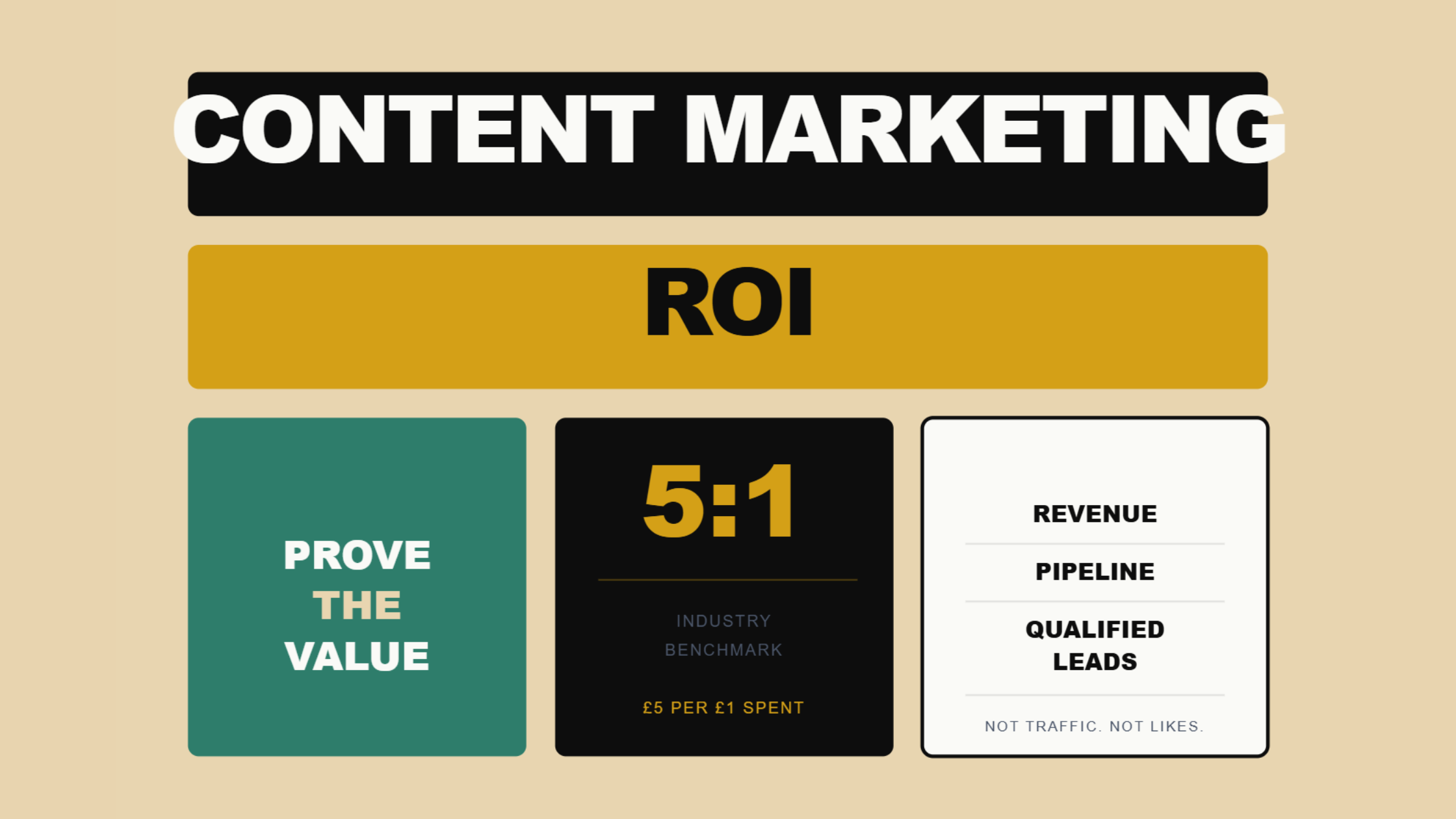
Google Analytics provides the traffic data. Your CRM provides the commercial connection. Joining the two is what produces a defensible content marketing ROI argument when business objectives need to be justified to leadership.
The Content Decay Detector identifies pages losing organic traffic over time, which is consistently the most commercially significant finding in any content audit. A well-refreshed existing piece recovers traffic in weeks. A new piece on a competitive topic can take months to rank. Continuously optimising existing content almost always produces better short-term ROI than creating new content at the same pace.
The Bottom Line
Here is what changes when B2B content marketing is done properly. Your sales team starts conversations with prospective clients who have already read your case studies, understand your service offerings, and have a clear sense of why you are the right choice. The sales cycle gets shorter. The leads arrive warmer. The content that took months to build generates a pipeline that no paid channel could replicate at the same cost.
That is the success state. A commercial operation that runs more efficiently because business leaders arrive already informed and already closer to a decision. Not a traffic graph. Not social media followers. Actual business outcomes.
The brands I have seen build real competitive advantage through content marketing got clear on what they wanted to be known for, produced relevant content their prospective clients could not find anywhere else, and made sure it reached the right business audience consistently over time. That is available to any growth-stage B2B company willing to approach it systematically.
Get a free SEO audit, and I will tell you exactly where your content strategy has gaps and what to prioritise first.
Frequently Asked Questions About B2B Content Marketing
What is B2B content marketing?
B2B content marketing is the practice of creating and distributing valuable content to attract, educate, and build trust with business buyers, generating leads and driving revenue for business-to-business companies. Unlike B2C, which targets individual consumers, B2B content targets key decision-makers within organisations across a longer and more complex sales cycle.
How is B2B content marketing different from B2C?
B2B content focuses on logic, ROI, and solving complex business problems. Decision-making involves multiple stakeholders and longer conversion paths. Content needs to support prospective clients through a structured buyer's journey rather than driving immediate purchase behaviour.
What content formats work best in B2B?
It depends on the stage of the sales funnel. Blog posts and informative content build awareness. White papers, research reports, and case studies support consideration. Customer testimonials, ROI calculators, and case studies with named results are most effective at the decision stage. Video content and thought leadership work across all stages to build brand recognition and audience engagement.
How do I measure content marketing ROI?
Track which content is influencing the pipeline in your CRM alongside Google Analytics traffic data. Key metrics: conversion rate from content to qualified lead, content-attributed pipeline value, and cost per lead by content type. That connection between traffic and pipeline is what produces a defensible ROI argument when marketing efforts need to be justified.
How much content should a B2B company publish?
Less than most teams think. Two well-distributed, high-quality content pieces per month consistently outperform five generic posts with no distribution plan. Publish less. Promote content more deliberately. Increase volume only once quality and distribution are working.
What makes thought leadership effective in B2B?
It must reflect genuine first-hand experience and contain actionable insights that could not have been produced without direct involvement in the topic. If it could have been written by anyone with a Google search and two hours, it is not thought leadership. It is filler dressed up as authority.
How important is technical SEO for B2B content marketing?
Technical SEO is the foundation that makes all content marketing efforts work at scale. Without it, even the most compelling content will not be found through organic search. Clean crawlability, proper internal linking, schema markup, and a logical site structure are the prerequisites for content that generates inbound leads consistently over time.