How to Measure Content Marketing ROI: A Framework for Proving Value
Published: April 6, 2026 | 10 min read
By Graeme Whiles
There is a specific moment every content marketer eventually faces. Leadership wants to know what the content programme is producing. You have traffic data, social media engagement figures, a growing blog archive, and a deck full of graphs that all point upward. None of it answers the question being asked.
That question is: what is this generating for the business?
Most content teams cannot answer it clearly, not because the content is not working, but because they are measuring the wrong things. Vanity metrics feel like progress. Conversion rates and revenue generated tell the actual story. This is the practical framework for telling that story in a way that survives a CFO's scrutiny and wins the budget conversation.
I have sat in enough of those conversations with clients to know how they go when the numbers are vague. The content programme gets cut, the team spends a year rebuilding from scratch, and six months after that, someone asks why organic traffic has fallen off a cliff. Getting the measurement right from the start is what prevents that cycle.
Author Bio
Graeme Whiles is an independent SEO and AEO consultant at GWContent. He has worked with enterprise and SaaS brands including Originality.ai, Connecteam, 6sense, and Practice Better, growing organic traffic and AI search visibility across some of the most competitive categories in B2B. He also built Three Putt Golf Clothing from a blank domain as a live proof of concept for his methodology.
Short on time? Here are the key takeaways
- Content marketing ROI is revenue generated minus total cost, divided by total cost, multiplied by 100.
- Vanity metrics do not prove ROI. Revenue, conversion rates, and qualified leads do.
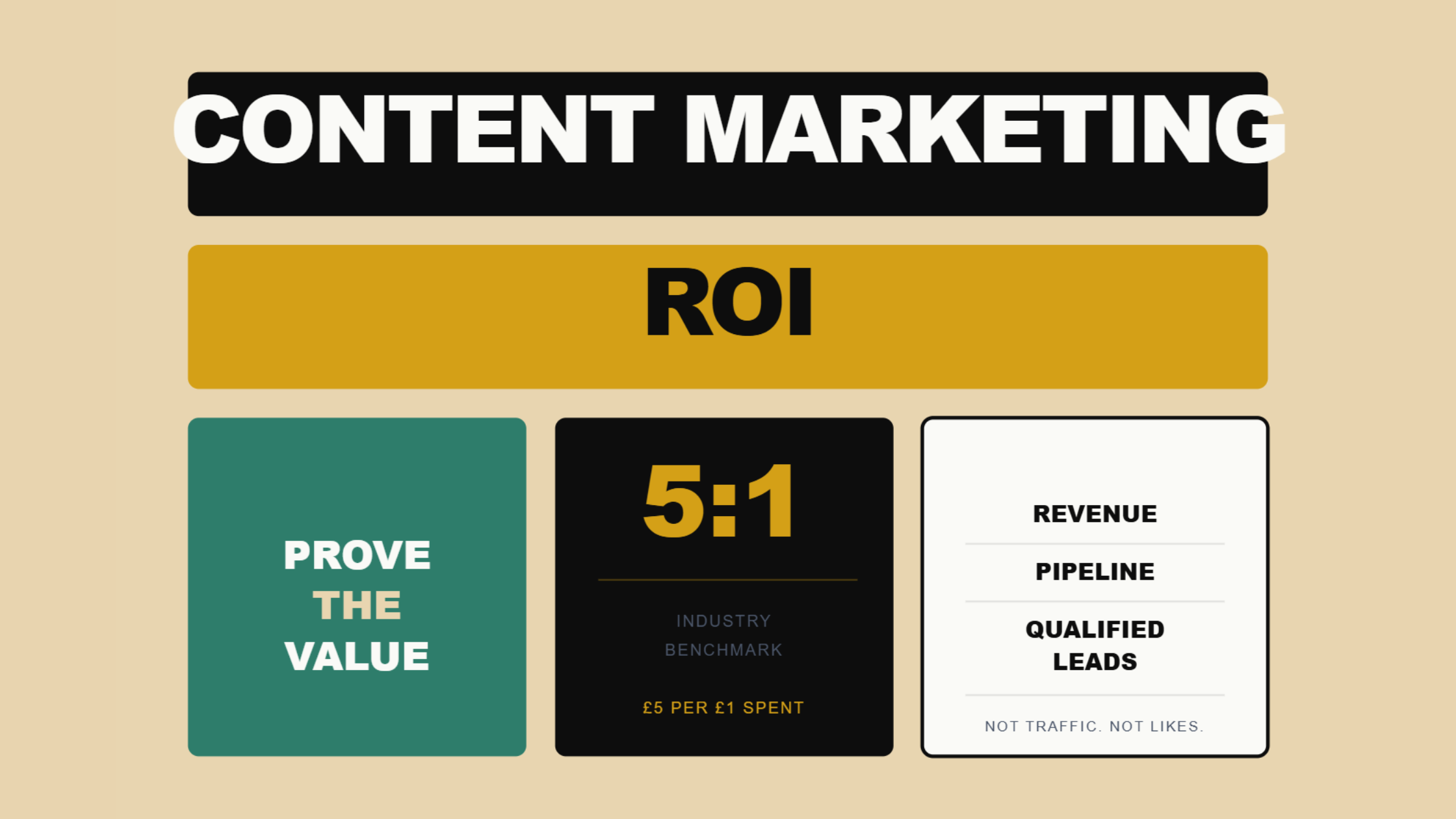
- The industry benchmark is a 5:1 ratio. Five pounds returned for every pound invested.
- Last-click attribution systematically undervalues content. Multi-touch models give a more accurate picture.
- Evergreen content improves your ROI percentage over time without increasing spend.
Why Most Content Teams Cannot Prove Their ROI
The content marketing industry has a collective accountability problem. There is a long tradition of defending content investment with brand awareness arguments and reach metrics because connecting content to actual sales is genuinely difficult work. Difficult does not mean impossible, but it does mean most teams never do it properly.
The result is a measurement stack built entirely around what is easy to track. Website traffic. Social media posts performance. Time on page. These are useful diagnostic signals. They are not business outcomes. Leadership does not care how many people read a blog post. They care how much revenue it generated, how many qualified leads it produced, and what it cost to generate them.
The shift required is not a technological one. It is a philosophical one: from measuring content activity to measuring content outcomes. Everything in this framework follows from that shift.
The Content Marketing ROI Formula
The basic formula
Content marketing ROI is the revenue generated from content marketing efforts compared to the total cost of creating and distributing that content, expressed as a percentage.
The formula: (Revenue - Cost) / Cost x 100
If a content programme costs £4,000 per month across labour, tools, and promotion, and generates £24,000 in attributable revenue, the ROI is (24,000 - 4,000) / 4,000 x 100 = 500%. That is the 5:1 revenue-to-cost ratio the Content Marketing Institute identifies as a common industry benchmark, meaning £5 returned for every £1 invested.
The formula is a simple formula. The hard work is in two places: capturing total cost accurately, and defining what counts as revenue generated by content.
What counts as total cost
Total cost must include every input: content creation time for staff and freelancers, tools and software subscriptions, promotion and distribution spend, briefing time, editing time, and strategy time. The most common mistake is counting only direct production costs and ignoring the internal labour that goes into briefing, reviewing, and publishing.
This usually doubles the apparent cost. But the ROI number that emerges from that honest calculation is also far more defensible in a budget conversation. A CFO who spots that you have excluded your own team's time will discount the entire analysis.
What counts as revenue generated
This is the more complex input. Revenue attributed to content includes: direct revenue from leads that converted after a content touchpoint, influenced revenue from deals where content played a role in the buyer journey, and pipeline value from marketing qualified leads generated through content.
The SEO ROI Calculator makes it straightforward to model content-driven revenue projections before a programme is in place, which is useful for justifying investment upfront rather than only retrospectively.
The Metrics That Actually Prove Content ROI

The metrics worth tracking
Not every metric is an important metric. The ones worth reporting to leadership are the ones that connect content marketing efforts directly to business outcomes.
- Conversion rates are the percentage of visitors who take a defined conversion event after consuming content. Form fills, demo requests, free trial signups. Divide total conversions by total interactions and multiply by 100. According to HubSpot's research, personalisation through audience segmentation can increase conversion rates by over 200% for specific calls to action, which makes audience-specific content one of the highest-leverage investments in any content marketing programme.
- Marketing qualified leads are the data points the sales team actually cares about. Content generating high volumes of website traffic but low MQL conversion is not producing commercial results regardless of what the traffic figures say. The right question is not how many people visited. It is how many of them were the right audience, taking the right action.
- Customer acquisition cost is the total cost of acquiring a customer through content divided by the number of customers acquired. The most compelling CAC argument for content is the trajectory over time: content CAC falls as the asset base grows, because existing content keeps generating leads without additional creation cost. Paid CAC stays flat or rises.
- Customer lifetime value is the total revenue a customer generates throughout their relationship with the brand. High CLV customers justify higher acquisition costs, which means content attracting the right audience at lower initial conversion volume may have a better ROI than content optimised purely for traffic volume. Long-term customer relationships built through consistent, high-quality content produce measurably better CLV than relationships initiated through cold outbound.
- Revenue generated and pipeline contribution are the ultimate content marketing metrics. Track which content pieces are influencing deals in your CRM. For B2B specifically, tools like HockeyStack are built to surface exactly which articles and pages are driving the most revenue across the buyer journey, giving you the data points that convert a sceptical CFO.
The metrics that feel important but are not ROI
Website traffic is a useful leading indicator. It is not a business outcome. A piece of content generating 10,000 sessions at 0% conversion has a negative ROI once you account for the cost of creating it.
Social media engagement tells you how well content is travelling. It does not tell you whether it is generating paying customers. Time on page and bounce rates are engagement signals worth monitoring. They are not metrics for a budget conversation.
Use these to diagnose what is working and what is not. Do not use them to prove content ROI to leadership. That conversation requires revenue, pipeline, and qualified leads. Everything else is context.
Attribution: The Hardest Part of Content ROI
Why last-click attribution undervalues content
Last-click attribution gives full credit for a conversion to the final touchpoint before a purchase. In B2B, this is typically the demo request page or the sales call. Every piece of content the buyer consumed before that moment gets zero credit.
This is the most common reason content programmes are undervalued internally. The blog post that introduced a prospect to the brand six months before they signed is invisible in a last-click model. The content marketing efforts driving awareness, building trust, and nurturing the relationship across the buyer journey simply do not appear in the numbers.
I have seen content programmes cut entirely because the ROI appeared to be zero under last-click attribution. The same programmes, measured with a multi-touch model, showed they were influencing the majority of closed deals. The content did not change. The measurement did.
Multi-touch attribution: a more accurate picture
Multi-touch attribution distributes credit across all content touchpoints in the customer journey rather than just the last click. According to Google Analytics 4 documentation, GA4 supports data-driven attribution models that distribute conversion credit based on actual user behaviour across sessions, which is significantly more accurate than position-based or last-click models for content-heavy buyer journeys.
The practical starting point if you cannot implement a full model immediately: track content-influenced deals in your CRM, where at least one content touchpoint is logged before the deal closes. That single change will reveal more about content marketing ROI than any traffic report you have produced.
Real-World Content ROI in Practice

The compounding ROI argument is easier to make with real numbers behind it.
With Originality.ai, a content strategy combining topical authority, E-E-A-T signals, and structured content grew organic traffic from 278,000 to 1.18 million sessions, a 324.7% increase, while referral domains grew from 1,098 to 9,942. Each month, the asset base generated more leads at a lower marginal cost than the month before. The content investment did not increase at the same rate as the return. That gap is the ROI improving in real time. Read the Originality.ai case study.
With 6sense, a focused content and AI visibility strategy delivered 57.5 million impressions and 314,000 clicks with 279% impression growth. The customer acquisition cost from content fell significantly as the content cluster grew, because existing content was generating incremental returns without proportional increases in total cost. Read the 6sense case study.
Three Putt Golf Clothing demonstrates that content ROI applies beyond enterprise B2B. Built from a blank domain with zero authority, a deliberate content strategy produced 668,000 impressions and 6,795 clicks in six months with an average position of 4.5.
The creation cost was fixed. The returns compounded. In month six, the content was generating returns at a fraction of the month-one cost per session. That is the evergreen content ROI argument made visible. Read the Three Putt Golf case study.
Building Your Content ROI Reporting Framework

Set up tracking before you create anything
Define conversion events clearly before publishing any content. What action do you want users to take after reading this piece? If you cannot define the conversion event, you cannot measure the ROI. This sounds obvious. Most content teams skip it.
Implement Google Analytics 4 across all landing pages and content pages. Track user behaviour, session length, and conversion events. Connect GA4 to your CRM so content touchpoints are visible alongside deal data.
The Content Decay Detector identifies pages losing organic traffic over time, which is the earliest signal that content ROI is deteriorating before it shows up in lead volume or revenue data. Catching and addressing decay early is how you maintain ROI percentage without creating new content at the same pace.
Build a reporting dashboard that leadership will actually read
The metrics your leadership team needs to see: total revenue influenced by content, number of MQLs generated by content, CAC for content versus paid channels, and content-attributed pipeline value.
Four numbers. One dashboard. That is more persuasive than twelve slides with seventeen metrics that collectively obscure the answer. Keep it simple because simplicity implies confidence. Complexity implies that you are still looking for the number that makes the case.
Review the dashboard monthly. Identify which content pieces are generating the most MQLs and pipeline, allocate future content creation resource accordingly, and retire or refresh the pieces that are not contributing. The B2B content marketing guide covers the broader strategic framework this sits within.
Strengthen E-E-A-T to improve conversion rates
Content that generates website traffic but converts poorly usually has a credibility problem. Visitors are not convinced enough by what they find to take the next step. The E-E-A-T Score tool identifies the specific signals that are missing across experience, expertise, authoritativeness, and trustworthiness, and prioritises the fixes most likely to improve conversion rates.
High-quality content with strong E-E-A-T signals converts at higher rates because it builds trust faster. Trust is the precondition for conversion in B2B. Content demonstrating genuine expertise, real client results, and transparent methodology removes the doubt preventing qualified leads from acting.
One more dimension worth noting for 2026: content ROI now has an AI search component. Content that ranks and converts in traditional search increasingly also needs to be structured for citation in ChatGPT, Perplexity AI, and Google AI Overviews. Ignoring that channel means your total cost stays the same while a growing share of potential revenue goes uncaptured. The answer engine optimisation guide covers what to do about it.
The Bottom Line
The brands that keep their content marketing budgets are not necessarily the ones producing the best content. They are the ones who can prove what the content is producing.
The framework is not complicated. Define conversion events before you create anything. Track the full customer journey rather than just the last click. Measure revenue and pipeline rather than traffic and engagement. Show leadership four clear numbers rather than seventeen metrics that collectively obscure the answer. And make the compounding argument: show them what the ROI looks like in month twelve versus month one.
Content marketing ROI improves over time by design. The asset base grows. The CAC falls. The evergreen content keeps working. The brands that understand this invest consistently and measure properly rather than cutting the programme every time a quarter gets difficult.
Get a free SEO audit and I will show you exactly which content is producing commercial results and where the gaps in your measurement are.
Frequently Asked Questions About Content Marketing ROI
What is the formula for content marketing ROI?
(Revenue - Cost) / Cost x 100. Total cost must include all labour, tools, software, and promotion. Revenue should include direct conversions, influenced deals, and pipeline value attributed to content across the full buyer journey, not just last-click conversions.
What is a good content marketing ROI?
The common industry benchmark is a 5:1 ratio: £5 in revenue for every £1 invested. Content marketing ROI tends to improve over time as evergreen content compounds, so the return in month twelve is typically higher than month one for the same programme.
What metrics should I track to measure content ROI?
Conversion rates from content to qualified lead, marketing qualified leads generated by content, customer acquisition cost via content versus paid channels, customer lifetime value of content-acquired customers, and content-attributed pipeline value in your CRM. Traffic and social media engagement are diagnostic metrics, not ROI metrics.
Why does last-click attribution undervalue content marketing?
Because it gives all conversion credit to the final touchpoint before a purchase and zero credit to every content piece the buyer consumed earlier in their journey. Multi-touch attribution models distribute credit across all touchpoints and produce a more accurate picture of what content is actually contributing to revenue.
How does evergreen content improve ROI over time?
The creation cost is fixed at publication. If the content continues generating leads for two years, the total revenue generated grows while total cost stays flat, meaning the ROI percentage improves automatically. Repurposing high-performing content multiplies this effect further without proportional increases in cost.
How do I justify content investment to leadership?
Build a dashboard showing content-attributed revenue, MQLs, and CAC versus paid channels. Use multi-touch attribution rather than last-click. Show the compounding trajectory: how ROI improves over time as the asset base grows. Make the comparison to paid explicit: content keeps generating revenue long after the investment is made. Paid does not.