Content Marketing for Startups: How to Build an Engine From Zero
Published: April 7, 2026 | 12 min read
By Graeme Whiles
Most content marketing advice for startups is written by people who have never had to build from a blank domain with no audience, no authority, and no proof that any of it is going to work. The advice sounds reasonable: publish consistently, build topical authority, create a content calendar. What it does not address is the zero-to-one problem. How do you get content to produce anything commercially useful when nobody knows you exist yet?
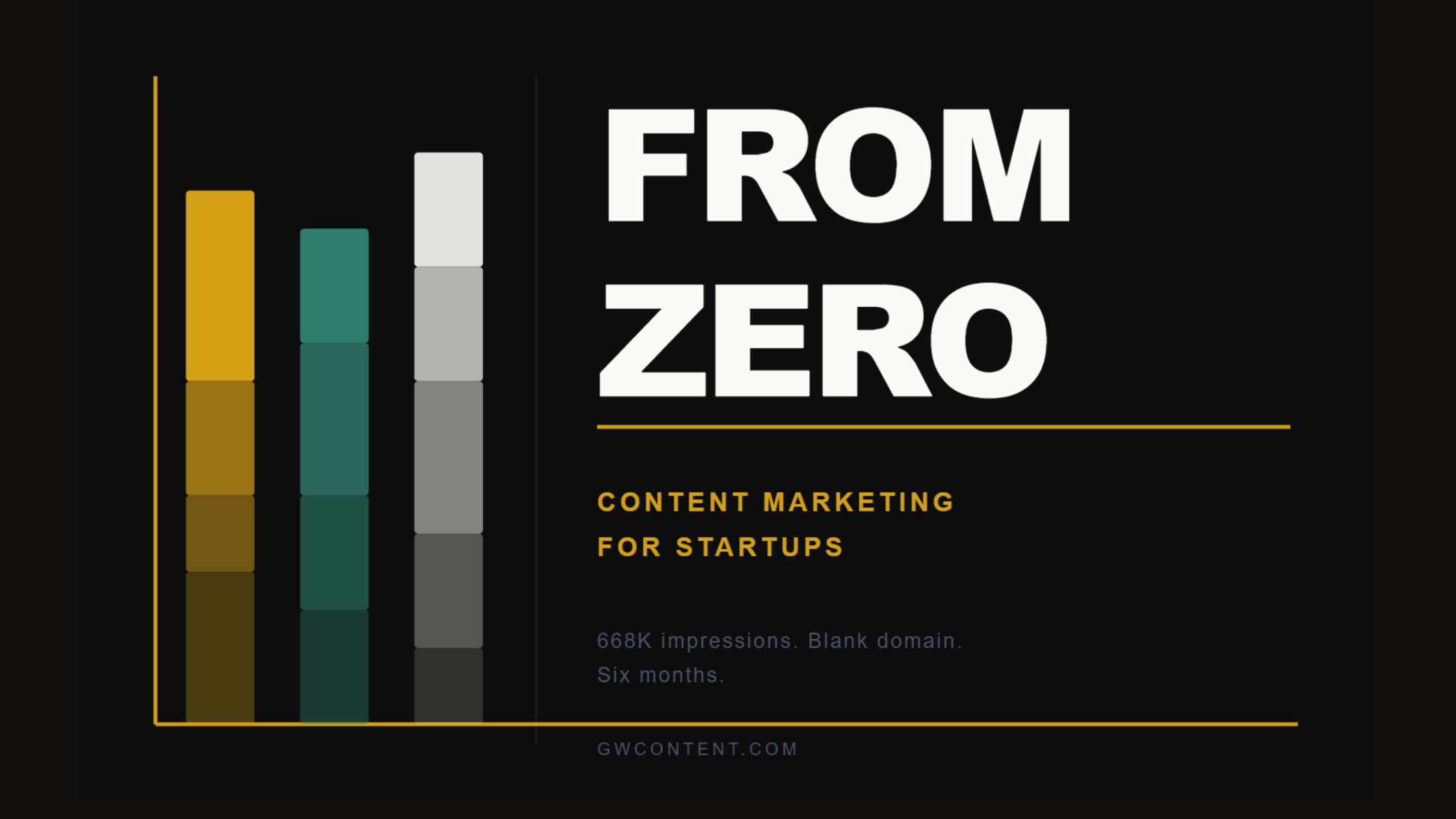
I know what that problem actually looks like because I built Three Putt Golf Clothing to solve it deliberately. A golf streetwear brand launched on a blank domain with no existing audience, no paid spend, and no brand recognition. Pure content strategy, keyword research, and consistent publishing. 668,000 impressions and 6,795 organic clicks in six months. That is not a hypothetical framework. It is a documented result from a startup I built specifically to prove the methodology works.
This is the practical guide for replicating it.
Author Bio
Graeme Whiles is an independent SEO and AEO consultant at GWContent. He has worked with enterprise and SaaS brands including Originality.ai, Connecteam, 6sense, and Practice Better, growing organic traffic and AI search visibility across some of the most competitive categories in B2B. He also built Three Putt Golf Clothing from a blank domain as a live proof of concept for his methodology.
Short on time? Here are the key takeaways
- A successful content marketing strategy costs 62% less than traditional marketing and generates over three times as many leads. For startups without paid advertising budget, it is often the only scalable growth channel available.
- Start with bottom-of-funnel conversion content first. Pricing pages, case studies, and comparison content convert. Awareness content compounds later.
- Authentic founder voice outperforms polished corporate content every time. Your unfair advantage as a startup is specificity.
- You do not need authority to start. You need a clear unique value proposition, a focused content strategy, and the discipline to execute consistently.
- Expect meaningful results within three to six months of consistent effort. Content compounds. Paid channels go silent the moment you stop spending.
Why Content Marketing Works for Startups
Content marketing costs 62% less than traditional marketing and generates over three times as many leads. For a startup without budget to sustain paid advertising at scale, this is not a nice-to-have. It is often the only cost-effective, scalable growth channel available.
The commercial case is straightforward. Unlike paid channels that stop producing the moment you stop spending, well-built content compounds. A blog article published in month three can still be generating organic traffic and qualified leads in year two. The startup that invests in content early builds an asset base that appreciates over time. The one that relies entirely on paid channels has to keep feeding the machine.
Content marketing also builds brand recognition and trust in a way paid advertising cannot replicate. Potential customers research before they purchase, particularly in B2B and higher-consideration purchases. The startup whose content answers those research questions first earns the trust that converts. That trust is available to any brand willing to produce content that genuinely helps their target audience, regardless of how long they have been in business.
Three Putt Golf is the clearest demonstration I can point to. When I started it, I had zero domain authority, zero brand recognition, no paid spend, and no user-generated content.
Despite that, I used my strong content marketing strategy experience to create a content engine that reached 668,000 impressions and an average position of 4.5 across the content cluster in six months. That is what a correct approach to startup content marketing looks like in practice. Read the Three Putt Golf case study.
What makes startups different
The challenges facing a startup's content marketing strategy are distinct from those facing an established brand. No existing audience means every piece of content starts from zero distribution. No domain authority means search engines do not yet trust the site. Limited budget means every content decision has to justify its resource cost quickly.
But there is a genuine advantage. Startups can be specific, direct, and founder-led in a way that large brands structurally cannot. Authentic voice from founders consistently outperforms polished corporate content. A startup that writes honestly about its own experience, including what has not worked, builds trust faster than a brand publishing generic thought leadership assembled from secondary sources.
Startups must also focus on content that de-risks the purchase. Transparent pricing pages, honest comparisons, real customer results with specific numbers. This is the content that converts potential customers who have found you but are not yet sure whether to trust you. And for early-stage companies, that trust is everything.
Before You Write a Word: Laying the Foundation

Goals first, content second
An effective content marketing strategy begins with setting clear goals tied directly to business objectives. Not "build brand awareness." Not "increase website traffic." Specific, measurable targets: generate twenty qualified leads per month from organic search within six months. Reduce sales call length by creating content that addresses the five objections the sales team hears in every conversation.
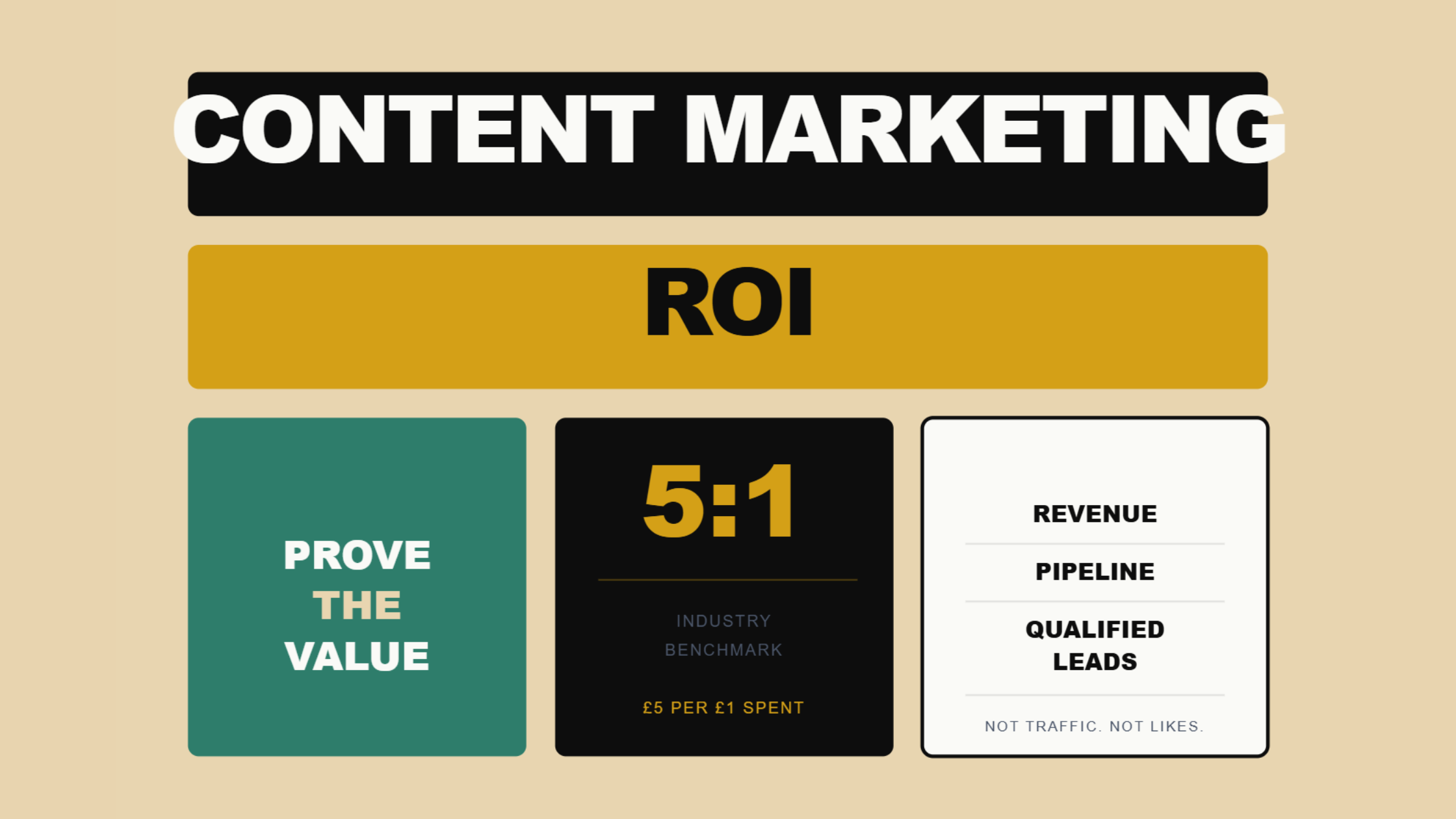
Content marketing budget for startups is almost always constrained. Understanding content marketing ROI from the outset, connecting content activity to pipeline and revenue rather than traffic and pageviews, is what sustains the investment long enough for it to compound. Most startup content marketing programmes get cut not because they are not working but because nobody measured what they were producing in commercial terms. Define those metrics before you publish a single piece.
Build buyer personas from real conversations
Before generating a content idea, you need to understand your target audience at a level most startups skip. Not demographic profiles assembled from secondary research. Real conversations with the people you are trying to reach: what specific problems are they solving, what questions do they ask before purchasing, what objections come up in sales calls?
Founder knowledge is the most valuable input here and it is almost always underused. The founder usually has the deepest understanding of the customer pain points the product addresses. That understanding should directly shape the own content strategy, not sit unused while a content marketer writes generic blog posts about industry trends.
Buyer personas for content planning should include the specific questions the persona asks at each stage of the customer journey, the search terms they use when researching the problem, and the objections they raise before purchasing. This foundation makes every subsequent content decision faster and more likely to produce the right result.
Keyword research: finding winnable ground
New domains cannot compete for high-volume, high-difficulty keywords against sites with years of domain authority. The practical keyword research approach for startups is to find winnable ground: specific, lower-competition keywords where search intent aligns closely with your unique value proposition and where you have something genuinely better to say than what is already ranking.
Long-tail keywords with clear commercial or informational intent are where startup content marketing wins early. "Best golf clothing brands UK" is more winnable for a new golf clothing brand than "golf clothing." "Content marketing tools for startups" is more winnable for an early-stage SaaS than "content marketing tools." Finding that specific angle and owning it completely before trying to compete for broader terms is the correct sequence.
The free SEO tools are useful for identifying keyword opportunities, checking current content health, and assessing meta description performance before building a content calendar. Use them before committing to a content plan.
With Three Putt Golf, the early keyword strategy was built entirely around specific, low-competition queries where I could produce genuinely better content than what existed. "Trendy golf brands" became one of the highest-performing pages, generating 783 clicks and 55,600 impressions. That did not happen by competing for "golf clothing." It happened by finding a specific angle nobody else was owning clearly and building depth around it.
Build Bottom-Up, Not Top-Down
This is where most content marketing guides for startups get the advice exactly backwards. The instinct is to build awareness first, then convert later. The correct approach is to build conversion content first, then add awareness content on top.
Start with conversion content
The most common startup content mistake is creating only top-of-funnel awareness content while neglecting the conversion pages that close business. Blog articles about broad industry topics build potential audience over time. A startup with six months of runway needs content that converts now.
Bottom-of-funnel content for startups: transparent pricing pages that address cost questions directly, detailed case studies with named results and clear methodology, honest comparison pages positioning your product against the alternatives, and FAQ content that pre-answers every objection a potential customer raises. This is the content that de-risks the purchase and compresses the trust-building process.
For Originality.ai, building conversion-focused content alongside topical authority work was central to the strategy from the outset. Not just blog articles covering AI detection as a category, but specific content directly addressing the questions a buyer asks before committing to an AI detection tool. That combination drove organic traffic from 278,000 to 1.18 million sessions while commercial conversion metrics moved in tandem. Traffic growth means nothing if the conversion content is not there to receive it.
Build topical authority around one cluster
Once conversion content is in place, topical authority content is how a startup's content marketing compounds over time. A hub article covering the main topic, spoke articles covering every related question, consistent internal links throughout. This is what tells search engines a domain genuinely covers a subject in depth rather than having a single optimised page and nothing else.
The content calendar for a startup should be built around one topic cluster initially. Spreading thin across multiple areas means none of them develop the depth needed for search engine rankings to materialise. One well-covered cluster that establishes the brand as the go-to source on a specific subject is more commercially valuable than ten loosely covered areas that each rank for nothing.
Three Putt Golf's entire content strategy was built around a focused cluster of golf clothing and golf fashion content. Every article reinforced the same topical signals. Average position 4.5 across the cluster in six months from a blank domain is the direct result of concentrated topical coverage rather than scattered content creation.
The Content Formats That Work for Startups

Blog posts and long-form content
Blog posts remain the cornerstone of any startup's content marketing strategy built around driving organic traffic and building search engine rankings. Regularly published, high-quality content helps search engines discover the site, builds topical authority, and creates the content assets that everything else links back to.
The quality bar for startup blog content needs to be higher than average, not lower. A new domain competing against established sites cannot win with generic content. It wins with blog content reflecting genuine first-hand expertise, containing proprietary data or real client results, and addressing specific search intent with more depth and specificity than anything else currently ranking.
Founder-led thought leadership
Authentic founder voice outperforms polished corporate content. This is one of the genuine content advantages startups have over large brands. A founder who writes honestly about what they are building, what they have learned, and what has not worked produces content that large brands structurally cannot replicate. That authenticity builds customer loyalty and brand recognition simultaneously.
The practical format: founder perspective pieces on industry trends, tactical content reflecting direct experience, and honest observations that go further than the generic advice already available. Not polished press-release content dressed up as thought leadership. Real insight from someone with genuine stakes in the outcome.
Short-form content and distribution
Content distribution is where most startup content strategies fail. Creating valuable content and not promoting it is the most common and expensive mistake in startup content marketing. Short-form, raw video currently delivers some of the highest ROI across social platforms and is significantly underused by startups focused purely on written content.
Social media posts should lead with insight rather than promotion. A post sharing a specific observation from a recent client engagement consistently outperforms a post announcing a new blog article. The goal is to create content that engages users in the feed and builds a social media following that compound over time.
Email marketing is the highest-converting distribution channel for startup content. Even a small, highly engaged list of potential customers converts significantly better than large passive social audiences. Building that list from day one, with genuinely valuable content as the exchange for contact details, is one of the highest-leverage activities in any startup's content marketing budget.
Repurposing content across formats maximises return on every piece of content created. One long-form blog article becomes three social media posts, one email, a short video, and a LinkedIn piece. The content creation cost is fixed. The distribution surface area multiplies.
The Practical Content Engine
Build a simple content calendar
A content calendar is not bureaucratic overhead. It is what turns a content marketing strategy into a programme that actually executes consistently. For startups with limited marketing team resource, a twelve-week rolling calendar is sufficient to maintain consistency without creating planning overhead.
Structure: one hub article per month covering a core topic in depth, two to three spoke articles covering related questions, one conversion-focused piece per month, and a distribution plan for every piece published. That distribution plan is non-negotiable. Every piece of content needs a documented plan for how it reaches the right audience, or it is content that nobody reads.
Keyword research should inform every calendar entry. Every piece should target a specific target keyword with clear search intent. If you cannot identify the search intent behind a content idea, it is not ready to be scheduled.
Measure what matters, report what converts
Measuring key performance indicators that connect to business objectives is what sustains content investment. For startups, the metrics worth tracking: conversion rate from organic content to qualified lead, organic traffic growth by intent stage, and cost per lead from content versus other marketing channels.
Google Analytics provides the traffic data. Your CRM provides the commercial connection. Report conversion rate, content-attributed pipeline, and cost per lead to stakeholders monthly. Avoid reporting vanity metrics like total page views or social media followers. Report the numbers that connect to revenue and make the business case for continued investment.
Account for AI search from day one
As AI search becomes a more significant source of website traffic, content needs to be structured for AI citation as well as traditional search rankings. Startups building content engines now have the advantage of building correctly from the outset rather than retrofitting. What is AEO and how to rank in ChatGPT cover what that means in practice. The B2B content marketing guide covers the broader strategic framework for growth-stage companies.
Common Startup Content Marketing Mistakes

Publishing only awareness content. The instinct is to build audience first, sell later. The result is months of effort with no commercial return. Start with conversion content. Add awareness content on top.
No distribution plan. Publishing content without a plan for who sees it and how they find it is the most common waste in startup content marketing. Every piece needs a documented distribution approach before it is published.
Measuring vanity metrics. Total page views and social media followers are not business outcomes. If you are reporting these to stakeholders, you are one difficult budget conversation away from losing the investment.
Generic content with no unique value proposition. Content that could have been written by anyone about anything will not build brand recognition or drive organic search rankings. Your content needs to reflect specific expertise, real results, and a genuine point of view.
Inconsistent publishing. A content calendar that runs for six weeks and then goes quiet produces worse results than a slower but consistent programme. Consistency is the compound interest mechanism of content marketing.
The Bottom Line
Most startup content marketing fails not because the content is poor but because the strategy is built in the wrong order: awareness content before conversion content, distribution as an afterthought, and measurement focused on vanity metrics that do not survive a budget conversation.
The framework that works is the reverse: conversion content first, one focused topic cluster, consistent publishing at a quality standard that reflects genuine expertise, and deliberate distribution to the right audience rather than hoping good content gets found.
Your unfair advantage as a startup is specificity. You know your customer's problem more directly than any established brand in your category. Your content should reflect that knowledge, not abstract it into generic advice that could apply to anyone.
I built Three Putt Golf Clothing to prove this works from a blank domain. The same methodology drives the results I produce for clients across SaaS, fintech, and B2B services. The content engine compounds when the foundation is right.
Get a free SEO audit, and I will tell you exactly where to start.
Frequently Asked Questions About Content Marketing for Startups
What is content marketing for startups?
Content marketing for startups is the practice of creating and distributing valuable content to attract potential customers, build brand recognition, and generate leads with limited budget and no existing domain authority. It is often the only cost-effective, scalable growth channel available to early-stage companies that cannot sustain large paid advertising spend.
How long does startup content marketing take to work?
Meaningful results typically appear within three to six months of consistent, quality publishing. Early wins come from conversion-focused content like pricing pages and case studies. Topical authority and sustained organic traffic compound over six to twelve months. Three Putt Golf reached 668,000 impressions in six months from a blank domain using this approach.
What content should a startup create first?
Bottom-of-funnel conversion content: transparent pricing, detailed case studies with named results, honest competitor comparisons, and FAQ content addressing specific objections potential customers raise before purchasing. Build the conversion foundation first. Add awareness content on top.
How do I do content marketing with a small team?
Focus on one content cluster rather than spreading across multiple topics. Build a twelve-week content calendar with realistic, sustainable output targets. Prioritise distribution as much as creation. Repurpose every long-form piece into multiple shorter formats. Track cost per lead rather than content volume.
How do I measure content marketing ROI as a startup?
Track conversion rate from organic content to qualified lead, content-attributed pipeline in your CRM, and cost per lead from content versus paid channels. Report these monthly to stakeholders. The content marketing ROI guide covers the full measurement framework.
Does content marketing work for B2B startups?
Yes, and it is often more effective for B2B startups than B2C because B2B buyers do more research before purchasing and are more likely to engage with content during evaluation. Case studies, thought leadership, and comparison content are particularly effective. The B2B content marketing guide covers the strategic framework in full.