How to Build an SEO Roadmap: Free Roadmap Template Included

Every client result I reference on this site started life as a single page. Not a 60-tab spreadsheet, not a 90-slide deck. One page that a CEO could read in four minutes and an SEO team could execute against for a quarter.
The roadmap is the artefact that turns SEO from a vague cost line into a sequenced, fundable, measurable programme. This article is exactly how I build one.
An SEO roadmap is a strategic document that sequences your SEO efforts over a defined timeline, translating business goals into prioritised SEO projects that a team can execute and leadership can fund.
A strong SEO roadmap connects three layers: the business goals at the top (revenue, qualified leads, market share), the SEO strategy in the middle (technical SEO, content strategy, link building, AEO), and the specific SEO projects at the bottom (the weekly work).
Graeme Whiles is an independent SEO and AEO consultant at GWContent, based in Leeds, UK. He has built and executed SEO roadmaps for enterprise and SaaS brands, including Originality.ai, Connecteam, 6sense, and Practice Better, and built Three Putt Golf Clothing from a blank domain as a live proof of concept for his methodology. He holds content bylines with Foundr Magazine and Originality.ai.
Short on time? Here are the key takeaways
- An SEO roadmap is a strategic document, not a task list. Its job is to make SEO legible to leadership and executable for the team at the same time.
- Build it on real inputs first: an SEO audit, keyword research, Google Search Console and Google Analytics data, and competitive analysis.
- The 90-day structure works because it is long enough to ship foundational technical SEO and short enough to report on.
- SEO is now one of the highest-return marketing channels available. FirstPageSage's 2026 ROI research puts the average return at roughly $22 for every $1 invested.
- Tie every SEO goal to a business goal. "Improve keyword rankings" is not a goal leadership can fund.
- Use the interactive 90-day SEO roadmap template further down this page as your starting structure.
Why Most SEO Roadmaps Fail
I have inherited a lot of SEO roadmaps from previous agencies and in-house teams. Most of them fail for the same reason: they are written for one audience and ignore the other.
A roadmap built for leadership reads like a strategy memo with no executable detail, so the SEO team has nothing to actually do on a Monday morning. A roadmap built for the team reads like a 200-row backlog of technical SEO issues, so leadership cannot see the strategy, the business case, or the point. Neither one survives a budget review.
The second failure mode is sequencing by tactic instead of by impact. A roadmap that lists "keyword research, then on page SEO, then link building, then local SEO" in a tidy waterfall ignores dependency and leverage.
You cannot judge content priorities before you have done keyword research, and you should not be buying links to pages that are technically broken. A strong SEO roadmap is sequenced so that each phase unblocks the next and front-loads the work with the highest ratio of impact to effort.
The third is that it never connects to a number leadership already cares about. SEO competes for budget against paid media, which can show a spend-to-revenue line by Friday. SEO cannot, because it compounds: rankings earned in month four keep producing organic traffic in month forty.
If your roadmap does not make that compounding curve explicit and tie it to revenue or pipeline, it loses the budget argument by default. The roadmap is where you win that argument in advance.
What an SEO Roadmap Actually Is

An SEO roadmap is a strategic document that takes your business goals and turns them into a sequenced, time-bound plan of SEO projects, with owners, dependencies, and measurable outcomes. It is not an SEO audit (that is an input), it is not a content calendar (that is one output of it), and it is not a backlog (that is the layer underneath it). The roadmap sits between strategy and execution and is the only artefact that speaks to both.
Think of it as three layers stacked on a single page. At the top sit the business goals: the commercial outcomes the business is trying to hit this quarter. In the middle sits the SEO strategy: the disciplines you will use to get there, across technical SEO, on-page SEO, content strategy, link building, and AEO. At the bottom sit the specific SEO projects: the actual work, scheduled into a timeline with named owners. Leadership reads top-down and sees the business case. The SEO team reads bottom-up and sees the work. Same document, two entry points.
The most useful mental model I can give you: the roadmap is a sequencing decision, not a list of everything you could do. Anyone can list 200 SEO tasks. The skill is deciding which 30 happen in the next 90 days, in what order, and why. That decision is what you are actually being paid for as an SEO specialist, and it is the part no tool can do for you.
The Two Audiences: Translating Strategy and Execution
The defining constraint of this article is the brief I set for every roadmap I build: leadership has to understand it, and the team has to execute it. Those two requirements pull in opposite directions, and reconciling them is the actual craft.
Leadership needs a roadmap to answer three questions. What is the business trying to achieve, in commercial terms? What will it cost, in budget and time? When will it show, with a realistic curve?
They do not need to know what a canonical tag is. They need to know that fixing crawl errors in month one is what makes the content in month two rank at all. Your job is to abstract the technical SEO work up into outcomes and dependencies they can reason about.
The SEO team needs the opposite. They need the roadmap to decompose into specific SEO projects with enough detail to start: which target keyword, which web pages, which structured data implementation, which internal links.
Vague instructions like "improve site structure" stall a team. "Flatten the blog taxonomy to three levels and add breadcrumb structured data across all web pages" does not.
The reconciling move is a layered document. One page for leadership that shows phases, outcomes, and the business case. A linked detail layer (the interactive template below is built exactly this way) where each phase expands into the executable SEO projects, owners, and SEO metrics.
Leadership reads the surface. The team works on the details. Neither audience is served a document built for the other.
Before the Roadmap: The Inputs You Need

A roadmap is only as good as the inputs it sequences. Build it on assumptions, and you will confidently sequence the wrong work. Before I write a single phase, I gather four inputs. This is the diagnostic layer, and skipping it is the most expensive mistake in the whole optimisation process.
1. A technical SEO audit
Start with a crawl. Screaming Frog on the site, cross-referenced with Google Search Console coverage data, tells you what search engines can actually reach and index. You are looking for the technical SEO issues that cap everything else: crawl errors, broken links, slow site speed, indexation problems, thin or duplicate web pages, and a site structure that buries important pages. There is no point building a content strategy on a site that search engine bots cannot crawl efficiently. My technical SEO audit checklist covers the full crawl-level diagnostic.
2. Keyword research and search intent mapping
Keyword research is where the roadmap gets its targets. I am not just pulling a list of keyword ideas by search volume. I am mapping each target keyword to search intent and to a stage of the funnel, then grouping them into clusters around which the content strategy will be built. This is where you decide which keyword rankings actually matter commercially, rather than chasing high-volume terms that never convert.
3. Google Search Console and Google Analytics baselines
You cannot show progress against a baseline you never recorded. Before the roadmap starts, I snapshot the current state in Google Search Console (impressions, clicks, average position, the queries already driving organic traffic) and Google Analytics (organic sessions, conversions, the web pages doing the commercial work). These baselines become the SEO metrics that the whole roadmap is measured against. They also frequently reveal the fastest wins: pages ranking on page two for a commercial target keyword are usually the highest-leverage work in the entire plan.
4. Competitive analysis
Competitive analysis tells you what the search results actually reward in your category. Which competitors hold the keyword rankings you want, what their content looks like, where their domain authority comes from, and which keyword ideas they rank for that you do not. This is gap analysis, and it stops you from sequencing work the market has already proven does not move the needle in your space.
When working with Practice Better, the inputs phase surfaced a cluster of commercial pages ranking on page two with no internal links pointing to them. Sequencing those fixes first, before any new content, was a meaningful part of the 193% click growth and 322% impression growth that followed.
The roadmap did not invent new work. It found the leverage already sitting in the data. Read the case study.
The 90-Day SEO Roadmap Framework
Ninety days is the right horizon for a first roadmap because it is long enough to ship foundational technical SEO and see early ranking movement, and short enough that leadership will actually commit to it and review it at the end. Annual SEO plans are fiction past the first quarter. A 90-day roadmap that compounds into the next 90 is how real programmes run.
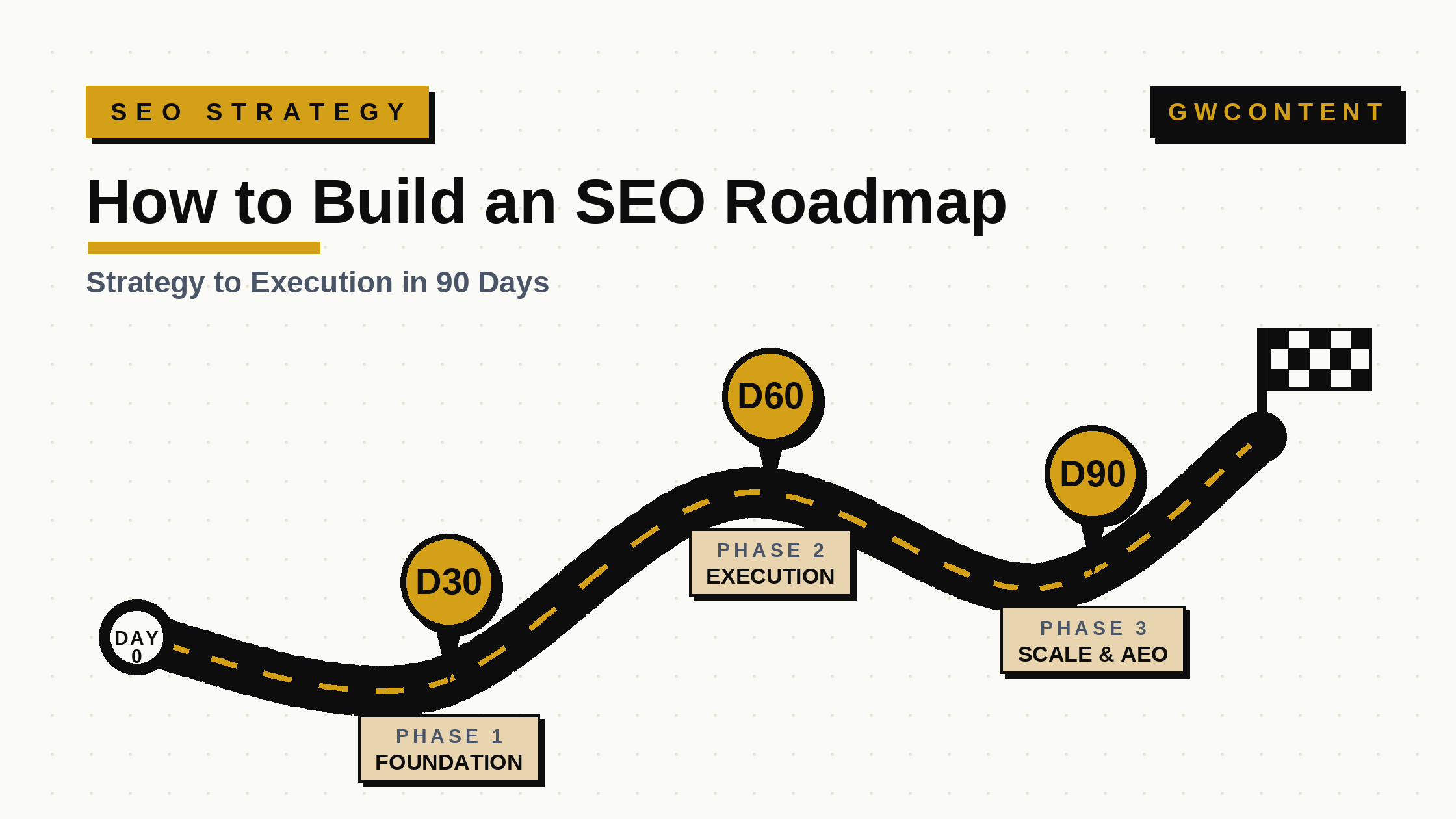
The framework runs in three phases, each building on the last. The sequence is deliberate: you fix the foundation before you build on it, you optimise what exists before you create more, and you scale authority and AEO once there is something worth amplifying.
- Phase 1, Days 1 to 30: Foundation. Technical SEO, the SEO audit, Google Search Console and Google Analytics set up properly, and the quick wins hiding in your existing data. Nothing else ranks reliably until this is done.
- Phase 2, Days 31 to 60: Execution. On page SEO across priority pages, the content strategy in production, internal links planned deliberately, and structured data implementation. This is where keyword rankings start to move.
- Phase 3, Days 61 to 90: Scale and AEO. Link building, off-page SEO, local SEO where relevant, and structuring content to earn citations in AI search. This is where search visibility compounds beyond traditional search results.
Phase 1 (Days 1 to 30): Foundation
The first month is unglamorous and non-negotiable. You run the SEO audit, fix the technical SEO issues that cap indexation (crawl errors, broken links, site speed, broken site structure), and get measurement right in Google Search Console and Google Analytics. In parallel, you ship the quick wins: the page-two commercial pages, the missing meta descriptions and title tags, the orphaned web pages that need internal links. Leadership sees early movement in month one precisely because this is where the cheapest wins live. The point of phase one is to remove the technical SEO issues that would otherwise make every later phase underperform.
Phase 2 (Days 31 to 60): Execution
With the foundation stable, month two is about page optimisation and content. You execute on-page SEO across the priority pages identified in keyword research: title tags, meta tags, heading structure, search-intent alignment, and on-page entity coverage. The content strategy moves into production against the keyword clusters, with each blog post briefed around a target keyword and its semantic neighbourhood. You plan internal links deliberately so authority flows to the pages that need to rank, and you add structured data so search engines correctly interpret your web pages. My on-page SEO checklist and structured data guide cover the execution details.
Phase 3 (Days 61 to 90): Scale and AEO
The final month scales what is now worth amplifying. Off-page SEO and link building earn the domain authority that lets competitive pages rank. Local SEO work (Google Business Profile optimisation, local citations, consistent NAP) runs here for any business with a physical or regional footprint. And critically, in 2026, you structure your optimised content to earn citations in AI search. Google's May 2026 updates pushed search further toward AI-synthesised answers, and pages structured for extraction now win visibility that traditional ranking alone does not capture. My AI Overview optimisation guide covers this layer.
Setting Goals Leadership Can Understand
This is where most SEO roadmaps quietly disconnect from the business. The fix is a discipline: every SEO goal must ladder up to a business goal, and every business goal must come back down to SEO metrics the team can actually move.
"Improve keyword rankings" is not a goal leadership can fund, because it does not obviously connect to money. "Own the 12 commercial keywords that drive our highest-intent organic traffic, growing organic-sourced pipeline by 30% in two quarters" is fundable, because the line from search visibility to revenue is explicit.
The translation looks like this.
| Business goal (leadership) | SEO strategy (the lever) | SEO metric (the team) |
|---|---|---|
| Grow a qualified inbound pipeline | Rank commercial-intent pages; AEO for buying queries | Keyword rankings on commercial terms, organic conversions |
| Reduce paid acquisition dependence | Build compounding organic traffic to money pages | Organic sessions, organic-sourced revenue share |
| Establish category authority | Topical content strategy, link building, E-E-A-T | Share of voice, domain authority, citations in AI search |
| Defend against AI search erosion | Structure content to earn AI Overview and AI Mode citations | AI search visibility, citation count, referral conversions |
Two more rules make goals legible.
First, separate leading metrics from lagging metrics.
Organic traffic and revenue are lagging: they move in months four to twelve.
Pages optimised, technical SEO issues resolved, and content shipped are leading: they move weekly and prove the roadmap is being executed before the revenue arrives.
Report both, and you keep leadership confident during the inevitable gap between work and results. Second, set goals against a baseline you actually recorded in Google Search Console and Google Analytics, so "progress" is a number and not a feeling.
The Tools That Power the Roadmap
SEO runs on a mix of free and paid resources, and a roadmap should be explicit about which essential tools the team needs. You do not need every tool on the market. You need the few that cover diagnosis, execution, and measurement, and the discipline to actually use them.
The free foundation is non-negotiable: Google Search Console for index coverage, queries, and keyword rankings, and Google Analytics for organic traffic and conversions. These two are the measurement spine of every roadmap, and they cost nothing.
On top of that sit the paid tools that earn their place: Ahrefs for keyword research, competitive analysis, and domain authority tracking; Screaming Frog for crawling and finding technical SEO issues like broken links and crawl errors; and Surfer SEO for on-page content optimisation against the target keyword. On a WordPress site, Yoast SEO handles the basics of meta tags, title tags, and XML sitemaps at the page level. My full content marketing tools stack breaks down what each tool actually earns its place doing.
Alongside the paid stack, I built a set of free SEO tools that cover the measurement layer of a roadmap directly: an AEO readiness score for the AI search layer, an E-E-A-T score checker for content trust signals, a schema markup generator for structured data implementation, and a content decay detector for spotting optimised content that is losing ground.
The SEO ROI calculator is the one to put in front of leadership: it turns the roadmap into the spend-to-return number they will actually weigh against paid media.
Building SEO Knowledge Across the Team
A roadmap is only executable if the SEO team has the SEO knowledge to run it. If you are an SEO specialist handing this to a marketing generalist, or a founder executing it yourself, build a small upskilling track into the plan. You do not need to become an SEO expert to execute a good roadmap, but everyone touching it should understand the SEO basics and SEO principles behind the work they are shipping.
For learning SEO without spending a penny, the strongest free resources are Google's own SEO Starter Guide in Google Search Central, which is the single most authoritative free reference on how search engines actually work, and the documentation around Core Web Vitals on web.dev for the technical SEO side.
Beyond Google's free resources, Ahrefs and Backlinko both run a genuinely useful YouTube channel and free online courses, and the fastest way to build real SEO knowledge is to practise SEO on your own site. That is exactly why I built Three Putt Golf from a blank domain: the best way to learn SEO is to run the whole optimisation process on your own websites, where the stakes are real, and the feedback is honest. Mixing free and paid resources is fine. What matters is that the SEO journey includes hands-on reps, not just reading.
My SEO Roadmap Template
This is the interactive 90-day SEO roadmap template I use as the starting skeleton on client engagements. Each phase is collapsed to keep it scannable.
Click any phase to expand its objective, key deliverables, owner, the SEO metrics it is measured against, and the tools it runs on.
Treat it as a structure to adapt, not a script to follow blindly: the sequencing logic holds, the specifics flex to your site.
The 90-Day SEO Roadmap
Five phases, from pre-work inputs to compounding scale. Click to expand each.
0Pre-work · Week 0Inputs & DiagnosticGather the data the roadmap sequences. Never skip this.
Establish the factual baseline. You cannot sequence work you have not diagnosed, and you cannot prove progress against a baseline you never recorded.
- Technical SEO audit and full crawl
- Keyword research mapped to search intent
- Google Search Console & Google Analytics baselines
- Competitive analysis and gap report
- Indexed web pages vs submitted
- Starting keyword rankings & positions
- Baseline organic traffic & conversions
- Domain authority vs competitors
1Days 1 to 30FoundationFix what caps everything else. Ship the quick wins.
Remove the technical SEO issues that cap indexation and ranking, get measurement right, and capture the cheapest wins hiding in existing data. Leadership sees early movement here.
- Fix crawl errors, broken links, indexation issues
- Improve site speed & Core Web Vitals
- Resolve thin / duplicate web pages & site structure
- Quick wins: page-two pages, title tags & meta descriptions
- Technical SEO issues resolved
- Core Web Vitals pass rate
- Index coverage improvement in GSC
- Early ranking movement on quick-win pages
2Days 31 to 60ExecutionOptimise what exists. Put content into production.
Execute page optimisation across priority pages and move the content strategy into production against the keyword clusters. This is where keyword rankings start to move.
- On page SEO: title tags, meta tags, headings
- Content strategy in production (briefed per target keyword)
- Internal links planned so authority flows to money pages
- Structured data implementation (Article, FAQ, Organization)
- Pages optimised vs planned
- Quality content published vs calendar
- Keyword rankings on target keywords
- Rising organic traffic to optimised pages
3Days 61 to 90Scale & AEOAmplify what is now worth amplifying. Win AI search.
Build the authority that lets competitive pages rank, capture local search where relevant, and structure optimised content to earn citations in AI search. This is where search visibility compounds.
- Link building & off page SEO (digital PR, placements)
- Local SEO: Google Business Profile, citations, NAP
- Content structured for AI Overview / AI Mode citations
- Topical cluster completion for category authority
- Referring domains & domain authority gain
- Citations in AI search / AI Overview visibility
- Compounding organic traffic curve
- Organic conversions & pipeline
∞Day 90 and beyondCompound & ReportTurn the first 90 days into a programme that compounds.
Review against the baseline, report to leadership in business terms, and roll the next 90-day roadmap. SEO is compounding work, not a one-off project.
- 90-day report: results vs baseline, in business terms
- Content refresh cadence for decaying pages
- Ongoing biweekly execution sprints
- Next 90-day roadmap sequenced from new data
- Organic traffic vs baseline
- Organic-sourced revenue / pipeline
- Keyword rankings & search visibility trend
- ROI vs spend (the leadership number)
Want this built for your site rather than a blank template? A free SEO audit gives you the inputs phase done for you: the technical SEO issues, the keyword research, and the quick wins, sequenced into a roadmap leadership will fund and your team can execute.
How to Present the Roadmap to Leadership
A roadmap that wins budget is presented, not emailed. When I take a roadmap into a leadership meeting, I run it in one specific order, and it takes about ten minutes.
Open with the business goal, not the SEO. "Here is the organic pipeline target and why it matters this quarter." Then show the curve: the realistic compounding shape of SEO, with the gap between work and results made explicit so nobody panics in month two.
Then the three phases are outcomes, not tasks. Leadership does not need the 200-row backlog; they need to understand that month one makes month two possible.
Then the number: spend against expected return, anchored on credible data. FirstPageSage's 2026 research putting SEO at roughly $22 returned per $1 invested is the kind of benchmark that reframes the conversation from cost to investment. Close with the single decision you need from them, whether that is sign-off, budget, or developer time.
Keep the executable detail one click away, not in the room. That is the entire logic of the layered template above: the surface is for the meeting, the detail is for the team. Walk in with a 60-tab spreadsheet, and you will lose the room.
Walk in with one page and the detail on standby, and you look like someone who has already done the thinking.
Common SEO Roadmap Mistakes
Across the roadmaps I have built and the many I have inherited, the same mistakes recur.
Buying links to technically broken pages, or briefing content before keyword research is done. Each phase should unblock the next. Foundation before execution, execution before scale.
A roadmap of SEO tasks with no line to revenue or pipeline loses every budget review. Every SEO goal must ladder up to a business goal leadership already cares about.
Skipping the SEO audit, keyword research, and competitive analysis means confidently sequencing the wrong work. The diagnostic layer is not optional.
If you did not snapshot Google Search Console and Google Analytics at the start, you cannot prove progress at the end. "It feels better" is not a report.
Roadmaps written for traditional search results only are already dated. With AI Overviews compressing click-through on informational queries, structuring content for AI search citations belongs in the plan, not as an afterthought.
Annual SEO plans are fiction past the first quarter. Work in 90-day roadmaps that compound, reviewed and re-sequenced against fresh data each cycle.
Measuring Roadmap Success
Three things make reporting credible. Always report against the baseline you recorded in Google Search Console and Google Analytics, so every number has a reference point.
Attribute conversions, not just rankings: a page ranking first that converts nobody is a vanity result. And track AI search visibility separately, because with Google's May 2026 core update pushing further into AI-synthesised answers, traditional ranking alone increasingly undercounts the value SEO is actually delivering.
The roadmap is not finished by day 90. It is reviewed, reported, and rolled into the next one.
The Bottom Line
An SEO roadmap is the difference between SEO as a vague cost line and SEO as a sequenced, fundable, measurable programme. The ones that work serve two audiences at once: leadership reads the strategy and the business case, and the team reads the executable SEO projects.
They are built on real inputs, sequenced by dependency and impact rather than by tactic, and tied to business goals leadership already cares about.
The 90-day structure is the unit that actually runs: foundation, then execution, then scale and AEO, reviewed against a baseline and rolled into the next cycle. Use the interactive template above as your starting skeleton.
The sequencing logic holds across almost every site. The specifics are where your audit, your keyword research, and your own data take over.
Want your roadmap built for you?
Get a free SEO audit and I will turn your site's inputs into a sequenced 90-day roadmap: the technical SEO issues, the keyword research, and the quick wins, prioritised so leadership will fund it and your team can execute it.
Get a free SEO auditFrequently Asked Questions
What is an SEO roadmap?
An SEO roadmap is a strategic document that sequences your SEO efforts over a defined timeline, translating business goals into prioritised SEO projects with owners, dependencies, and measurable outcomes. It connects three layers: business goals at the top, SEO strategy in the middle, and specific SEO projects at the bottom. It is the artefact that makes SEO legible to leadership and executable for the team at the same time.
How long should an SEO roadmap be?
Work in 90-day roadmaps that compound into each other rather than annual SEO plans. Ninety days is long enough to ship foundational technical SEO and see early ranking movement, and short enough that leadership will commit to it and review it. Each 90-day cycle is re-sequenced against fresh Google Search Console and Google Analytics data.
Who owns the SEO roadmap?
An SEO specialist or SEO expert owns the roadmap and its sequencing, but execution is shared across the SEO team, developers (for technical SEO issues and site speed), and content writers. Leadership owns the business goals that the roadmap ladders up to. The roadmap is the shared document that keeps all of them aligned.
What tools do I need to build an SEO roadmap?
The free foundation is Google Search Console and Google Analytics. On top of that, the paid tools that earn their place are Ahrefs for keyword research and competitive analysis, Screaming Frog for crawling, and Surfer SEO for on-page optimisation. On a WordPress site, Yoast SEO covers page-level basics. The free SEO tools at GWContent cover the AEO, E-E-A-T, schema, and content decay measurement layers.
How is an SEO roadmap different from an SEO audit?
An SEO audit is a diagnostic of the current state: it tells you what is wrong and what the opportunities are. An SEO roadmap is what you build from that diagnosis: a sequenced, time-bound plan of what you will do about it and in what order. The audit is an input to the roadmap, not the roadmap itself.
How do I make an SEO roadmap that leadership will fund?
Tie every SEO goal to a business goal, lead with the compounding ROI rather than the tactics, present phases as outcomes rather than tasks, and keep the executable detail one click away. Anchor the business case on credible data: SEO returns roughly $22 per $1 invested on average, with break-even typically between months six and nine.
Can I build an SEO roadmap myself without being an SEO expert?
Yes. You do not need to be an SEO expert to execute a good roadmap, but you should understand the SEO basics behind the work. Use the interactive template on this page as your structure, ground it in real inputs (audit, keyword research, your own data), and build SEO knowledge as you go using free resources like Google's SEO Starter Guide. Practising SEO on your own site is the fastest way to learn.