Custom GPTs for Marketing: Build Tools That Scale Your Content
Published: June 10, 2026 Read time: 12 minutes
Author: Graeme
Most marketers no longer struggle to create content. They struggle to create it consistently, in their brand voice, at the pace their channels demand. That problem is exactly what custom GPTs solve.
Custom GPTs for marketing are tailored versions of ChatGPT configured for one specific job, such as scoring drafts, mapping content to the buyer journey, or writing alt-text at scale. You build one by combining written instructions, knowledge files like brand guidelines, and capabilities such as web browsing, then share it with your whole team through a single link.
Over the last year, I have built and used a stack of them on client projects. Some handle the repetitive tasks that eat up a marketing team's week. Others act as a second pair of eyes before you hit publish. None is flawless, but all of them save me hours, and I share them publicly so other marketers can use them for free.
Table of Contents
What Is a Custom GPT?
A custom GPT is a tailored version of ChatGPT that you configure for one specific job. You give it written instructions, upload knowledge files such as brand guidelines or a style guide, and switch on capabilities like web browsing or data analysis. The result is an AI assistant that does one thing consistently well, without you re-explaining the brief in every chat.
Anyone with a paid ChatGPT plan can build one. OpenAI's guide to creating a GPT covers the mechanics, and once published, your GPT gets a shareable link. Free users can use it; only building requires a subscription.
Why Custom GPTs Beat a Blank ChatGPT Window
Adoption is no longer the differentiator. Salesforce's generative AI research shows the overwhelming majority of marketers already use AI somewhere in their workflow. The gap now sits between marketers who type ad-hoc prompts into a generic chat and marketers who build their own GPT for each recurring job.
The difference comes down to four things:
- Consistency. A custom GPT carries your brand voice, brand tone, and voice guidelines into every output. No more pasting the same style guide into every conversation as manual input.
- Speed. The brief is baked in. You go straight from task to output, which is how you scale content creation without sacrificing quality.
- Focus. A GPT built for one job refuses to drift. It will not turn a page audit into a poem.
- Shareability. One link gives your whole marketing team the same tool, the same instructions, and the same standard. That is marketing automation at its cheapest.
In other words, custom GPTs turn AI from a novelty into a repeatable part of your marketing strategy. The strategic advantage is not the model. Everyone has the model. The advantage is the thinking you encode into it.
Five Custom GPTs I Built for Marketing Work

These are the five tools I have built, tested on real client projects, and shared on LinkedIn. All of them are free to use, and none of them need logins, dashboards, or setup.
The Quick Content Assessor
Most marketers no longer struggle with content creation. They struggle with content judgment: knowing whether a draft is actually good enough to publish. The Quick Content Assessor reads your draft and gives an instant, plain-English verdict across five layers: clarity, structure, intent, tone, and engagement. It will not give you keyword data, because you already have tools for that. It gives you the editorial gut-check most teams are missing.
The Page Scorer GPT
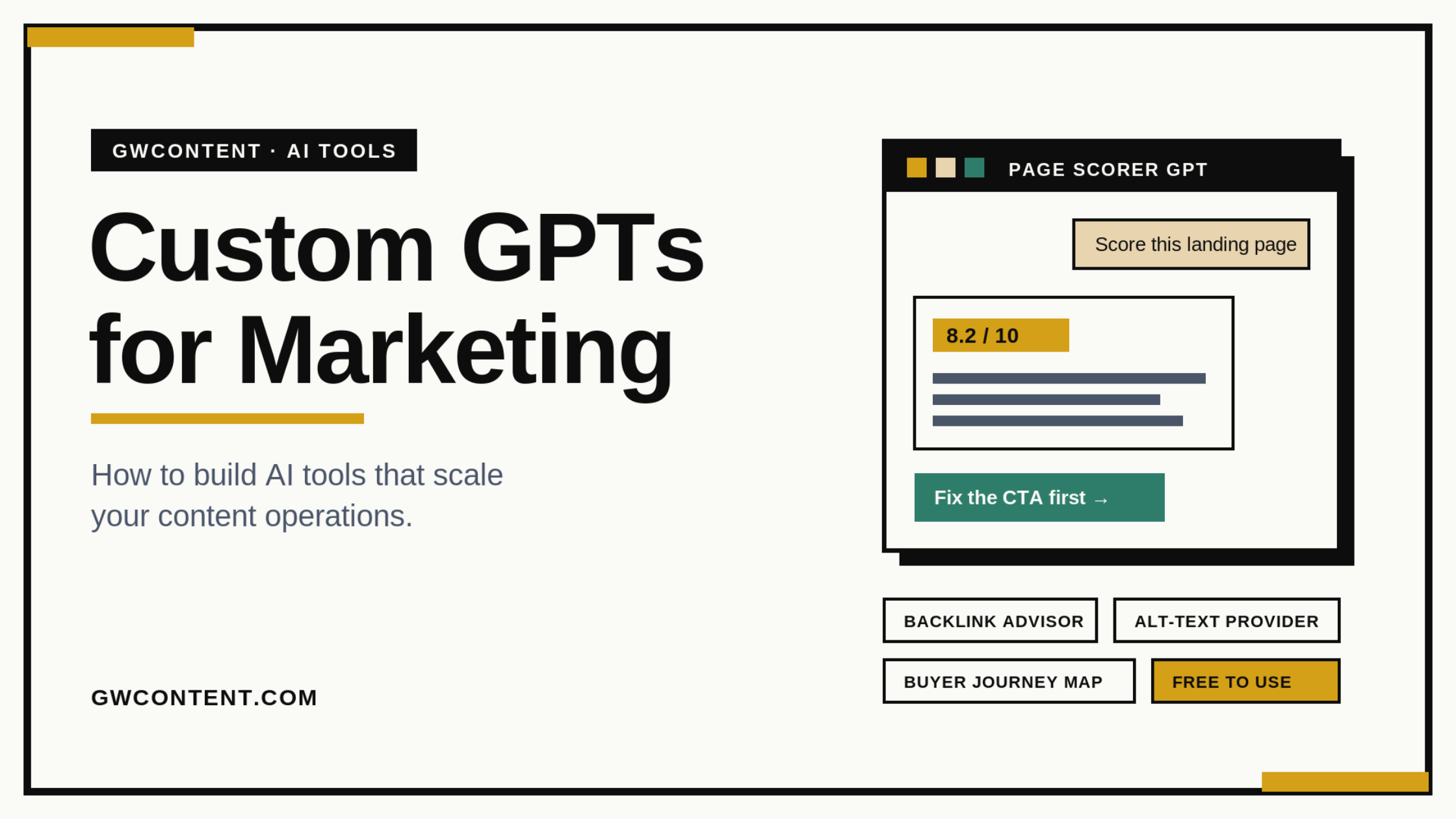
There are endless tools that analyse your pages, but sometimes you do not need more data. You need a sense check. Page Scorer GPT scores any URL across wording, technical SEO, and user experience, then tells you what to fix first. It assesses how a page feels to a real reader deciding whether to stay, click, or leave, which is exactly what a conversion rate lives or dies on. Pair it with my on-page SEO checklist when you act on the findings.
The Buyer Journey Assessor
Most brands do not need more content. They need better funnel balance. The Buyer Journey Assessor maps your blog posts to awareness, consideration, decision, and retention stages. I ran it across a client's last 50 posts and found 25 sat in retention while only 4 targeted awareness. They were brilliant at keeping customers engaged and almost invisible to new, high intent prospects. It also recommends a next action per URL, such as adding a case study CTA or pricing comparison, so it feeds directly into your content strategy rather than just describing it.
The Backlink Advisor
The Backlink Advisor takes a brand name, yours or a competitor's, and returns a tailored link-building strategy: outreach targets with angles and pitch templates, relevant review sites and directories, a 90-day roadmap, and a prioritised opportunity map scored by effort versus reward. It does not replace Ahrefs, and it is not trying to. It is for the marketer flying solo who needs to go from "where do I start?" to a 30-site outreach plan in one sitting.
The Alt-Text Provider
Alt-text is underrated. Everyone talks about backlinks and topical authority, yet alt-text quietly shapes how AI systems and search engines interpret your visuals. Most of it is missing, wrong, or keyword-stuffed. The Alt-Text Provider writes human-sounding, brand-aligned alt-text that works for accessibility, search engines, and the LLMs learning from your site, and it scales across hundreds of images in a single batch. If you care about getting cited by AI, this is low-effort groundwork. My guide on how to rank in ChatGPT explains why these signals matter more every month.
How to Build Your Own Custom GPT

Building your own GPT takes an afternoon, not a development budget. Here is the process I follow:
- Pick one painful, repeatable job. The best custom GPTs solve problems you face weekly: briefing writers, scoring drafts, writing ad copy variants, summarising PPC campaigns. One GPT, one job. Resist the urge to build a do-everything assistant.
- Write instructions like a job description. Define the role, the exact output format, the tone, and what the GPT must never do. Specificity is the whole game. "Be helpful" produces mush; "score the page from 1 to 10 across these three criteria and explain each score in two sentences" produces a tool.
- Upload knowledge files. Brand guidelines, voice guidelines, sample outputs, product messaging docs. These are the data sources that separate your GPT from generic AI output and keep everything on-brand.
- Enable the right capabilities. Web browsing if it needs to pull data from live URLs, data analysis if it needs to crunch spreadsheets. Leave everything else off to keep it focused.
- Test it against work you have already done. Run it on tasks where you know what good looks like, then compare. Gaps in the output are gaps in your instructions.
- Share it and continuously refine. Real user interactions will surface weaknesses you never predicted. Every GPT I have shared improved because someone used it in a way I did not expect.
More Custom GPT Ideas for Marketing Teams
Beyond my five tools, here are builds I would prioritise for most digital marketing teams:
- Ad copy generator trained on your brand tone and best-performing creatives, producing platform-ready variants for testing.
- PPC campaign analyst that reads exported campaign data and flags wasted spend, weak ad groups, and follow ups worth testing.
- Competitor research assistant that profiles competitors' positioning and messaging from their public pages.
- Landing page brief builder that turns a keyword and audience into a wireframe-level brief with headline options and CTA placement.
- Email follow-up writer that drafts sequences in your voice from a single bullet-point summary of the conversation.
- Reporting translator that converts analytics exports into plain-English insights your stakeholders actually read.
If you want to see how these fit alongside conventional software, my round-up of content marketing tools covers the wider stack.
Hosting Tools on Your Own Website

Here is the part most marketers miss. The GPT Store is a fine distribution channel, but every chat happens on OpenAI's domain. The traffic, the engagement, and the lead never touch your site.
So I went one step further and built free tools directly into my own website. My tools hub hosts an E-E-A-T score checker, an AEO readiness score, a content decay detector, and more. The logic is simple:
- You own the traffic. A tool page is a landing page that earns links, ranks for tool-intent keywords, and captures visitors at the exact moment they have a problem.
- Tools build authority. Useful interactive assets are exactly the kind of expert insights that strengthen E-E-A-T and earn citations from AI assistants. McKinsey's State of AI research shows organisations redesigning workflows around AI, and the brands that productise their expertise are the ones getting referenced.
- Tools qualify leads. Someone who runs your scorer on their own site has told you exactly what they need before they ever email you.
Start in the GPT Store because it is fast and free. Graduate to your own site because that is where the compounding value lives.
Want this done for your brand? Building tools is one layer of what I do as an AEO and SEO consultant. The bigger picture is making your content rank on Google and get cited by ChatGPT. Start with a Content Strategy Blueprint, an AI Visibility Audit, or a full-stack retainer if you want ongoing senior-level delivery.
Work With Me
Every tool above is free, and they will get you a long way on their own. But tools flag problems; a consultant fixes them. I work with SaaS, eCommerce, and enterprise brands as a hands-on SEO and AEO consultant: content strategy, AI visibility, and the execution behind both. No juniors, no handoffs. If that is the kind of help you need, explore my Content Strategy Blueprint or get in touch directly.
And if you want to see new tools as I release them, follow me on LinkedIn. That is where every GPT lands first.
FAQs About Custom GPTs for Marketing
Do I need to code to build a custom GPT?
No. You build the entire thing in plain English through ChatGPT's GPT editor: write instructions, upload knowledge files, toggle capabilities, and publish. Code only enters the picture if you connect custom actions to external APIs, and most marketing use cases never need that.
Are custom GPTs free to use?
Using a shared GPT is free for anyone with a ChatGPT account. Building and publishing one requires a paid ChatGPT plan. All five of my GPTs are free to use via the links above, with no signup beyond a standard ChatGPT login.
What are the best custom GPTs for marketing?
The best custom GPTs for marketing solve one recurring job well: content scoring, buyer journey mapping, link-building strategy, alt-text writing, or brief building. You can explore GPTs in the GPT Store by searching for the task, but always test a GPT against work you already know is good before trusting it on live projects.
Can a custom GPT replace my SEO tools?
No, and it should not try. GPTs excel at judgment, structure, and first drafts. Ahrefs, GSC, and your analytics stack remain the source of truth for data. The winning setup combines both.
How do custom GPTs keep content on-brand?
Through knowledge files. Upload your brand guidelines, style guide, and strong past examples, then instruct the GPT to follow them in every output. That is how you scale volume without diluting voice.