Entity SEO: How Search Engines Use Knowledge Graphs
Published: 11 May 2026 | Last updated: 11 May 2026 | 12 min read
When I launched Three Putt Golf Clothing from a blank domain in September 2025, I did not start with keywords. I started with entities. Six months later: 6,795 organic clicks, 668,000 impressions, average position 4.5, 64.74% CTR on the primary brand query. None of that happens without an entity SEO foundation. This article covers what entity SEO is, why it matters more than keyword targeting in 2026, and the framework I use on every client engagement.
The headline answer
Entity SEO is the practice of optimising content for the people, places, things, concepts, and brands that search engines recognise as distinct entries in their knowledge graphs. Where traditional search engine optimization targets keywords, entity based SEO targets the underlying concepts those keywords represent. Google uses named entity recognition, structured data, machine learning, and natural language processing to map content into a structured database of entities and the semantic relationships between them. Pages that signal which entities they cover, and how those entities connect across the web, rank better, get cited in AI Overviews, and earn the kind of compounding visibility that keyword-only strategies cannot deliver.
About the author
Graeme Whiles is an independent SEO and AEO consultant at GWContent. He has worked with enterprise and SaaS brands including Originality.ai, Connecteam, 6sense, and Practice Better. He built Three Putt Golf Clothing from a blank domain as a live proof of concept for his entity-first methodology.
Short on time? Here are the key takeaways
- Entity SEO has replaced keyword-only optimisation as the dominant ranking framework. Google's Knowledge Graph and the AI systems built on top of it (Google AI Overviews, ChatGPT, Perplexity) reason in entities, not in strings.
- Google announced the Knowledge Graph in 2012 and has been refining entity understanding for over a decade.
- Entity SEO matters most where keyword competition is high or where brand authority is being built from zero.
- Three Putt Golf was built as a live entity SEO proof of concept. The result: 6,795 clicks and 668,000 impressions in six months from a domain that did not exist before launch.
- The free SEO tools at GWContent cover the implementation layer of entity SEO.
What Entities Actually Are (And Why They Matter)

An entity is anything specific enough that search engines can identify it as a distinct entity: a person, a place, a product, a concept, a company. "Tiger Woods" is an entity. "Mizuno irons" is an entity. "Sorona fabric" is an entity. What makes entities different from keywords is that entities exist in semantic relationships with each other.
Google knows Tiger Woods and Augusta National are connected. It knows Mizuno irons and Japanese golf brands are connected. The relationships are the value. When users search Google, the search system runs entity extraction on the user query, decides which entity matches the user intent, and ranks content based on which pages cover that main entity plus its related entities. Pages that help search engines understand all the entities on the page outperform pages that bury the same information in keyword-dense paragraphs.
This is the underlying technology behind Google search, AI Overviews, ChatGPT citations, Perplexity answers, and every modern search system. Strings of text are decoded into entities through named entity recognition, then mapped against the knowledge graph to determine relevance, authority, and trust. The older latent semantic indexing approach estimated topical relevance through co-occurring terms; modern entity SEO uses an explicit structured database of verified relationships.
Why Entity SEO Matters More in 2026
Three forces have made entity optimisation essential.
The first is the AI search layer. AI systems extract the entities mentioned in your content, link each to its internal representation, and decide whether to cite you based on entity authority. Pages with strong entity signals win citations in AI search; pages without them are invisible to the citation layer, regardless of how well they rank in traditional blue links.
The second is the Knowledge Graph itself. Google has built its structured database of entities for over a decade. Pages connected to an authoritative entity (a Wikipedia page, a verified Google Business Profile, a domain Google already recognises) inherit authority through entity linking. Pages outside the entity graph are functionally invisible to semantic search features and context aware answers from AI assistants.
The third is competitive saturation. Keyword-only SEO produces marginal gains in saturated categories. An entity strategy produces structural advantages because once your brand becomes a distinct entity Google recognises, every page you publish contributes to that entity's authority rather than competing in isolation for individual search queries. Entity SEO helps both new and established brands, but the lift is biggest where competitors have not yet built their own web presence as recognisable entities, ranking across hundreds of relevant search results rather than ten blue links for a handful of head terms.
Knowledge Panels and Entity Recognition
The most common misunderstanding about entities in SEO is that the goal is to trigger a Google knowledge panel. The panel is a visible byproduct of knowledge graph recognition, not the goal.
An entity can exist in the knowledge graph without ever triggering a panel. Panels appear only when Google is confident the entity is well-defined, has enough search demand, and has no overlapping entities. Many brands I work with achieve full entity recognition (Google clearly understanding them as a distinct entity, ranking them as the authoritative entity for relevant queries, citing them in AI Overviews) without ever earning a panel. The strategic objective is knowledge graph inclusion and the trust signals that come with it.
Focus on entity authority, consistency, and connections first. The panel follows when the entity exists clearly enough that Google has nothing to be uncertain about.
The Three-Putt Approach: Building an Entity From Zero

I launched Three Putt in September 2025 to prove entity SEO works at the brand-building level. The strategy ran in three layers.
Layer one: connect the brand to authoritative entity neighbourhoods. Three Putt cannot compete on raw domain authority, but it can connect to entities Google already recognises: tournament golf, Japanese golf brands, old school golf culture, Sorona fabric, sustainable apparel. The blog cluster was built to create those connections through content that references and links to other entities. Linking entities together is the fastest way to inherit relevance for a new domain.
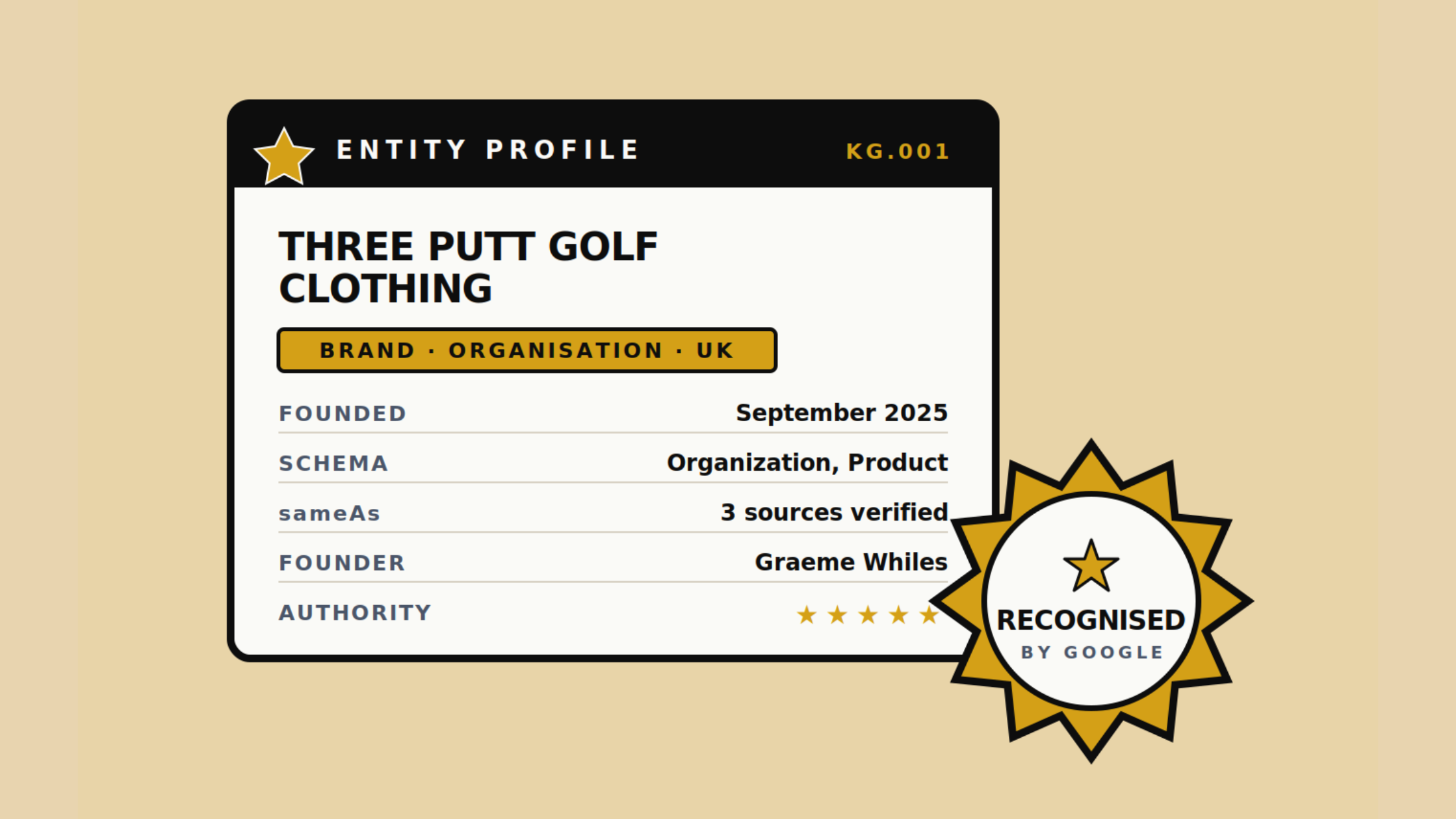
Layer two: define the brand as its own distinct entity. Every page signals Three Putt through schema markup: Organization schema with consistent naming, Person schema for the founder, Product schema, location data (UK), founder story, mascot. The structured data for SEO guide covers how to implement structured data at this layer. The AI info page and llms.txt file give AI systems a reference for who the brand is. sameAs properties confirm the same entity exists across the web.
Layer three: maintain consistency across the web. The same brand name, founder, location, and positioning appears on every page, in every schema block, on the Google Business Profile, and in every external mention. Entity resolution (Google deciding two mentions refer to the same entity) only works when the signals are consistent. Inconsistent naming or contradictory schema fragments the entity and slows recognition by months.
Six months later: 6,795 clicks, 668,000 impressions, position 4.5, 64.74% CTR on "three putt golf." The brand is now treated by Google as the canonical entity for its category. Read the Three Putt case study.
The Framework: How to Implement Entity SEO

For client engagements, the entity SEO strategy runs in four steps.
Step one: identify entities. Every business has a primary entity (usually the brand) and 5 to 15 supporting core entities (products, founders, services, locations, key concepts). The content marketing consultant approach starts every engagement with this mapping exercise.
Step two: map your entity neighbourhood. What authoritative entities is your primary entity related to? For SaaS, this includes industry concepts, competitor names, and technical terms. For ecommerce, this includes product categories, materials, and lifestyle concepts. Each connection is an opportunity to capture semantic relationships and inherit authority through entity linking.
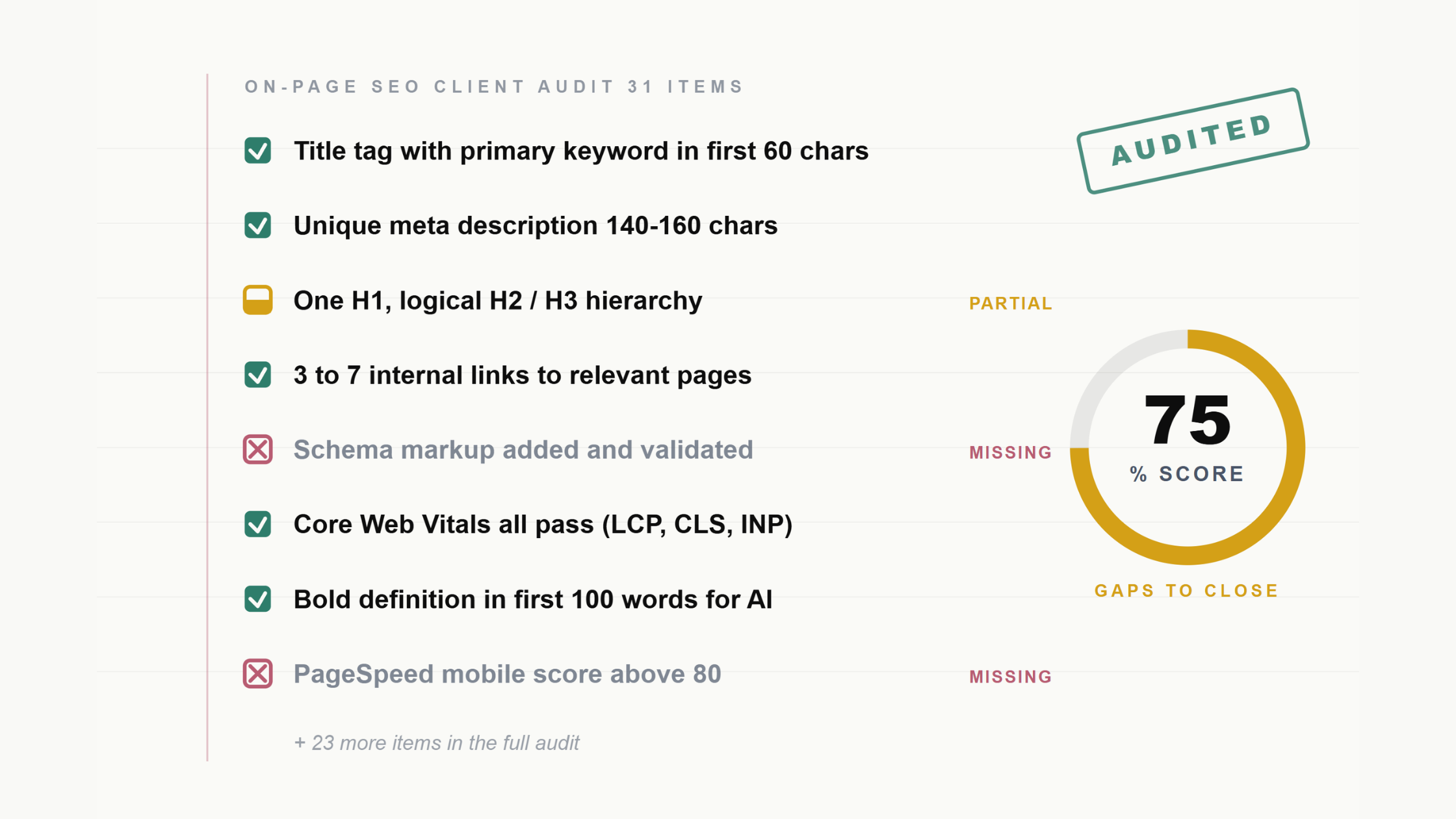
Step three: implement structured data and entity signals. Schema markup is the most direct way to define entities to search engines. Organization schema for the brand, Person schema for founders and authors, Product schema for products, Article schema for content. Use Google's Rich Results Test to validate. Add sameAs properties pointing to authoritative external mentions (Wikipedia, LinkedIn, Crunchbase, industry directories) so the same entity exists across the web with verifiable provenance. The on-page SEO checklist covers where these signals sit on each page, including placing the main entity early in the title tag and H1.
Step four: connect entities through internal linking. Internal links between entity-defining pages signal which entities your site treats as connected. The semantic SEO guide covers the broader topic neighbourhood approach. The same entity should be discussed consistently across web pages on your own website, with each page reinforcing the definition. This is how machine learning models build a stable representation of what your brand is authoritative for.
Where to Start: First 30 Days
The highest-leverage actions in the first month are tactical. These are the key elements I implement on every new engagement.
★ ENTITY SEO: FIRST 30 DAYS
- Audit your current schema. Use the Google Rich Results Test on your homepage, primary product pages, and About page. Note which entities are currently defined and which are missing.
-
Implement Organization schema with full
sameAsproperties. Link to your LinkedIn company page, Crunchbase listing, Wikipedia page if one exists, and major industry directories. This builds entity authority through verified external references. - Claim and complete your Google Business Profile. Even pure-online brands benefit from a complete profile. Consistent NAP across this profile and your site is fundamental to entity resolution.
- Write or rewrite your About page as your entity home. One canonical place where Google can read what your brand is, who founded it, where it operates, and what it does. This page should be the most-linked-to internal page on your site.
- Set up Google Alerts and Google Search Console monitoring for your brand and primary product names. Watch for inconsistent naming in external coverage and request corrections where possible.
- Plan three topical content pieces connecting your primary entity to your entity neighbourhood. Not keyword-targeted; entity-connection targeted.
Do these six and you have done more entity SEO than 90% of competing brands. Everything else compounds on this foundation.
The Entity Web: Explore Yours
Click the central node to start. Reveal the six entity types Google needs to see signals for, then expand each one for examples, detection methods, and implementation signals.
Interactive tool
The Entity Web
0 of 6 entity types explored. Click the centre to reveal your brand's entity neighbourhood, then click each entity type to expand its details.
Common Entity SEO Mistakes
⚠ Mistake 01 · Inconsistent brand naming
"Three Putt" vs "Three Putt Golf" vs "Three Putt Golf Clothing" across pages fragments knowledge graph recognition. Pick one canonical name and use it everywhere on your own website and across the web.
⚠ Mistake 02 · Missing or incomplete schema
Schema is the most direct signal of entity definition. Sites without Organization, Person, and Product schema are invisible to the entity layer of Google search and other search systems.
⚠ Mistake 03 · No external entity signals
A brand that only exists on its own domain is harder for search engines to understand than a brand mentioned on Wikipedia, in industry publications, and across review sites. Build external entity signals through digital PR and authoritative directory listings.
⚠ Mistake 04 · Treating entities as keywords
Stuffing a page with entity-flavoured keyword variations is not entity SEO. It is about signalling which specific entity a page covers and how it connects to other entities, not optimising for entity-themed phrases.
The Originality.ai engagement that grew from 278,000 to 1.18 million monthly sessions hit exactly these issues in the first audit. Fixing inconsistent schema, defining the brand as a distinct entity, and connecting it to the AI detection entity neighbourhood produced the compounding growth. Without the entity work, the content would not rank content at the scale it did.
Frequently Asked Questions
What is entity SEO?
Entity SEO is the practice of optimising content for the people, places, things, concepts, and brands that search engines recognise as distinct entries in their knowledge graphs. It uses structured data, internal linking, named entity recognition signals, and external authority connections to make a brand recognisable as a specific entity rather than a string of keywords. Entity SEO helps Google understand who you are, what you offer, and where you belong.
How is entity SEO different from semantic SEO?
Entity SEO focuses on making specific entities recognisable. Semantic SEO covers the broader semantic understanding of relationships between entities and concepts in semantic search. The disciplines overlap heavily, and modern strategies combine both.
What tools help with entity SEO?
The free SEO tools at GWContent cover schema generation and AEO readiness scoring. Google Search Console, Google's Natural Language API demo, and Google Alerts identify which entities your content signals. The Google Knowledge Graph Search API verifies whether a specific entity exists in Google's understanding.
How long does entity SEO take to show results?
Schema implementation can show results in four to eight weeks. Full knowledge graph recognition typically takes three to six months of consistent signalling. Triggering a knowledge panel takes longer and depends on search demand.
What is the difference between a knowledge graph and a knowledge panel?
The knowledge graph is Google's structured database of entities. The knowledge panel is the visible card that sometimes appears on the right side of search results. An entity can exist in the knowledge graph without ever triggering a panel. The goal is knowledge graph inclusion, not panel visibility.
The Bottom Line
Entity SEO is the framework underneath modern Google search, AI Overviews, AI search systems, and Google Discover. The same signals drive AI Overview visibility and AI search citations (the AI Overview optimisation guide covers that implementation specifically). Brands that signal their entities clearly outrank brands that rely on keyword density. Three Putt proved this from zero; Originality.ai proved it at scale.
Get a free SEO audit and I will map your current entity signals against your competitive entity neighbourhood. You will see which entities Google recognises you for, which you should be connected to but are not, and where the fastest wins are. It is the easiest way to find out whether your brand is being treated as a distinct entity or still floating as a string of keywords.