
The Converstational Keyword Advisor

Traditional keyword research tools were built for Google.
But search has evolved, and so have the ways people ask questions.
When users open ChatGPT, Claude, or Perplexity, they don’t type “best invoice template UK.” They ask, “Can you show me a simple VAT invoice template for freelancers?”
That shift matters.
Because while legacy keyword tools surface phrases optimised for algorithms, Answer Engines rely on natural, conversational intent.
The Conversational Keyword Advisor was built to bridge that gap, helping you uncover human-sounding, intent-rich query variants that reflect how people actually talk to LLMs. It’s designed to give SEO strategists, content leads, and growth teams the missing layer between keyword data and human dialogue, so your content is optimised for how search really works now.

What It Does
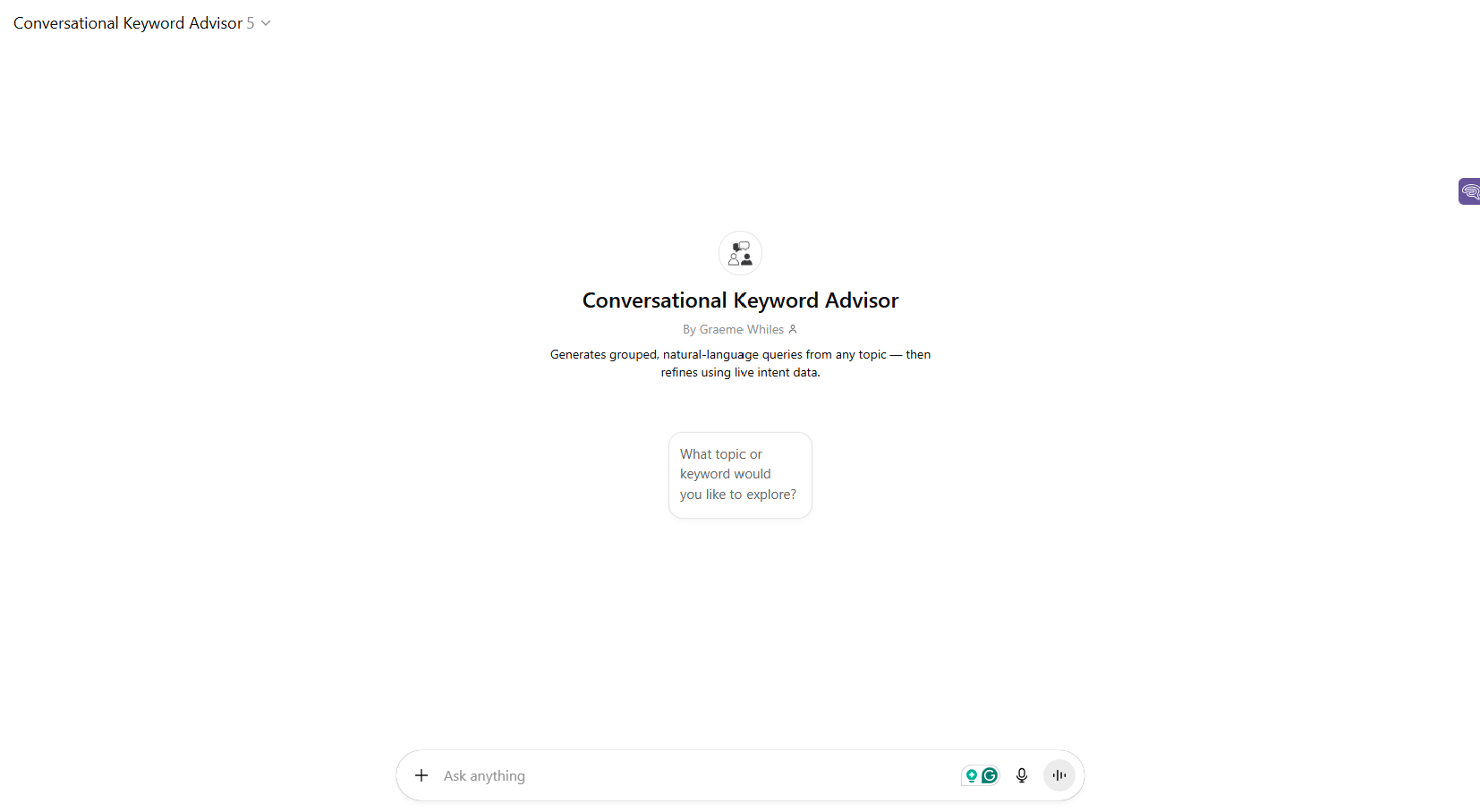
The Conversational Keyword Advisor reveals how real people phrase their searches inside AI tools, not how keyword planners think they do.
It takes any seed topic or keyword (like invoice templates, restaurant POS, or AI detection tools) and expands it into a clean, structured set of human-sounding, intent-grouped queries. Each line is unique, natural, and grounded in real conversational behaviour — not mechanical rewrites.
You can control audience, region, and depth, then choose between three modes depending on your goal:
Quick Mode: fast ideation for everyday SEO use
Deep Mode: full-funnel mapping with semantic clustering
LLM Optimization Mode: AEO-ready outputs with overlapping concepts, FAQ suggestions, and AI Info Page cues
The result is a de-duplicated, realistic query set that mirrors how users ask, explore, and compare inside LLMs, giving you everything you need to future-proof your keyword strategy for AI search.
Who It’s For
The Conversational Keyword Advisor is built for anyone rethinking keyword strategy in the age of AI search, especially:
SEO Strategists who need human-first keyword sets that go beyond legacy tools.
Content Leads mapping AI Info Pages, FAQ hubs, or prompt-driven content clusters.
Product Marketers shaping narrative coverage around user questions and decision triggers.
Growth Teams aligning content strategy with how people actually search in ChatGPT, Claude, and Perplexity.
If your role involves building content that answers like a human but ranks like an expert, this tool belongs in your workflow.
The Core Problem It Solves
Traditional keyword tools still think in Google syntax (short, mechanical phrases optimised for typed search).
But users don’t talk like that anymore.
Inside ChatGPT or Perplexity, people ask open-ended, context-rich questions:
“What’s the easiest way to send invoices without software?”
“Can I use Google Sheets as a VAT invoice template?”
These are the queries driving Answer Engines, not the keyword databases most teams rely on.
The problem? Those conversational, intent-rich prompts don’t show up in Ahrefs, Semrush, or Keyword Planner, leaving a huge blind spot in your content strategy.
The Conversational Keyword Advisor fills that gap. It generates realistic, diverse, LLM-native queries so you can see (and target) how people actually phrase their searches.
How It Works
The Conversational Keyword Advisor turns a single keyword into a full semantic intent map, showing how users naturally ask, explore, and decide within LLMs.
It’s built on a clear, five-step logic:
Input your seed topic: Start with a keyword like invoice templates, restaurant POS, or AI content detection tools.
Add optional context: Include your audience, region, or focus intent (e.g., comparison, problem-based, or transactional).
Select a mode:
Quick Mode: 15–25 balanced variants for fast ideation.
Deep Mode: 50+ variants with full intent coverage and semantic clustering.
LLM Optimization Mode: Adds AI Info Page recommendations, overlapping concepts, and FAQ candidates for Answer Engine Optimization (AEO).
Generate structured outputs: The GPT returns clean, Markdown-formatted results grouped by intent. Conversational, Informational, Problem-based, Comparison, Transactional, and more.
Use it to guide your content: Each query can inspire headings, FAQ sections, or new pages, helping you write content that aligns with how users actually search and how AI actually retrieves.
Limitations
Like all specialist GPTs in the GWContent suite, the Conversational Keyword Advisor is built with focus.
It’s designed to uncover natural-language search behaviour, not replace full keyword tools or analytics platforms.
Here’s what it doesn’t do:
❌ No search volume or difficulty metrics. It focuses on realism and intent coverage, not numerical data.
❌ No marketing copy or full article generation. Outputs are query sets, not content drafts.
❌ No synonym padding. If two phrases mean the same thing, it keeps the best one and drops the rest.
❌ No brand or tool promotion unless you explicitly request it.
❌ No regulatory or financial claims. Phrasing stays neutral and compliant.
This keeps outputs lean, accurate, and genuinely useful for strategists who value semantic quality over quantity.
Summary
The Conversational Keyword Advisor redefines what keyword research looks like in an AI-driven search world.
Instead of churning out keyword permutations, it reveals how people actually phrase their questions inside ChatGPT, Claude, and Perplexity, and turns those insights into structured, intent-grouped data you can act on.
For SEO strategists and content teams, it’s the bridge between human conversation and search engine visibility.
Every output helps you write content that aligns with what people genuinely ask, and how AI systems interpret those questions.
In short, it’s the missing link between keyword research and Answer Engine Optimisation (AEO).
